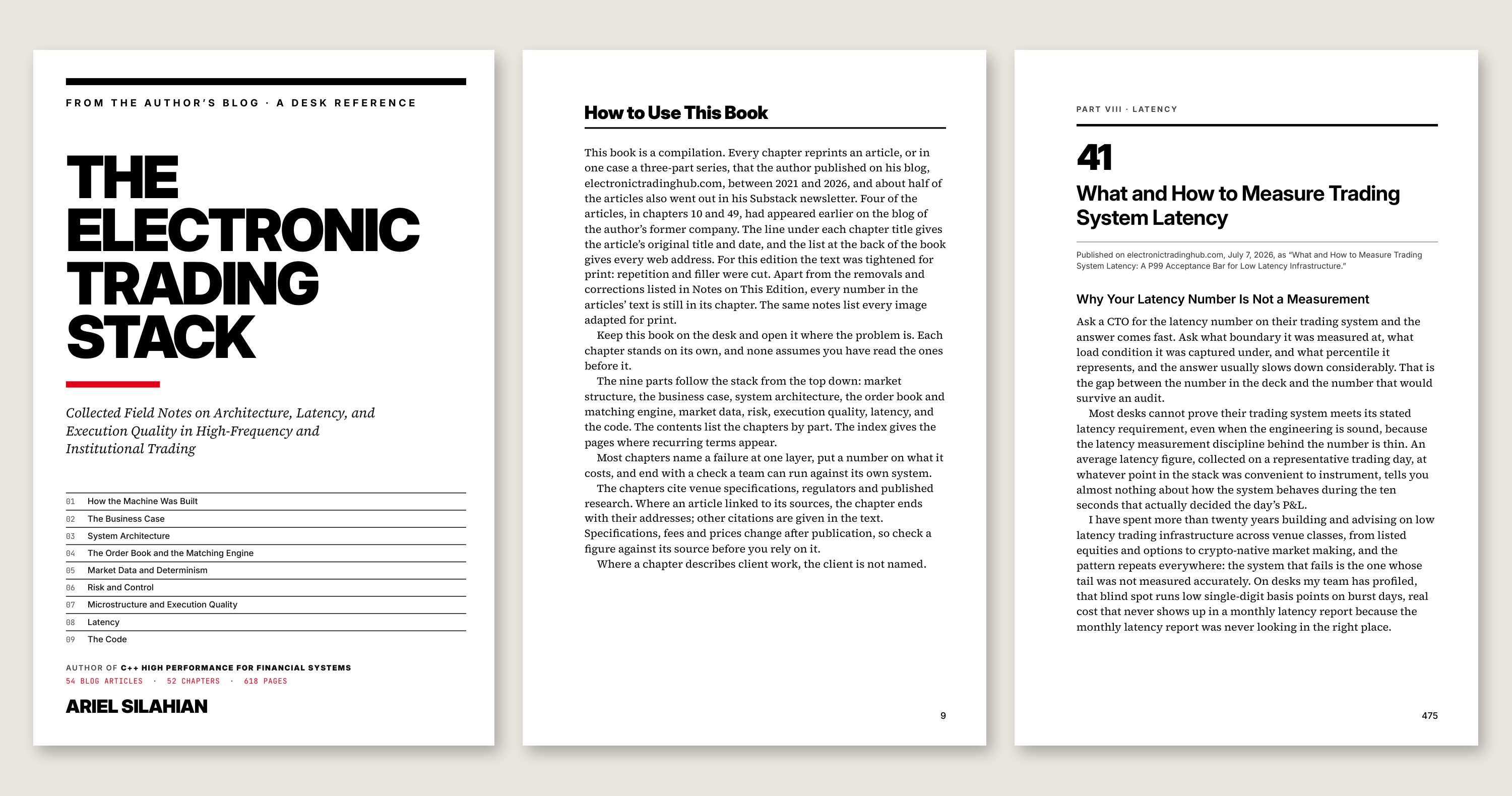

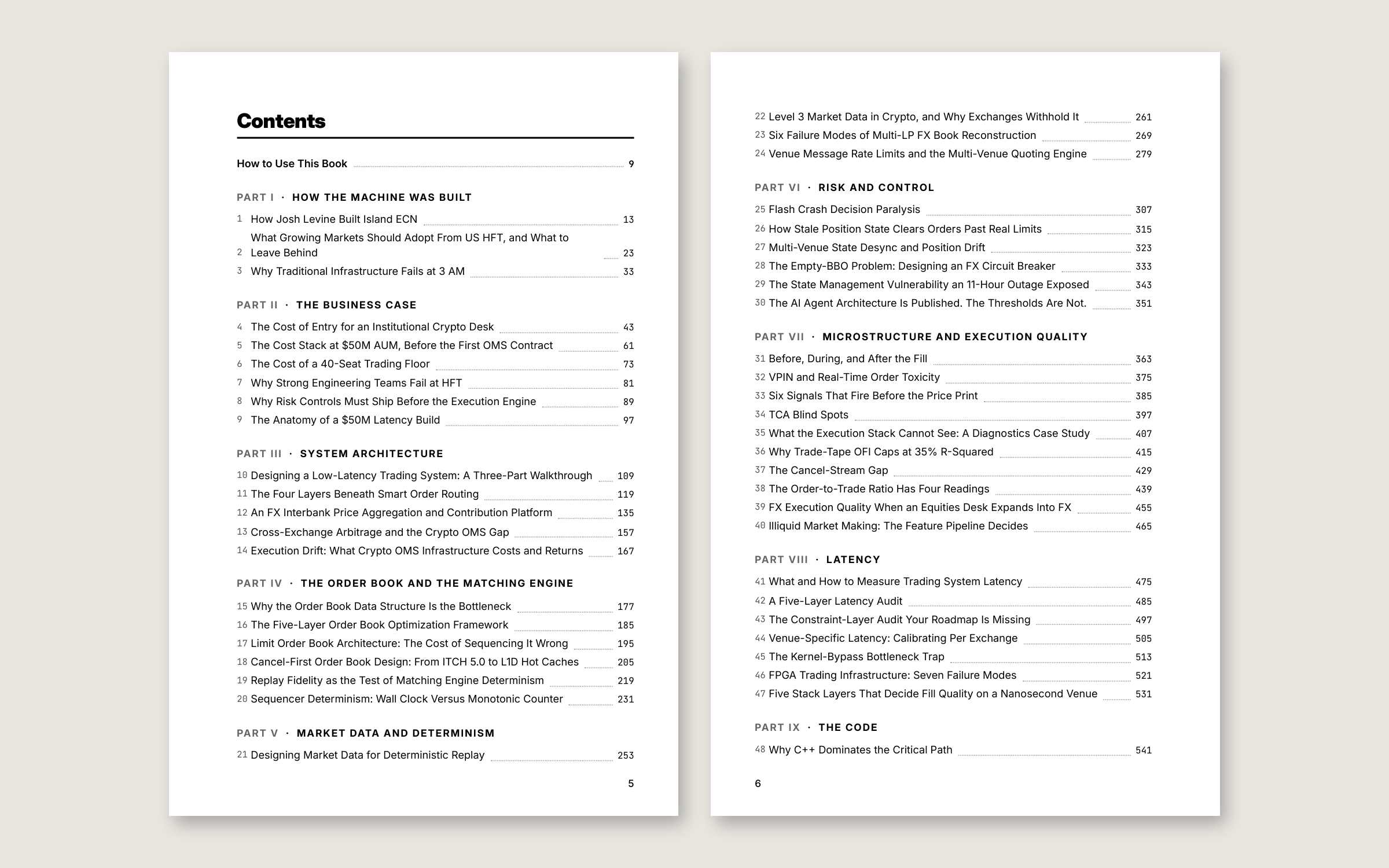
Table of Contents
- What This Book Is
- Open It Where the Problem Is
- Why I Printed It
- What Is Inside
- What Changed for Print
- Read Free, or Buy It Printed
- About the Author
What This Book Is
Between 2021 and 2026 I published articles about electronic trading systems on my blog, Electronic Trading Hub. The Electronic Trading Stack collects 54 of them in one book: 52 chapters, nine parts, 618 pages, indexed.
Half of them, 27 of the 54, are also on my Substack. The book is the same material, edited for print.
If you have read the blog, you have read this book. The paperback adds an order that runs from the top of the stack down to the code, an index you can search by hand, and paper. Every chapter title on this page links to its free article.
Open It Where the Problem Is
Each chapter stands on its own. Most chapters put a number on what the failure costs and end with a check a team can run.
Why I Printed It
Some readers want a printed reference on the desk to reach for at any time. People also asked me for a printed version. For them the book is a six-by-nine paperback.
What Is Inside
The nine parts run from market structure at the top of the stack to the language runtime at the bottom. They hold between three and ten chapters each.
Thank you for reading this post, don't forget to subscribe!
Part I, How the Machine Was Built, has three chapters. It covers where the modern matching engine came from, how order flow moves across a fragmented venue map, and what a market that trades around the clock asks of infrastructure built for fixed trading hours. It opens with “How Josh Levine Built Island ECN” and closes with “Why Traditional Infrastructure Fails at 3 AM.”
Part II, The Business Case, has six chapters on what an institutional desk spends before its first trade, and on the order in which the parts of a trading system should be built. Chapters here include “The Cost of Entry for an Institutional Crypto Desk” and “The Anatomy of a $50M Latency Build.”
Part III, System Architecture, covers the components of a trading system and the boundaries between them. It opens with the three-part system design series, run together here as one chapter, then takes the multi-venue case apart layer by layer in chapters like “The Four Layers Beneath Smart Order Routing” and “Cross-Exchange Arbitrage and the Crypto OMS Gap.”
Part IV, The Order Book and the Matching Engine, covers order book design and the matching engine that updates the book: where their latency goes, and how an engine is designed to produce the same result on every replay. Its six chapters include “Why the Order Book Data Structure Is the Bottleneck,” “Cancel-First Order Book Design: From ITCH 5.0 to L1D Hot Caches,” “Replay Fidelity as the Test of Matching Engine Determinism” and “Sequencer Determinism: Wall Clock Versus Monotonic Counter.”
Part V, Market Data and Determinism, covers what a reconstructed order book leaves out, what it costs when that book drifts from the venue’s own, and how to build a market data path that replays exactly. It closes with the message rate limits venues place on order entry, and where the limiter has to live. See “Designing Market Data for Deterministic Replay” and “Level 3 Market Data in Crypto, and Why Exchanges Withhold It.”
Part VI, Risk and Control, covers pre-trade risk controls and the position state they depend on: gates that clear orders past real limits, circuit breakers, state that drifts between venues, and automated decisions made faster than a person can review them. Chapters include “Flash Crash Decision Paralysis” and “The State Management Vulnerability an 11-Hour Outage Exposed.”
Part VII, Microstructure and Execution Quality, is the longest part, with ten chapters: how to measure what a fill cost, and the order book signals that appear before it. It includes “VPIN and Real-Time Order Toxicity,” “Six Signals That Fire Before the Price Print,” “Why Trade-Tape OFI Caps at 35% R-Squared” and “TCA Blind Spots,” the chapter on where transaction cost analysis stops looking.
Part VIII, Latency, has seven chapters on low latency measurement and where optimization budgets go wrong. Several of them describe a desk that paid for speed before it measured where the time went, among them “The Constraint-Layer Audit Your Roadmap Is Missing.” The part also includes “A Five-Layer Latency Audit” and “FPGA Trading Infrastructure: Seven Failure Modes.”
Part IX, The Code, covers the language, the compiler, and the runtime, and what each does to tail latency. It opens with “Why C++ Dominates the Critical Path” and includes “Why Textbook C++ Optimizations Wreck p99 Latency.” Its last two chapters are where my own benchmark contradicted what I expected going in: “I Was Asked to Rebuild an HFT System in C#. I Measured It Twice.” and “The .NET Tier-0 JIT Cliff.”
What Changed for Print
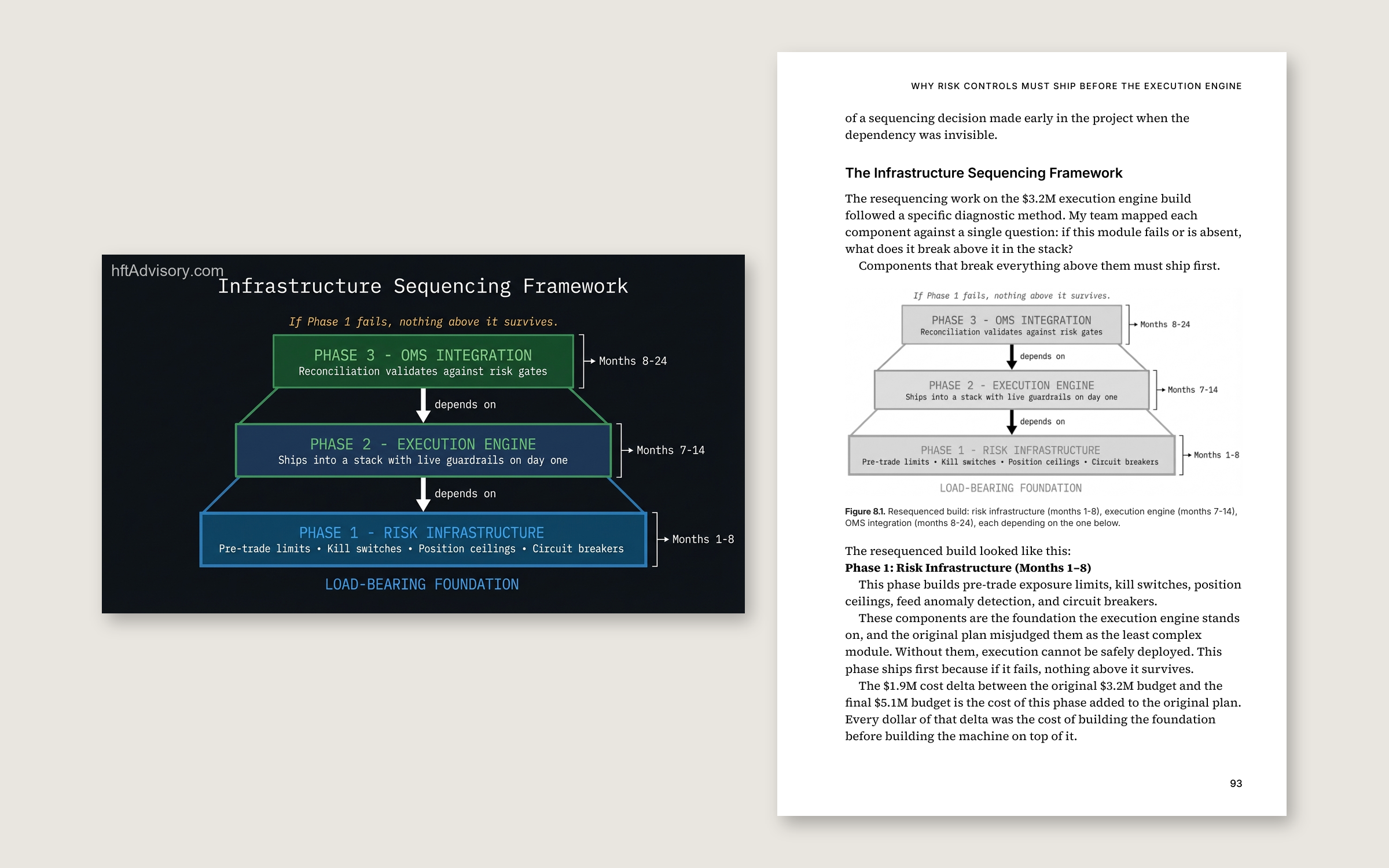
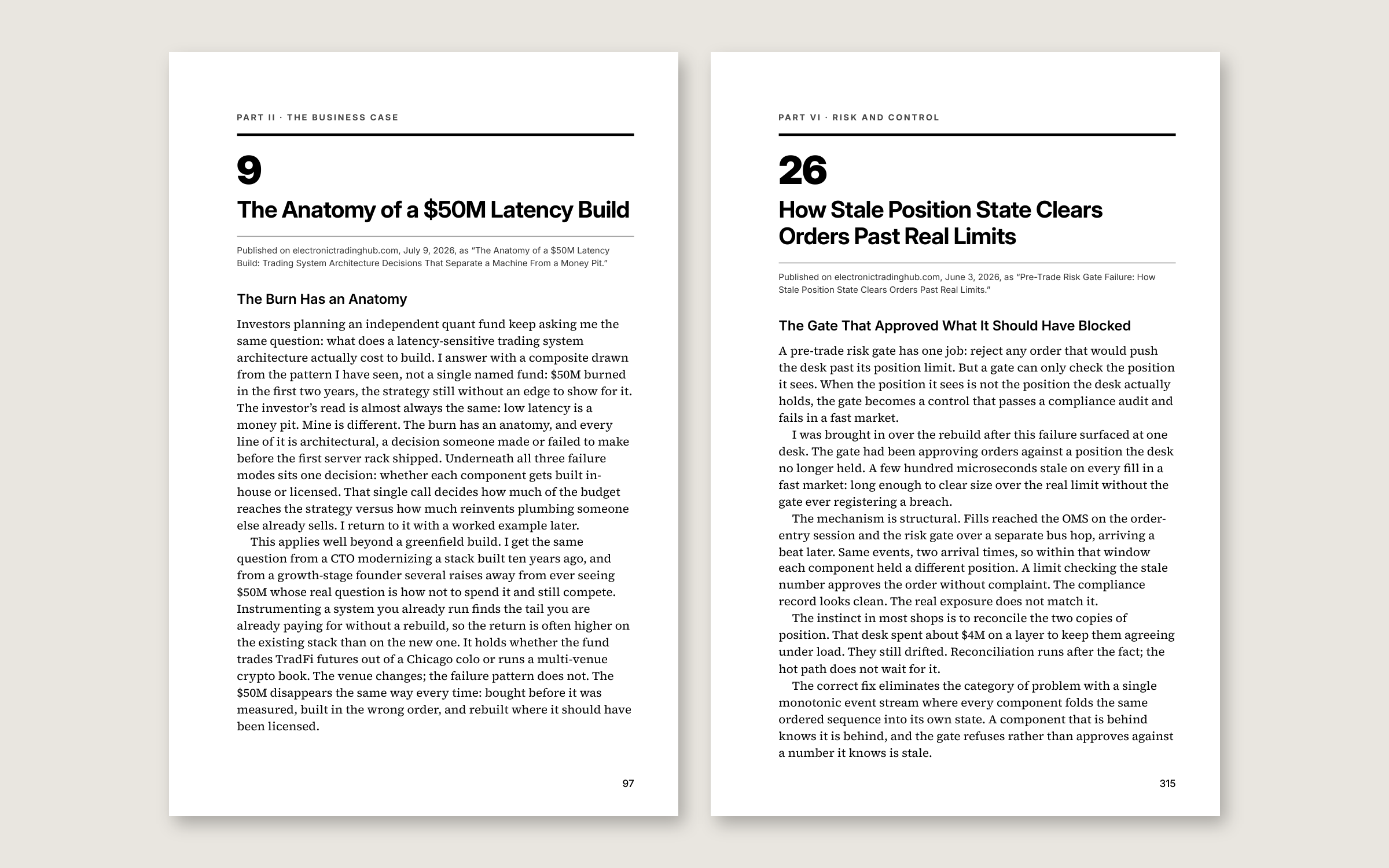
The prose was tightened for print: repetition and filler were cut. Every number in the articles’ text is still in its chapter, apart from the removals and corrections that Notes on This Edition lists. Figures were selected and adapted for one-color print, and many of the articles’ images were left out. The book prints 46 images, with every label at least 7 point, and sets as type 42 tables and 3 terminal listings that were images on the blog. Figure 8.1, from “Why Risk Controls Must Ship Before the Execution Engine,” shows the kind of change: the blog published it light on dark, and the book crops it to its diagram and prints it dark on light, without the web address stamp.
Each chapter has its blog title and publication date printed under the chapter title. The back of the book lists every article’s web address and, for each chapter, the figure changes, the corrections and a count of the prose edits.
Four of the articles, the three-part system design series and “Best Practices for Low-Latency Trading Software,” first ran on the blog of my former company before they ran on mine. The book says so on the page. Where a chapter describes client work, the client is not named.
Read Free, or Buy It Printed
Every article in this book is already on the blog, free, in whatever order you happen to find it. Reading it there costs nothing but the time it takes to read 54 articles.
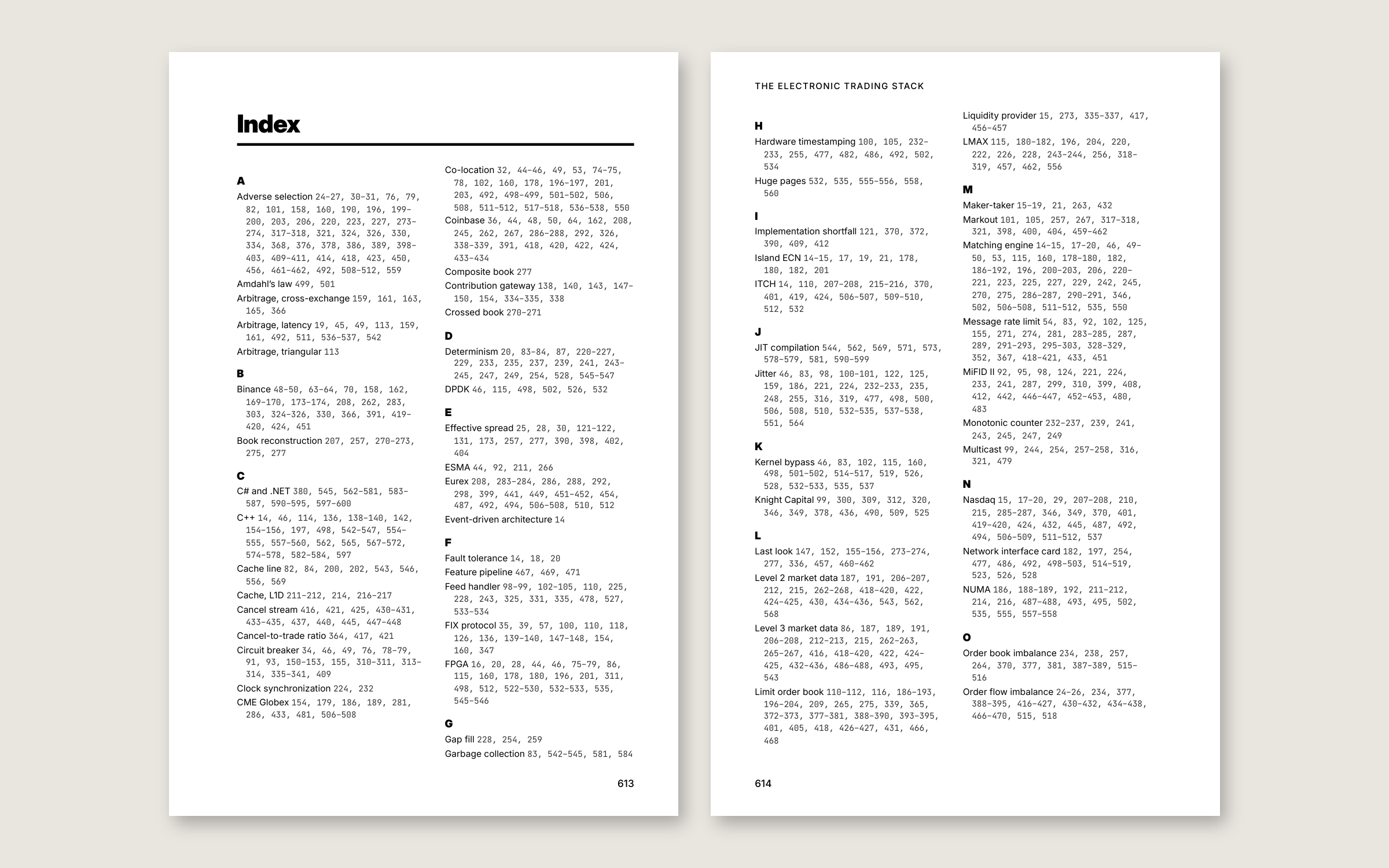
I printed it for one kind of reader: someone who wants the same 54 articles in one order, indexed, in a form they can put on a desk and open without a screen. If that is not you, the blog is enough.
If it is what you need, the printed edition is on Amazon.
About the Author
Ariel Silahian has spent more than twenty years building matching engines, feed handlers, order management systems and risk gates for trading firms and exchanges across traditional finance, institutional FX and crypto. He is the author of C++ High Performance for Financial Systems.
Never Miss an Update
Get notified when we publish new analysis on HFT, market microstructure, and electronic trading infrastructure. No spam.
Subscribe by EmailAriel Silahian is a senior technology executive in institutional electronic trading, with 30+ years across the buy and sell side (New York, Miami, London, Hong Kong). He is the author of "C++ High Performance for Financial Systems" (Packt) and the creator of VisualHFT, the open-source microstructure analytics stack. He writes on exchange architecture, market microstructure, and execution quality, and advises a select number of trading firms on infrastructure decisions that move P&L. Book a strategy call at hftAdvisory.com