
Table of Contents
- What the Dashboard Records vs. What the Market Sees
- Cancel Ratio Drift and Order-To-Trade Ratio as Adverse-Selection Signals
- Counterparty Composition in the Pre-Fill Window
- Queue Position as a P&L Variable
- Effective vs. Quoted Spread and the Rule 605 Compliance Clock
- When All Four Signals Converge: The Attribution Problem
- A Diagnostic Framework for Your Next TCA Review
- Conclusion
Introduction
$3.7 million. That was the execution cost surfaced in a diagnostic audit last quarter that the firm’s own TCA report had not flagged.
The desk was not running a broken system. Fill rates looked healthy. Benchmark comparisons were clean against VWAP and arrival price. The dashboard reported what it was built to report. The problem is that most TCA implementations are built for compliance, not for microstructure diagnosis. Those two objectives share some metrics and diverge sharply on others.
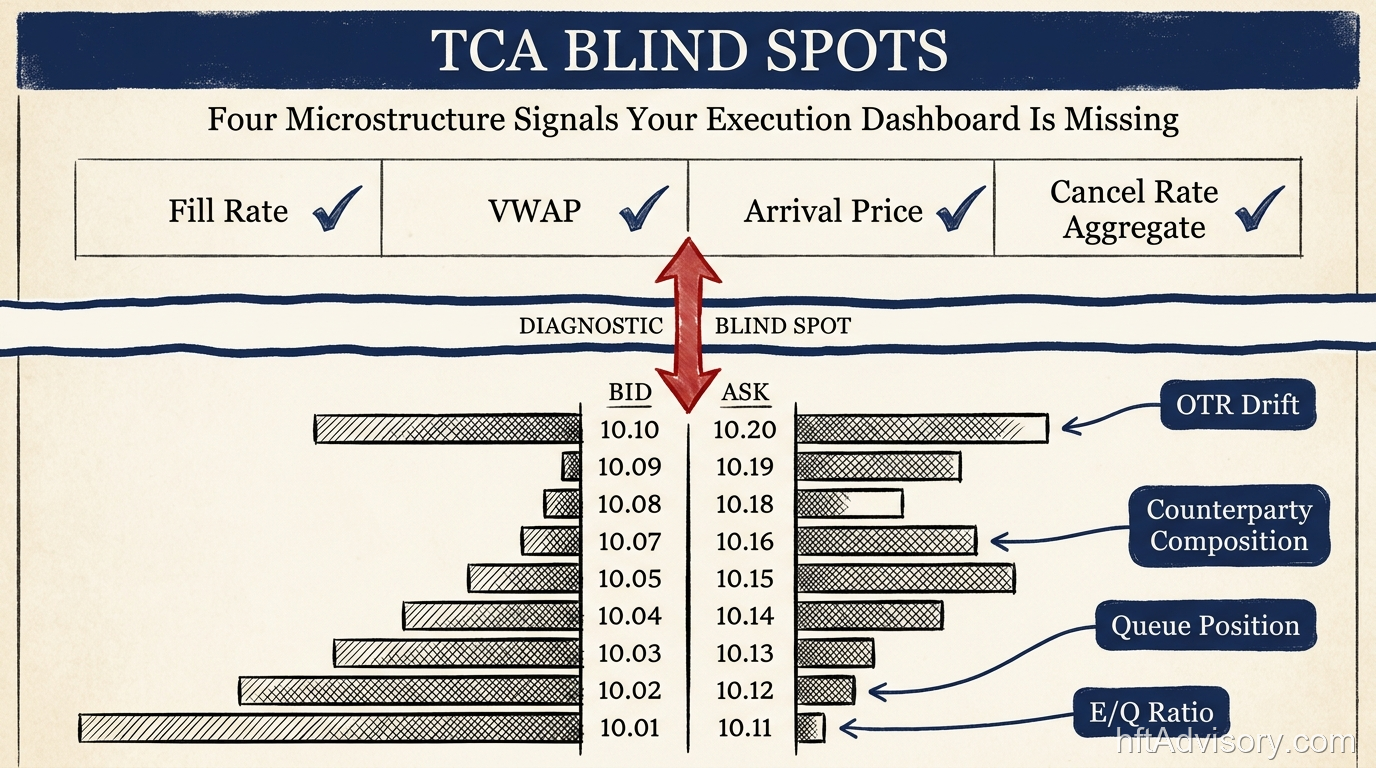
A CTO evaluating their execution quality today is asking the right question. The barrier is structural: compliance-grade TCA records what it was designed to record, and market-level microstructure sits outside that design scope. The gap has four specific measurement dimensions: order flow toxicity signaling via Order-To-Trade ratio drift, counterparty composition in the seconds before a fill, queue position economics at the point of execution, and the effective-versus-quoted spread ratio that regulators have now mandated but that most broker disclosures still do not surface transparently.
Coalition Greenwich data from a 2024 study of 103 buy-side equity traders globally found that 90% of desks conducted TCA for equity trading in the past year, and 83% stressed the importance of quantified TCA when evaluating broker performance. The infrastructure is nearly universal; the diagnostic depth that infrastructure enables is not.
This article maps the four gaps, explains the academic and regulatory context behind each, and closes with a diagnostic protocol you can apply on your next TCA report review.
1. What the Dashboard Records vs. What the Market Sees
Thank you for reading this post, don't forget to subscribe!
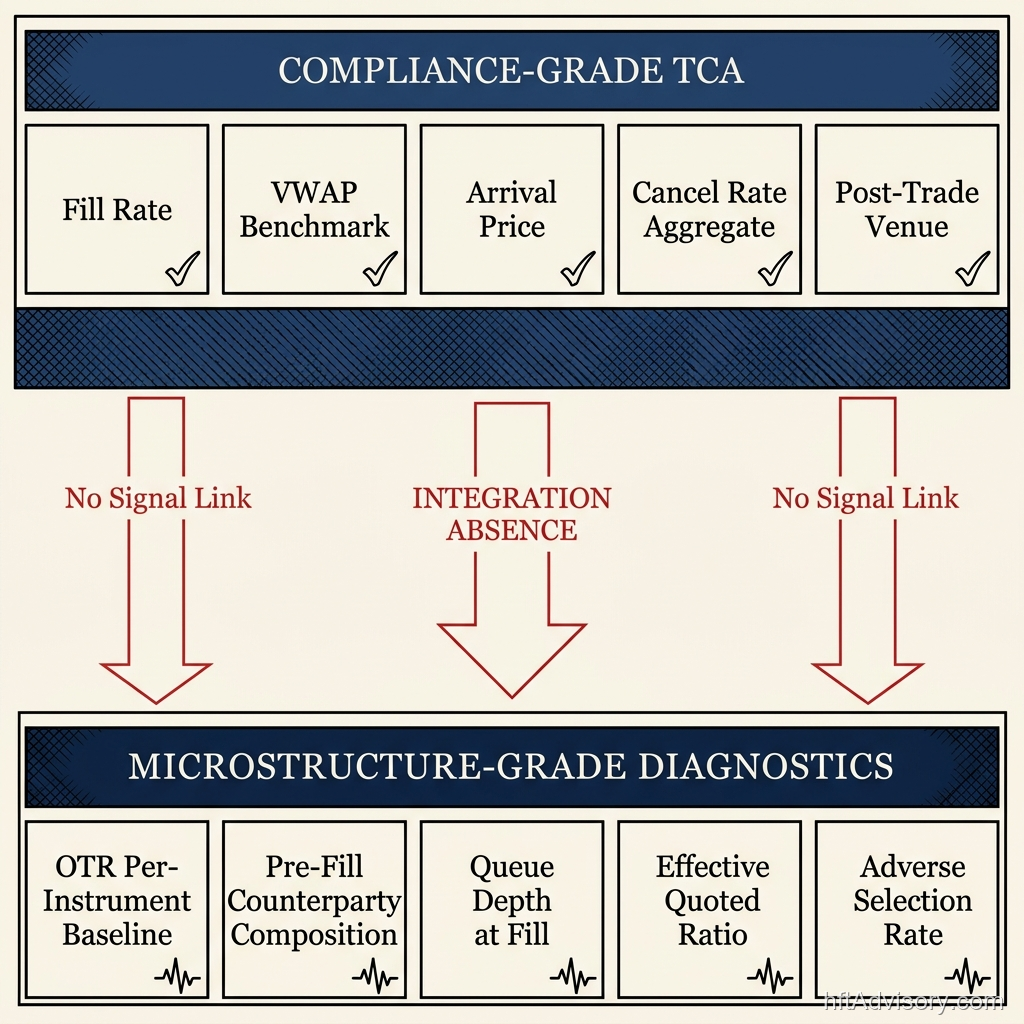
The core issue is architectural, not cosmetic. Compliance-grade TCA platforms were designed to answer a specific regulatory question: did you achieve best execution relative to a benchmark? They are very good at that job. Fill rate, slippage versus arrival price, cost versus VWAP, and post-trade venue analysis all serve that objective.
The picture varies across vendors. Some premium TCA platforms now surface a subset of microstructure signals (venue-level effective spread, basic adverse selection markouts), and some in-house quant desks have built their own diagnostics on top of market-by-order feeds. Where the gap consistently shows up is in the integrated four-signal view: per-instrument OTR baselines plus pre-fill counterparty composition plus queue position at fill plus E/Q ratio, attributed to the same instrument and time window. The diagnostic value lives in the convergence reading, which is the layer most platforms structurally do not produce.
What they do not do is analyze the microstructure of the order flow itself with that integration. KX research from 2024 captures the underlying issue precisely: “execution and research environments are usually separated in different systems, and transaction cost analysis is often treated as a required reporting function rather than a vital diagnostic input, with batch-based interrogation happening post-trade, not live.” The same research illustrates the practical consequence: passive fill rate can drop from 95% to 70% as liquidity migrates without triggering fill-rate alerts in standard TCA tooling.
The four signals described in the sections below exist in the order flow data. They require a different analytical frame to surface. When my team runs a diagnostic audit on a desk’s execution, we are not replacing their TCA system. We are adding the interpretation layer that translates microstructure data into the causal story behind the benchmark numbers.
2. Cancel Ratio Drift and Order-To-Trade Ratio as Adverse-Selection Signals
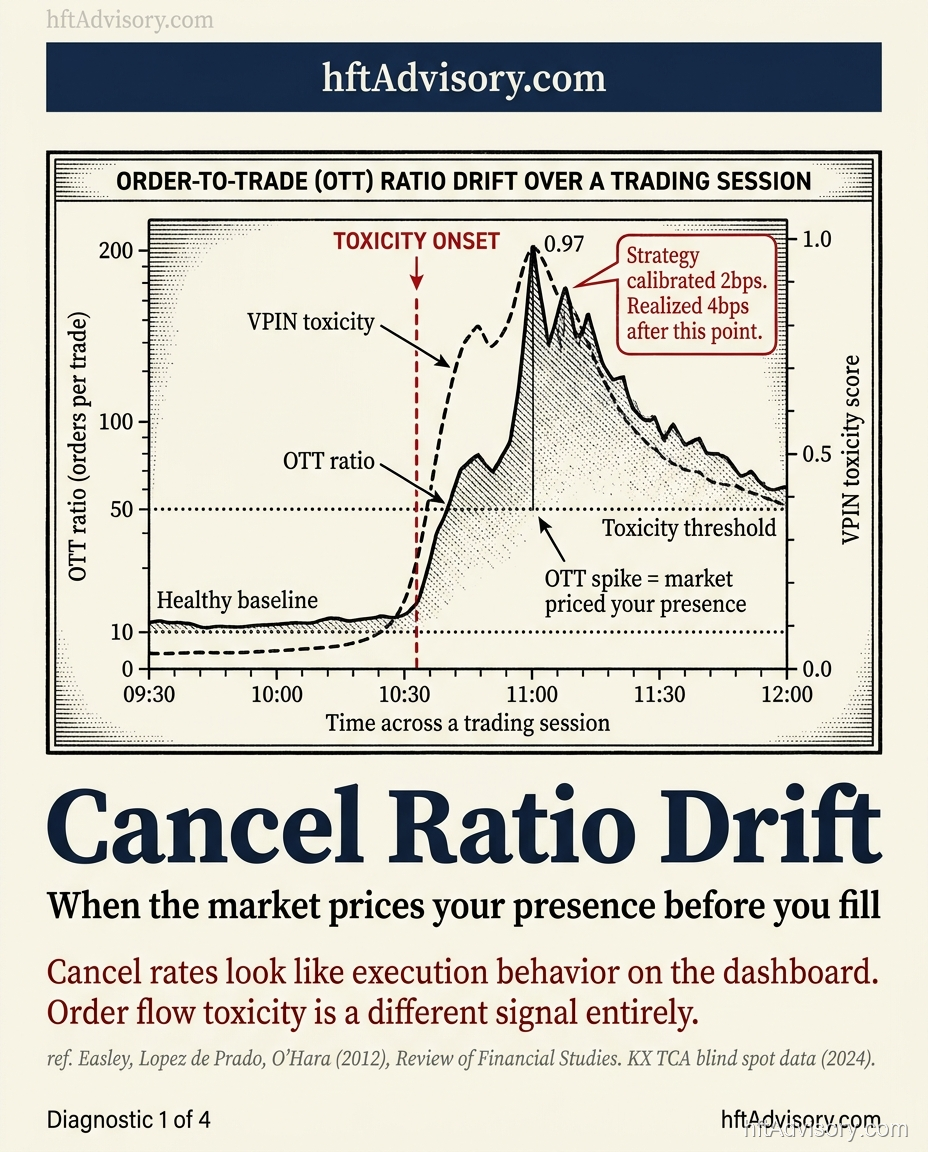
Your TCA dashboard records cancel rates as execution behavior data. What it typically does not surface is the relationship between cancel and trade activity and the probability that you are being systematically selected against before the fill.
Order-To-Trade ratio (OTR) is the number of order messages submitted per executed trade. It is a mandated surveillance metric under MiFID II RTS 9 in Europe and is used by major exchanges including Eurex, JPX, NSE, and others. The metric is well-established in regulatory infrastructure. What is less commonly surfaced in buy-side TCA is the per-instrument, time-windowed OTR trend as a signal for order flow toxicity.
The interpretive logic, as I apply it in audit work, is this: elevated OTR on a specific instrument over a defined window indicates that market participants are submitting and canceling orders at an elevated rate relative to execution volume. In patterns I have observed across desk audits, this frequently coincides with periods of adverse selection where informed flow is arriving ahead of fills. The dashboard records the activity. It does not connect the ratio to the adverse selection dynamic.
The academic framing for order flow toxicity as a measurable phenomenon comes from Easley, Lopez de Prado, and O’Hara’s VPIN (Volume-synchronized Probability of Informed Trading) framework, published in the Review of Financial Studies in 2012. VPIN rose in the hours preceding the May 6, 2010 Flash Crash and has been applied as a liquidity stress signal in market microstructure research. It is worth noting that Andersen and Bondarenko’s 2014/2015 work in the Journal of Financial Markets challenged VPIN’s out-of-sample predictive power, which is the correct frame for how to use it. VPIN and OTR drift are signals within a multi-signal diagnostic framework, not standalone predictors. The appropriate use is: OTR drift elevated plus other indicators confirming means the desk warrants a closer look at counterparty composition.
What your per-instrument OTR baseline looks like over 30 and 90-day windows is a reasonable starting point for any desk that has not looked at this dimension.
3. Counterparty Composition in the Pre-Fill Window
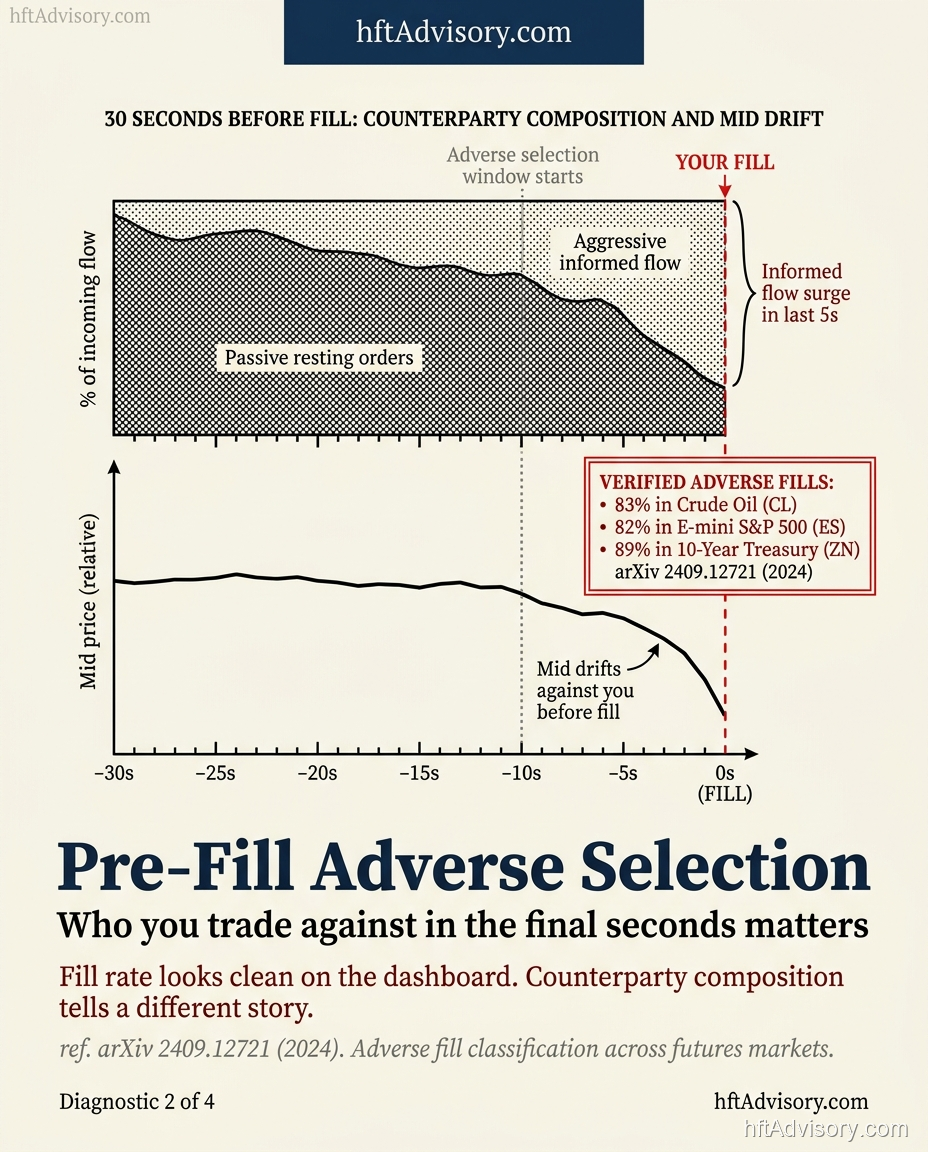
Fill rate looks clean. Counterparty composition often does not.
This is the second gap in standard TCA. The metric your report probably shows is fill rate by venue, possibly sliced by order size. What it generally does not show is the composition of counterparties trading against you in the seconds immediately before your fill executes.
In audit work I have conducted on desk order flow, a consistent pattern surfaces: in periods of measurable adverse selection, informed flow (orders from counterparties whose subsequent market impact is directionally unfavorable to your position) arrives systematically in the pre-fill window. The fill rate metric is blind to this because fill rate records whether you got executed, not who you traded against and what their subsequent activity revealed about information content.
The theoretical framework is from Glosten and Milgrom (1985), whose bid-ask spread decomposition model identifies adverse selection as one of three spread components. The practical implication: even if your spread cost looks normal, a disproportionate share of that cost may be adverse selection from informed counterparties rather than the inventory and order-processing components that algorithms can reduce.
IEX research covering January through August 2024 data provides a direct empirical illustration. Their analysis of trades against larger counterparties showed materially worse markouts than trades against smaller counterparties, and notably found that algorithmic order-slicing complicates trade-size-based filters as a protection mechanism against adverse selection. This is precisely the problem: the standard filter (look at order size) does not work when counterparties slice orders to appear smaller. The pre-fill counterparty composition window is where the signal lives.
The data requirement for this diagnostic is granular time-of-trade counterparty attribution at sub-second resolution, combined with post-fill markout tracking. Standard TCA tools do not surface this. The raw data exists in most venues’ market-by-order feeds.
4. Queue Position as a P&L Variable
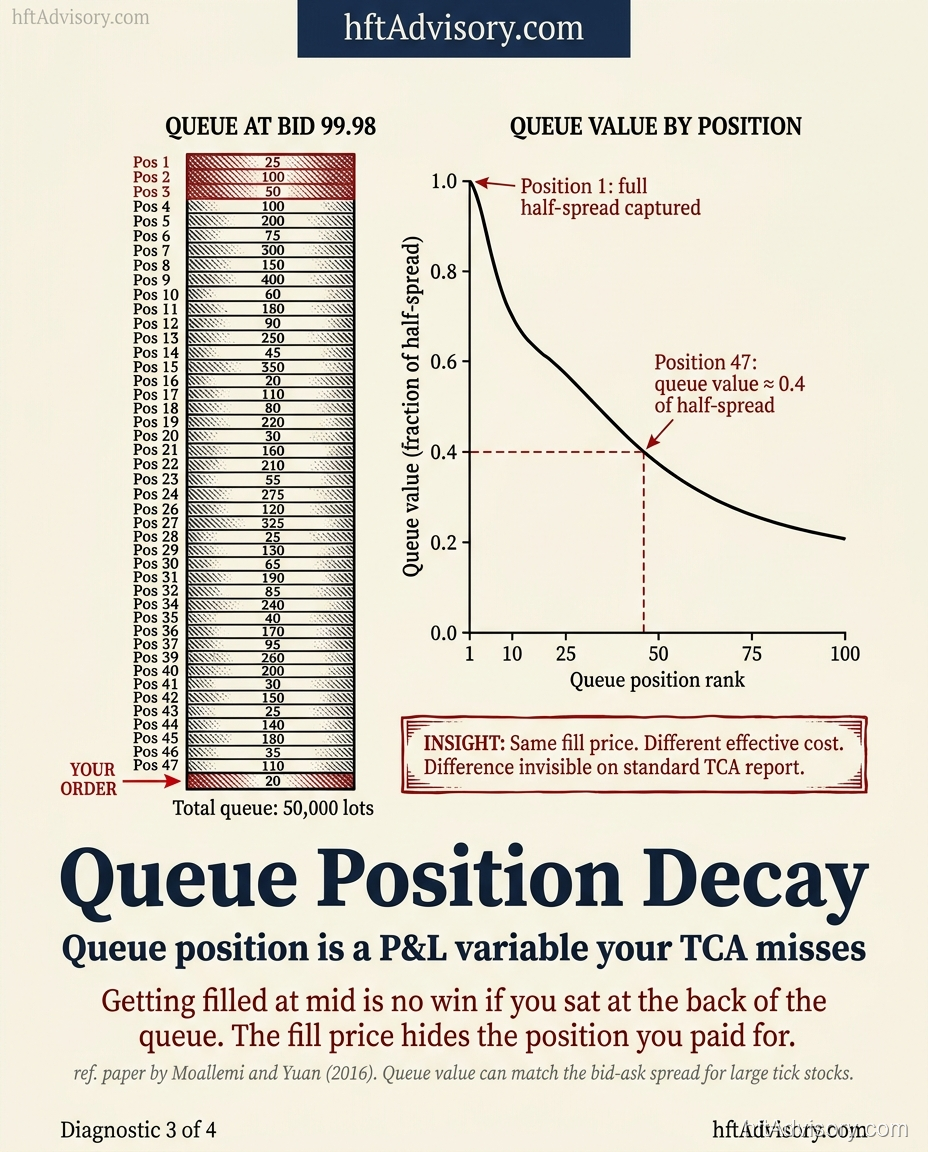
Getting filled at mid is not a win if your order sat at the back of a 50,000-lot queue before execution. This is a cost that does not appear on most TCA reports because most TCA reports do not record queue position at fill time.
The academic grounding comes from Moallemi and Yuan’s 2016 working paper, “A Model for Queue Position Valuation in a Limit Order Book” (Columbia Business School Research Paper No. 17-70, available on SSRN). The core finding, stated with its proper scope qualifier: for some large tick-size stocks, queue value can be of the same order of magnitude as the bid-ask spread.
The paper decomposes queue value into two components. The static component reflects the adverse selection trade-off that worsens as queue position moves back: orders deeper in the queue are more likely to execute against informed flow because patient informed traders also queue, and they tend to join queues with favorable adverse selection dynamics. The dynamic component captures the optionality value of locking in a queue position: once your order is at a specific position, there is economic value in maintaining that position because re-queuing after a cancel costs you that spot. The paper calibrated these components against NASDAQ ITCH market-by-order data on 9 highly liquid US equities and ETFs with bid/ask spreads close to 1 tick.
The practical consequence for a desk running passive execution strategies: your algo’s fill-rate optimization may be achieving fills at good prices while incurring queue-position-driven adverse selection costs that are invisible in the TCA output. The relevant diagnostic is to reconstruct queue depth at the time of fill and track where in the queue each execution occurred. Fill price plus queue position tells a materially different story than fill price alone.
On a desk running, say, $200M in daily passive equity flow, even a modest systematic queue-position adverse selection cost of 0.1 to 0.2 basis points per trade compounds to a meaningful annual figure. The Moallemi-Yuan working paper is a reasonable starting point for understanding the magnitude of what is being left unmeasured.
5. Effective vs. Quoted Spread and the Rule 605 Compliance Clock
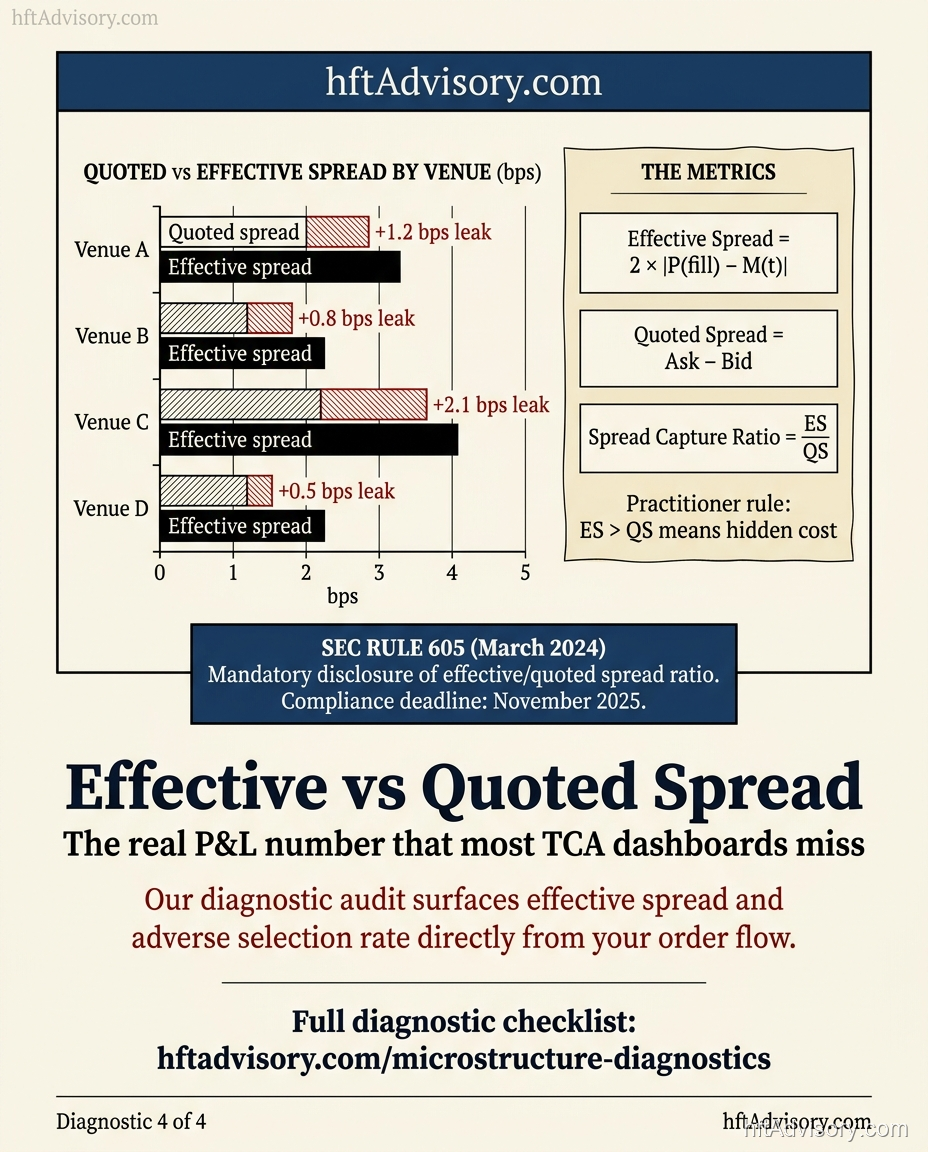
Effective spread is the actual cost of trading. Quoted spread is what was available at the moment you submitted your order. The ratio between them (E/Q ratio) is the single number that most directly captures whether your broker’s execution improved on, matched, or degraded the quoted price at the time of your order.
Most TCA dashboards do not surface this ratio. Based on patterns I have observed across desk reviews, broker reporting on execution quality generally emphasizes fill rate and price benchmark comparisons rather than the effective/quoted spread ratio, which directly measures adverse selection against the quoted price at submission time.
This will change. On March 6, 2024, the SEC adopted amendments to Rule 605 under Regulation NMS. The rule’s scope was significantly expanded: it now applies to broker-dealers with more than 100,000 customer accounts, single dealer platforms, and alternative trading systems, in addition to the original scope of market centers. The mandatory disclosures now include average effective spread, average quoted spread, average effective over quoted spread (the E/Q ratio), and realized spreads at five post-execution intervals: 50 milliseconds, 1 second, 15 seconds, 1 minute, and 5 minutes.
The compliance timeline: the rule became effective June 14, 2024. Originally scheduled for December 14, 2025, the SEC extended the compliance deadline to August 1, 2026, citing implementation complexity. That gives firms roughly three months from today to be compliant.
The August 1, 2026 deadline is, in effect, a forced market education moment. When broker disclosures at Rule 605 granularity become uniform, the E/Q ratio comparison across execution venues will be directly computable. Desks that have already built the internal measurement capability will be positioned to interpret those disclosures immediately. Desks that encounter this data for the first time in their broker reports will be catching up.
If your current TCA report does not include effective spread and adverse selection rate extracted directly from your order flow, the August 2026 disclosure regime is a reasonable forcing function to build that capability now rather than after the fact.
6. When All Four Signals Converge: The Attribution Problem
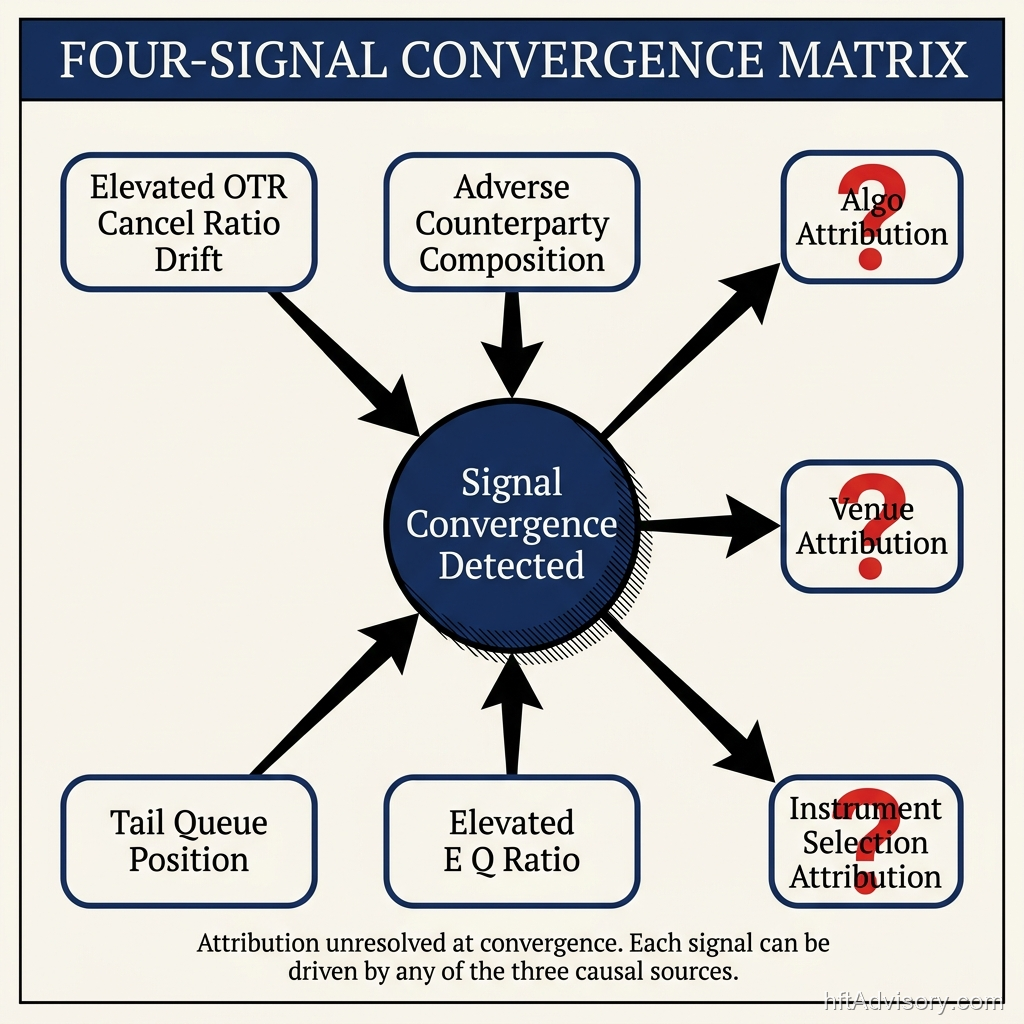
When cancel ratio drift, adverse counterparty composition, queue position concentration, and elevated E/Q ratios all surface simultaneously on the same instrument or venue window, you have a signal convergence event. The diagnostic question at that point is attribution: is the root cause the algorithm’s behavior, the venue’s liquidity structure, or instrument selection?
This is the question that does not have a clean resolution from within a standard TCA report, and honestly, it is the question that does not have a clean resolution from outside one either. Each of the four signals can be driven by any of the three causal sources, and the causal mixing looks different across venues, instrument classes, and market regimes.
An algo that is over-canceling on an equity might be entirely appropriate behavior on a futures contract with a different queue dynamics structure. A venue with apparent counterparty composition problems might simply reflect the instrument’s liquidity profile rather than venue-specific adverse selection. Instrument selection and market-hours timing interact with all four signals.
What the diagnostic audit produces is not a single root cause determination. It produces a ranked causal hypothesis set with the evidence weight behind each attribution, and a test protocol for separating them. The separation is typically possible, but it requires instrument-level data granularity and time-window isolation that needs to be purpose-built for the question. That is the interpretation layer that sits above the TCA system.
7. A Diagnostic Framework for Your Next TCA Review
The following checks can be run against any TCA report that provides order-level data. They do not require new tooling. They require a different set of questions applied to the data your system already captures.
Check 1: OTR Baseline Deviation For each instrument in your top-20 by notional volume, pull the Order-To-Trade ratio for the past 30 days. Compare against the 90-day baseline for the same instrument. An OTR that has elevated by more than 15% above baseline without a corresponding change in fill rate warrants investigation as a potential adverse selection signal. This is a practitioner threshold from audit work, not a published standard; calibrate it per instrument.
Check 2: Pre-Fill Counterparty Window If your venue data includes counterparty size attribution (many market-by-order feeds do), compute the average counterparty size in the 2-second window preceding each fill versus the 2-second window following each fill. A systematic size differential (larger counterparties arriving just before your fills) is the pattern to look for.
Check 3: Queue Position at Fill For your highest-volume passive strategy, request from your prime broker or pull from your own order management system the queue position at the time of fill for a 30-day sample. Compute the correlation between queue position (as a percentile of total queue depth) and post-fill 60-second markout. If back-of-queue fills show materially worse markouts than front-of-queue fills on the same instrument and venue, queue position is a measurable P&L variable for your desk.
Check 4: E/Q Ratio by Venue Ask your broker for effective spread versus quoted spread by venue. If they cannot provide this today, note which venues are absent from the response. After August 1, 2026, Rule 605 disclosures will make this computable directly. Build the comparison template now so you have a baseline for interpreting the 2026 disclosures against your current pre-disclosure benchmark.
Convergence Test If three or four of the above checks flag on the same instrument or venue window within a 30-day period, that is a convergence event. The next step is attribution analysis, not incremental tuning of the existing strategy.
8. Conclusion
A falsifiable test worth running before the Rule 605 deadline: take your single highest-volume passive equity instrument, compute its 30-day OTR against its 90-day baseline, pull the queue position distribution at fill, and calculate the effective/quoted ratio from your best available broker data. If all three are within normal range and uncorrelated, your execution quality on that instrument is genuinely solid. If any two show simultaneous deviation in the same 5-day window, you have a convergence event worth diagnosing before August 2026 disclosures change what your counterparties know about your execution profile.
The $3.7M surfaced last quarter was the aggregation of four gaps across a quarter of trading activity. Each was individually explainable. Collectively they were material.
Originally shared as a LinkedIn post. Source post on LinkedIn
Ariel Silahian has 20+ years of experience in electronic trading systems architecture. His advisory practice focuses on execution quality diagnostics, microstructure analysis, and trading system architecture for CTOs and Heads of Trading across electronic trading venue classes. For firms that want to run this diagnostic on their own order flow, the Discovery Assessment is a structured engagement that produces the four-signal report on a defined sample of an existing desk’s order flow, sits alongside whatever TCA platform the firm already runs, and delivers the convergence reading and attribution analysis as the deliverable.
Never Miss an Update
Get notified when we publish new analysis on HFT, market microstructure, and electronic trading infrastructure. No spam.
Subscribe by EmailAriel Silahian is a senior technology executive in institutional electronic trading, with 30+ years across the buy and sell side (New York, Miami, London, Hong Kong). He is the author of "C++ High Performance for Financial Systems" (Packt) and the creator of VisualHFT, the open-source microstructure analytics stack. He writes on exchange architecture, market microstructure, and execution quality, and advises a select number of trading firms on infrastructure decisions that move P&L. Book a strategy call at hftAdvisory.com