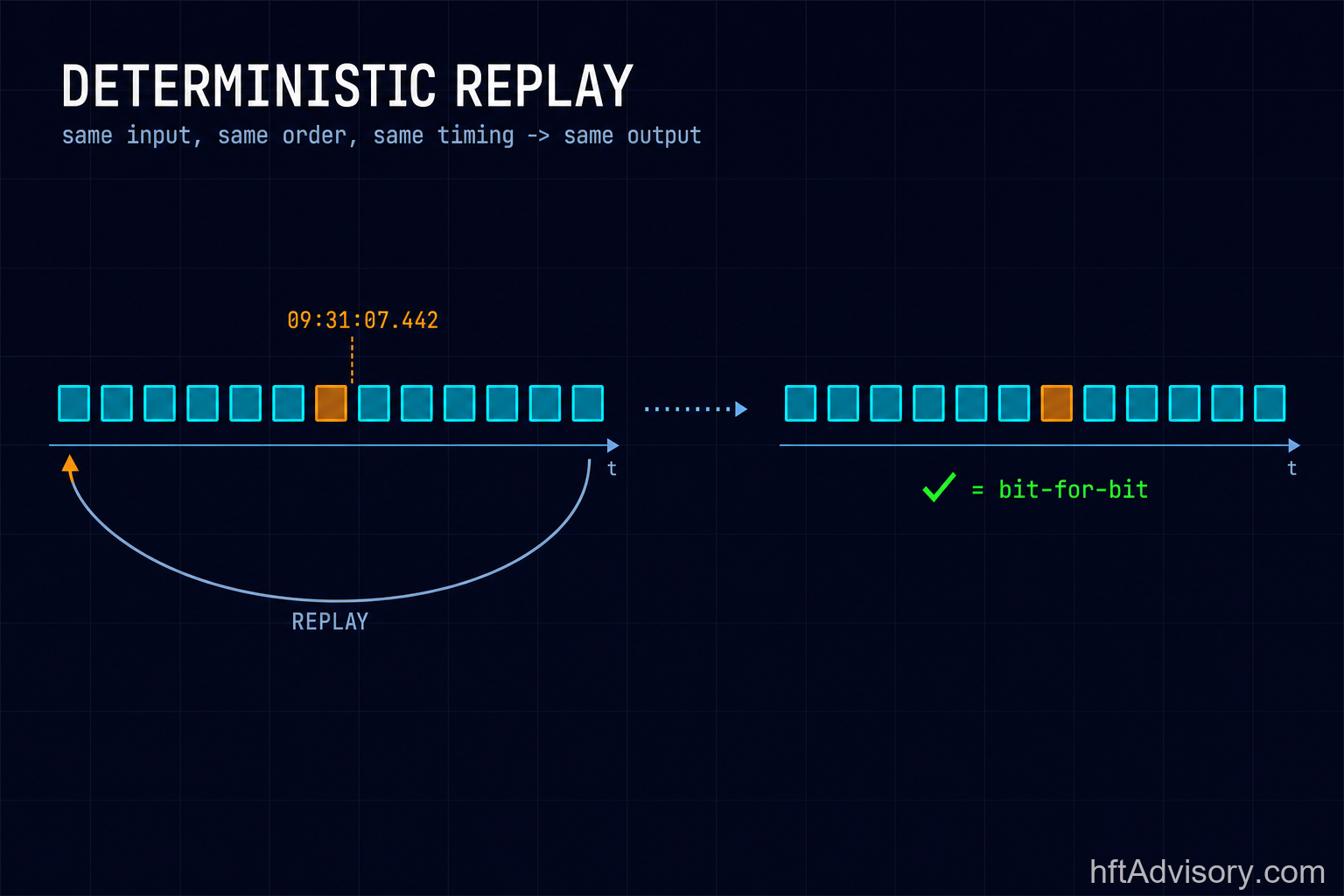

A fill lands on venue A. The strategy’s risk logic reads it, computes exposure, and fires a hedge. Milliseconds later, the same parent order’s fill on venue B lands, except the risk system does not know it yet: no shared clock told it the two fills belong to the same event, and no shared snapshot combined them into one position. For that window, the hedge is sized against a position that was already wrong.
No dashboard flags it, because there is no anomaly to catch: both venues behaved correctly, both fills were valid, and the only thing wrong was the order in which one system learned about them.
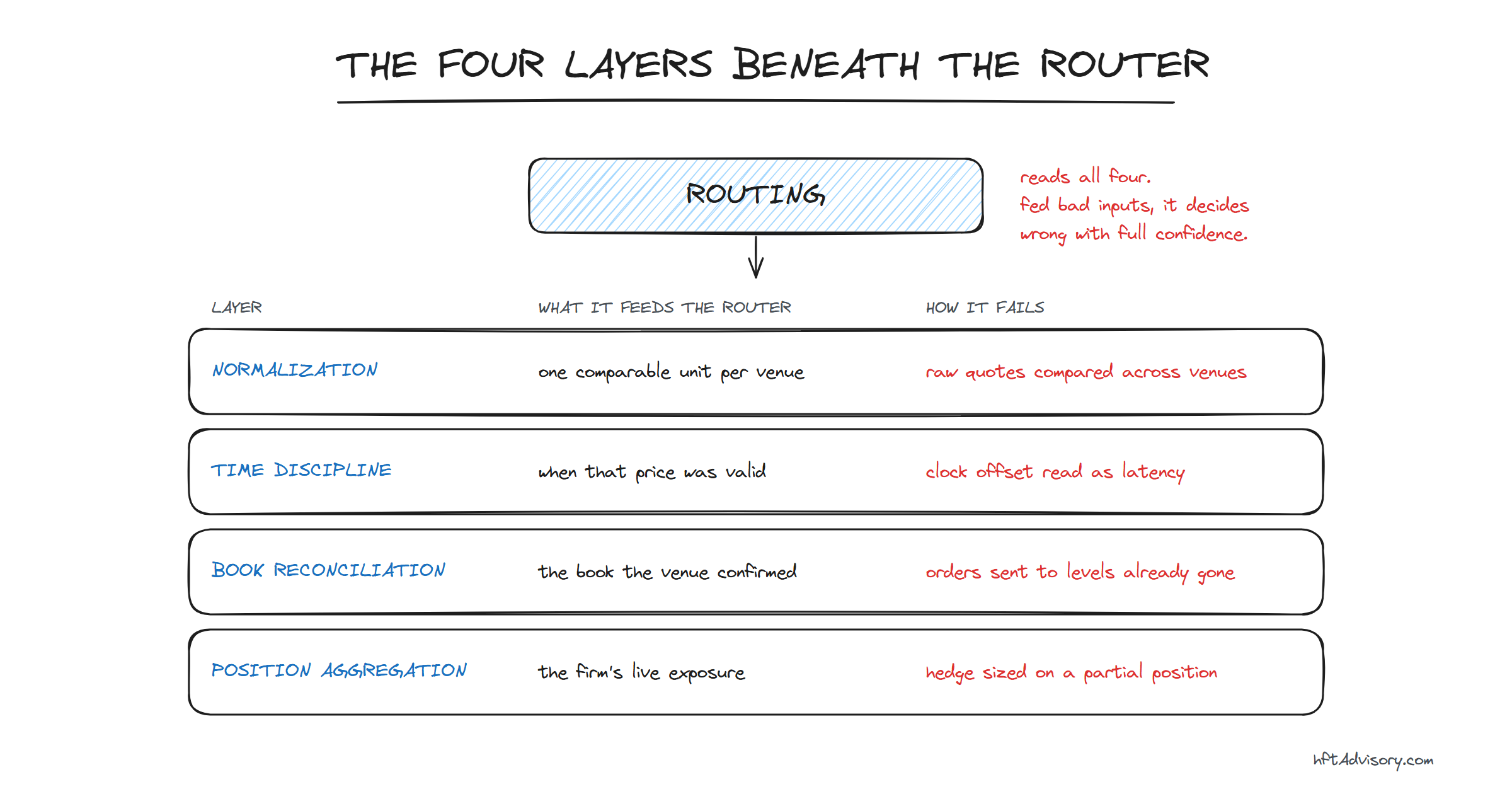
Multi-venue access is the edge: more liquidity pools, more price discovery, more places to work an order without moving the market against yourself. The router sitting on top depends on four layers underneath it, and normalization, time discipline, book reconciliation and position aggregation decide whether a five-venue strategy compounds its edge or its blind spots.
This piece walks each one: what it does, how it fails in production, the signature in the data, what to measure, what healthy looks like, and why the build order runs as it does.
Table of Contents
- The Four Layers Beneath the Router
- Normalization
- Time Discipline
- Book Reconciliation
- Position Aggregation
- What It Costs to Build This Properly
- If You Cannot Fund the Full Build
- The Self-Audit
- Where This Still Breaks
The Four Layers Beneath the Router
A router’s job looks simple from the outside: given a parent order and a set of venues, decide where to send each slice and when. Every decision depends on inputs it did not generate itself. It is told what the price is on each venue (normalization), when that price was valid (time discipline), what the book looks like against what the venue last confirmed (reconciliation), and what the firm’s live exposure is (aggregation). Feed it a mispriced comparison, a clock-corrupted latency figure, a stale level or an unaggregated position, and it optimizes against the wrong number with full confidence. The routing logic never had to break for that to happen, and the failure stays invisible to anyone watching the router’s decisions rather than its inputs.
The ordering is deliberate. Normalization and time discipline have to exist before a second venue is connected, because every cross-venue comparison from that point is a function of both. Reconciliation and aggregation compound with venue count differently: tractable to hand-build per venue at one or two, and no longer tractable once a third arrives.
Normalization
Thank you for reading this post, don't forget to subscribe!
Normalization translates each venue’s contract terms into one comparable unit before anything downstream, a price comparison, a routing decision, a P&L line, touches the number. Tick size, lot size, the price or quantity multiplier and the fee schedule are all defined independently by each venue for what is nominally the same instrument. Comparing raw quoted prices across venues without translating through each venue’s contract spec is comparing incompatible units that happen to look like numbers.
The production failure is mundane and expensive. A strategy computes best price from raw quotes: venue A ticks in $0.01, venue B in $0.0001, or in crypto an 8-decimal stablecoin pair against the same instrument quoted in 2-decimal fiat. The router sends to the better raw quote, and after maker or taker fees and effective-tick rounding the net execution is worse than the venue it passed over. Crypto adds its own variant: perpetual futures contract multipliers differ by exchange, one contract equals one unit of the underlying on one venue and ten dollars of underlying on another, so a position-sizing assumption that was correct on venue A silently over-sizes or under-sizes the same nominal order on venue B.
The observable signature is a gap between quoted spread and effective spread that widens on one venue relative to another for economically similar flow, with no matching change in that venue’s liquidity conditions. That pairing is the most direct place this shows up, but not the only one: implementation shortfall, price-improvement statistics and mid-price reversion analysis surface the same divergence from a different angle. If effective tracks quoted cleanly on venue A and decouples on venue B, that points at a normalization defect. Reading it as a market-quality difference between the two venues is how the defect survives for months.
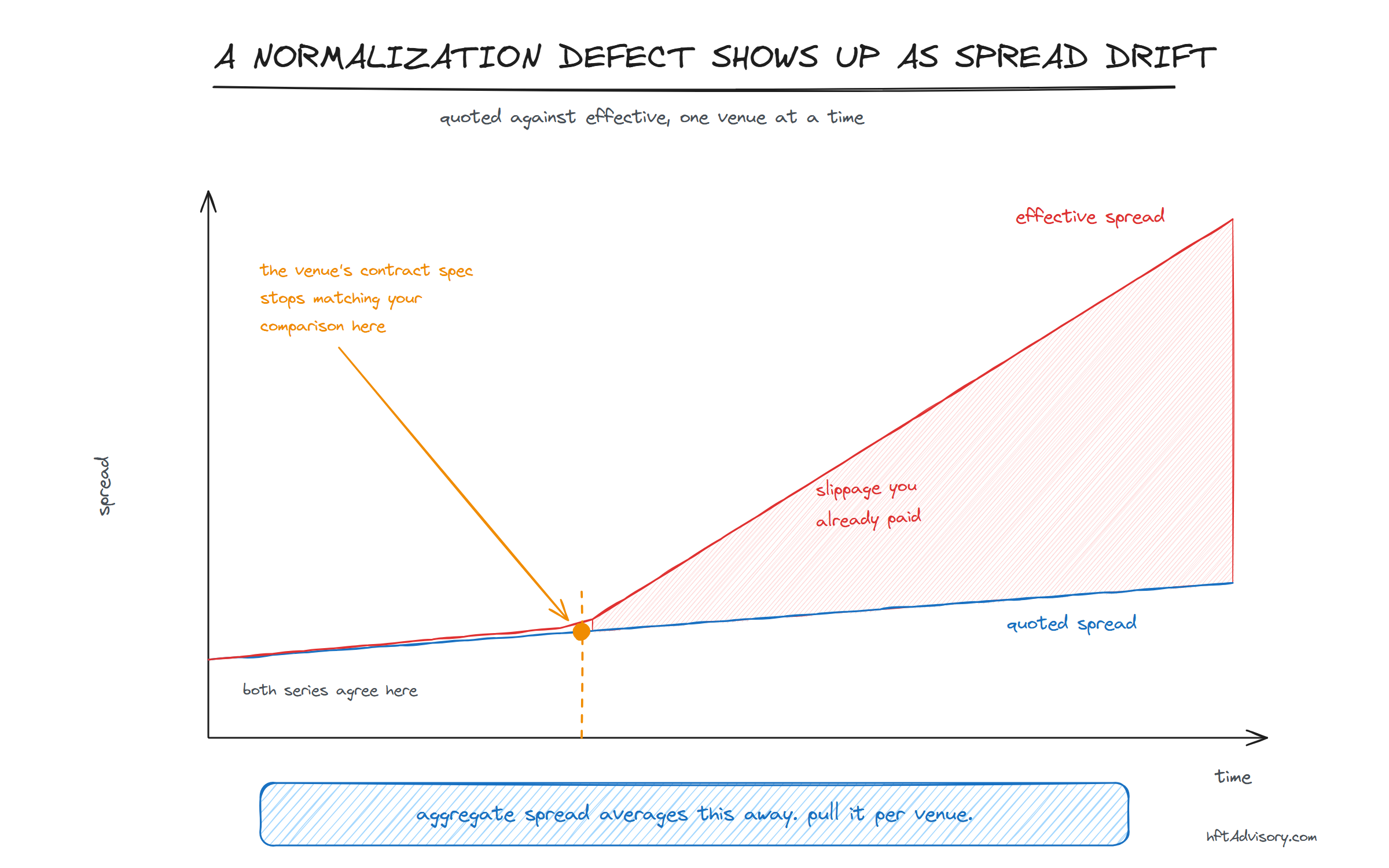
What to measure: effective spread against quoted spread, per venue, per instrument, rolling over 30 days.
What healthy looks like: the effective-to-quoted ratio is a regulated public disclosure, so in US equities the reference band already exists and you do not have to invent one. Rule 605 requires monthly reports from market centers, brokers and dealers carrying “the average effective spread divided by the average quoted spread, expressed as a percentage” (17 CFR 242.605(a)(1)(ii)(D)), made available to the public in a uniform, readily accessible electronic form. Hold your own per-venue figure against those published reports for the same period and order-size category, and look for a venue sitting outside that band with no venue mechanic anyone on the desk can name. FX, crypto and most futures carry no equivalent disclosure, so there the reference has to be built from your own venues. Either way the absolute level matters far less than the dispersion across venues, because the level is a property of the instrument and the dispersion is a property of your code.
Why it sits first: every downstream layer inherits normalization’s output. Time discipline timestamps a normalized event, reconciliation replays a normalized book, aggregation nets normalized positions. Get it wrong and every later layer is precisely wrong on the wrong number. It is also the cheapest layer to build correctly up front and the most expensive to retrofit once positions and P&L attribution already depend on the flawed baseline.
Time Discipline
Time discipline establishes one reconciled notion of “when” across venues that each timestamp events on their own matching-engine clock, on top of which your own infrastructure timestamps the same event again on receipt. It means knowing the offset and jitter between every venue’s clock and your reference clock, and never mixing timestamp sources inside a single latency or TCA computation. PTP and NTP are the two protocol families in play, PTP hardware-timestamped and used where auditable discipline matters most. Protocol choice is secondary to tracking the offset continuously and tagging every downstream figure with its source.
The production failure shows up quietly inside a TCA pipeline. Say it pulls time of fill from whichever field happens to be populated per venue: the exchange timestamp for venue A, which publishes a well-behaved clock, and the receipt timestamp for venue B, which does not reliably expose its own. That series carries true latency plus the clock offset between A and B, a constant or slowly drifting artifact riding inside a number the desk acts on. A team taking it at face value hunts for a network regression that is really a clock-sync event venue-side: an NTP resync, a leap-second handling difference, a clock-source failover on the venue’s own timing infrastructure.
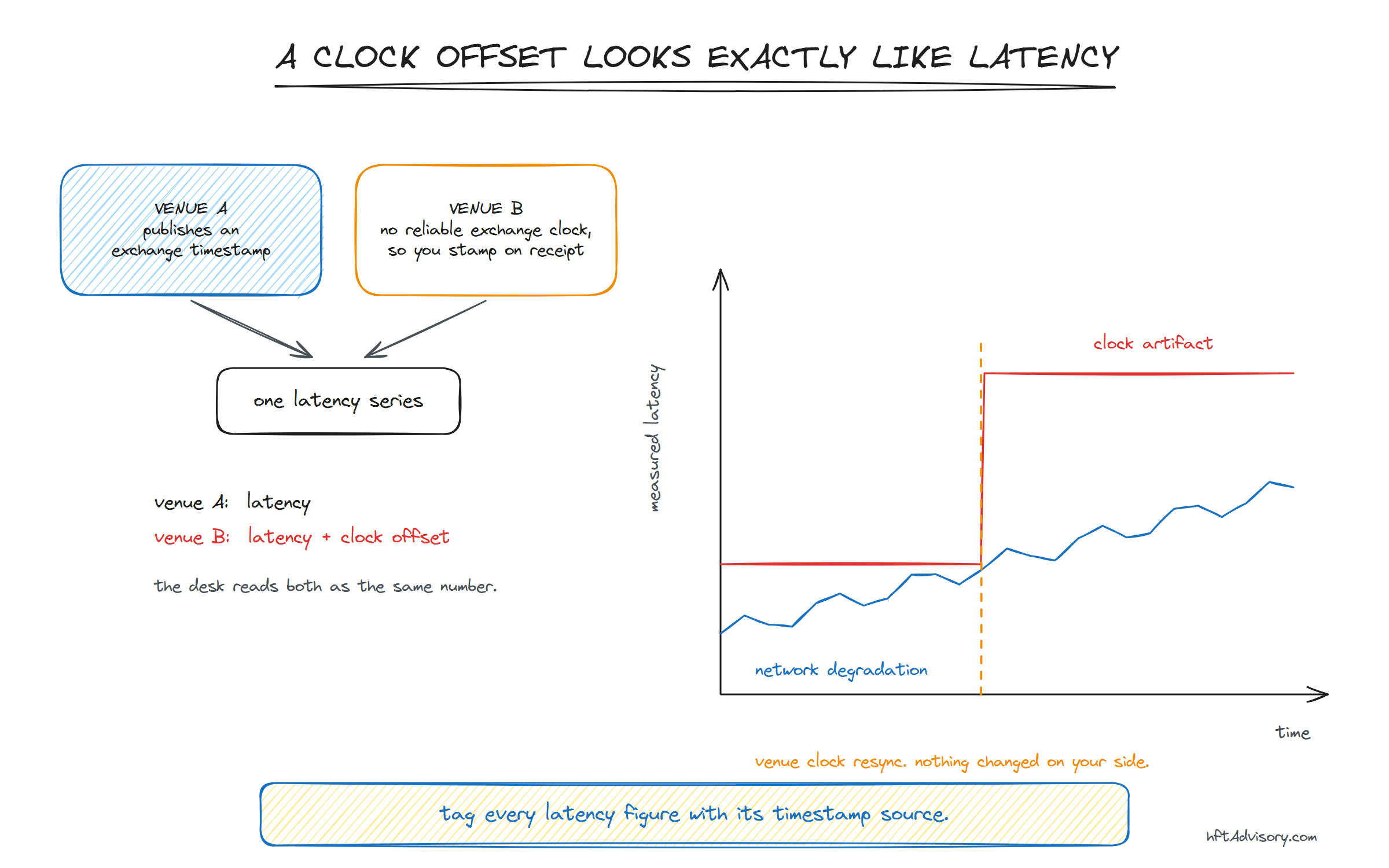
The observable signature is a clean step-function or slow-drift discontinuity in cross-venue latency that does not correlate with any change on your own infrastructure, and that is specific to one venue pair: A-versus-B looks fine, A-versus-C shows the jump. Network degradation is noisy and continuous. A clock artifact is a clean offset shift, which is what makes it easy to mistake for a network event when nobody is tagging clock provenance.
What to measure: per-venue clock offset against a single reference clock, sampled continuously rather than once at connection setup, with every latency and TCA figure tagged by its timestamp source. Without that instrumentation, cross-venue TCA conclusions become unverifiable rather than simply wrong, because there is no way to separate signal from artifact after the fact.
What healthy looks like: two regulatory regimes publish a number here, and both travel outside their own jurisdiction, because they set what a supervised desk is expected to hold. Under MiFID II’s RTS 25, a firm using a high-frequency algorithmic trading technique must keep its business clocks within 100 microseconds of UTC, with timestamp granularity of 1 microsecond or better; any other trading activity is allowed 1 millisecond on both. For US CAT reporting, FINRA Rule 6820(a)(1) requires business clocks synchronized “at a minimum to within a fifty (50) millisecond tolerance” of the NIST atomic clock.
Both govern your own clocks. The venue’s clock is the half that corrupts cross-venue TCA, and no regulation hands you its offset, so use the compliance figure as calibration: hold your own discipline at the 100 microsecond level and a per-venue offset materially above that becomes measurable instead of disappearing into your own noise. Build the alarm on any step change in measured offset larger than your normal one-way jitter on that path. That shape is the venue’s clock moving. Network degradation does not produce a clean offset step.
Why it sits second, required before venue two: the moment a second venue is connected, every cross-venue computation is a simultaneous function of both clocks. With one venue a clock artifact has nothing to compare against and stays invisible. With two it is baked into every comparison from the first day.
Book Reconciliation
Book reconciliation keeps a locally reconstructed order book per venue synchronized with that venue’s authoritative book, using sequence numbers and periodic snapshots to detect and recover from missed messages. The mechanics are day-one material for anyone who has connected a venue, so the part worth dwelling on is where the detection has blind spots.
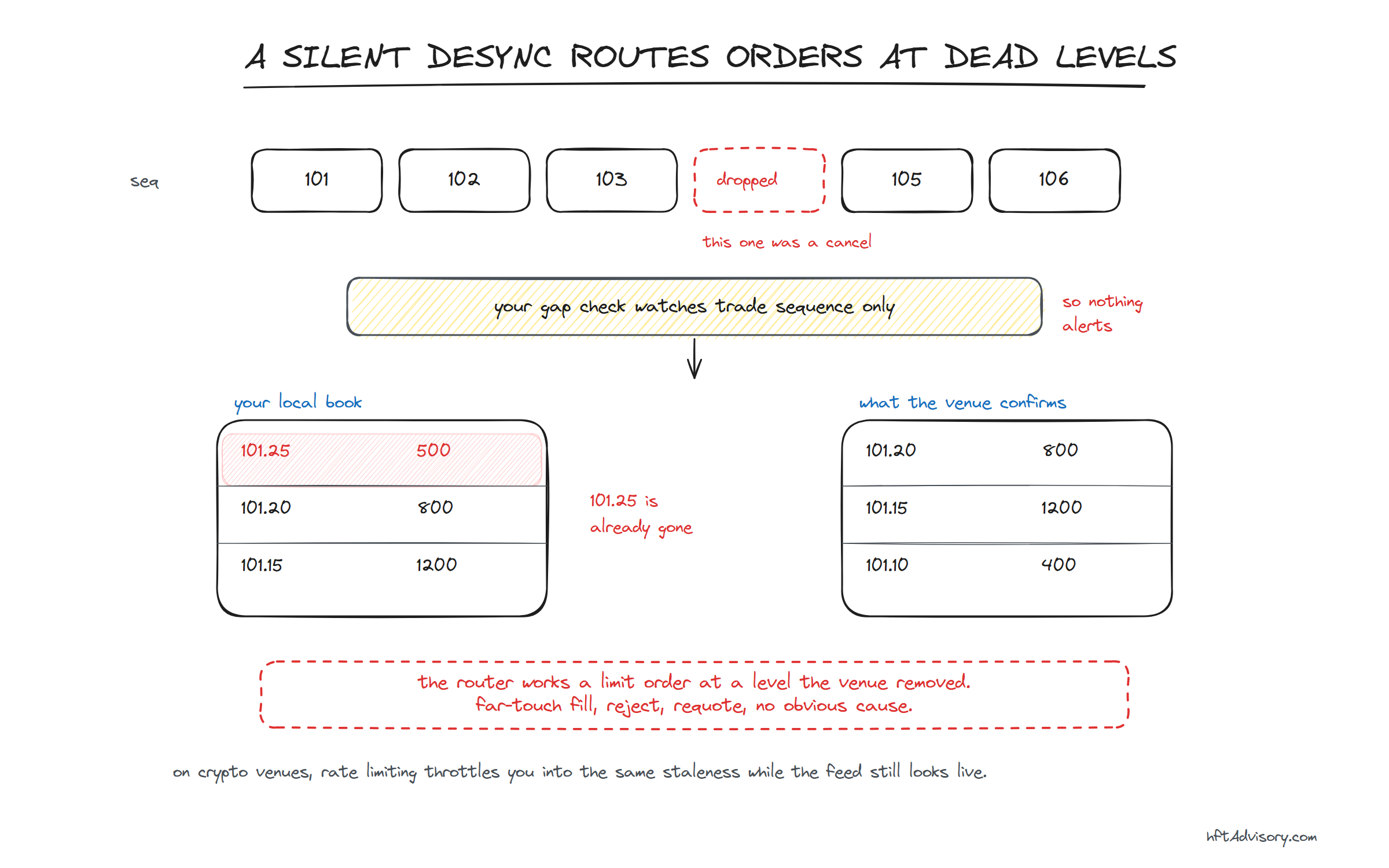
The failure starts with a dropped or out-of-order message. If gap detection checks sequence continuity only on trade messages rather than on every message type, the local book silently desyncs: stale levels remain after the venue has already moved or removed them. A router acting on that book sends limit orders to levels that no longer exist, producing far-touch fills, rejects and requotes with no obvious cause.
Crypto venues add two failure modes with different root causes. The first is REST or WebSocket rate limiting that throttles the client into staleness rather than erroring cleanly, so it believes it holds a live feed while running behind. That is a delivery problem.
The second is a retroactive change to the record, and two different things get collapsed into one here. On a centralized exchange, trades get busted or an operator declares a rollback: a governance decision by a company that changes what your fill history says after you booked it. On-chain, a reorganization does something else. It rewrites no order book, because on an AMM there is none; it unwinds settlement finality, so deposits and positions you treated as confirmed stop being confirmed. Both leave a blind spot with no counterparty to request a retransmission from, unlike a dropped FIX message where a GapFill has somewhere to go.
The observable signature is fills at price levels that, cross-referenced against the venue’s trade tape at that timestamp, were not tradable. For crypto, the tell is a mismatch between the locally held book and an independently pulled REST snapshot taken as a periodic canary.
What to measure: sequence-gap count per venue per day, time-to-detect and time-to-recover per gap, and for crypto venues the interval between confirmed live messages as a staleness indicator.
What healthy looks like: each venue publishes the bound you should hold it to. Its market-data specification documents the recovery path, including the cycle period of the snapshot or replay loop, and that period is your worst-case time to a known-good book whenever a retransmission request is unavailable or refused. Measure time-to-recover against that published period. Recovery that runs materially slower than the venue’s own loop points at your recovery path. What matters most is the count of gaps detected late or never: a gap your monitoring missed for a second is the one that routed orders at dead levels. One of those a month is worse than fifty clean ones.
Why it sits third: reconciliation cost scales with the number of distinct sequencing and recovery mechanics you support, one per venue’s protocol quirks. Venue three is roughly where hand-handling each venue’s recovery logic stops being tractable.
Position Aggregation
Position aggregation produces one current view of net position across every connected venue, given fills on a single parent order arriving asynchronously over independent paths with no shared clock and no shared transaction boundary.
The production failure is the one that opened this article. An order split across N venues fills at different times on different paths. If risk or hedging logic triggers off the first fill it sees rather than the full picture, it hedges against a partial, stale position. It gets worse where the aggregation logic assumes fills arrive in the order they were sent: independent paths race, so a snapshot taken at what looks like one logical instant is checking a position that never existed in that form.
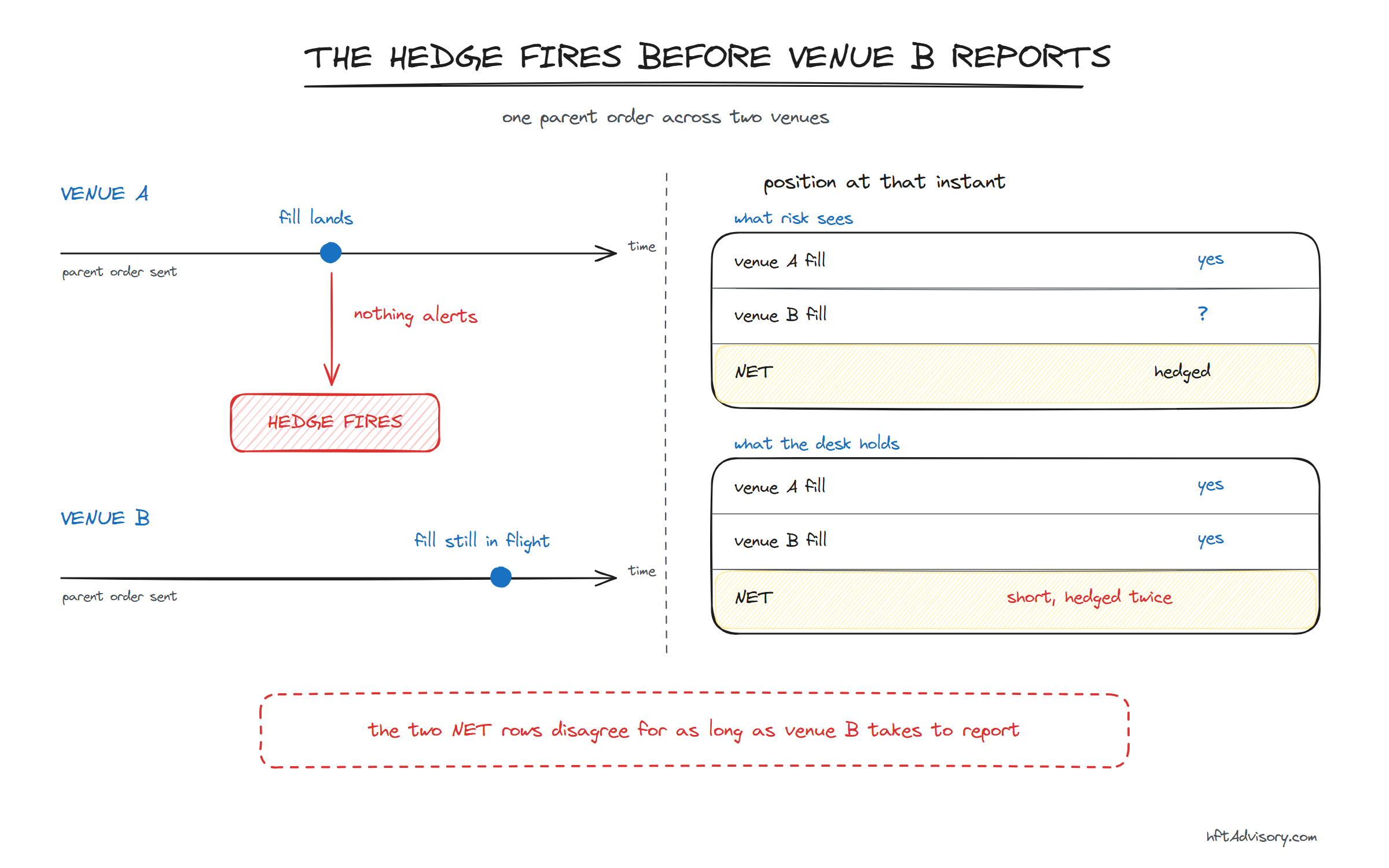
The observable signature is hedge trades sized inconsistently with the eventual reconciled parent-order fill quantity: a systematic over-hedge or under-hedge correlating with how many venues the parent was split across, worsening as fill-time dispersion widens.
What to measure: the distribution of inter-venue fill-time dispersion for split parent orders, the size and frequency of the mismatch between the hedge sent and the eventual reconciled position, and whether the risk system’s position view carries an as-of marker per venue or presents one number that hides a venue still in flight.
What healthy looks like: this one compares two of your own numbers. Take the ninety-ninth percentile of your inter-venue fill-time dispersion and hold it against the window in which your hedge logic fires. If the dispersion tail is wider than the trigger window, you are measuring a rate of mis-hedging, and the arithmetic tells you roughly how often. If your hedge fires inside a window that your fifth venue routinely misses, the question is already answered.
Why it sits last: aggregation risk is a function of how many independent asynchronous paths exist simultaneously. With one or two venues, the asynchronicity window is small and the blast radius of a mis-hedge is bounded. That risk compounds as venue count grows, which is why it phases in alongside book reconciliation.
What It Costs to Build This Properly
These are engineering budgets, not advisory fees: the cost of your own team doing the work. They are ranges drawn from engagements I run, offered as one advisor’s operating numbers rather than an industry benchmark, and they will not match every shop’s cost structure. Building all four layers properly, across a stack connecting five to eight venues, runs $2M to $5M over 18 to 24 months, engineering only, no data or connectivity costs included.
Normalization and time discipline are the non-negotiable first tier: they have to exist correctly before venue two goes live, because every cross-venue comparison from that point on depends on both. That tier runs $400K to $800K of the total. Book reconciliation and position aggregation are the second tier, phasing in with venue three, roughly where per-venue handling of sequencing, gap recovery and asynchronous fill aggregation stops being something a small team can hand-roll and has to become shared, monitored infrastructure.
If You Cannot Fund the Full Build
Most desks cannot allocate two engineers for a year, and the four layers do not fail in the same order at every size.
At two or three venues, normalization bites first and bites silently: cross-venue comparisons are already wrong and nothing in your P&L labels them as such. The cheap version is one authoritative contract-spec table, a row per venue and instrument holding tick, lot, multiplier and fee schedule, with every price comparison forced through it. That is engineer-weeks of work, and it removes the failure class at the source. Time discipline has a similarly cheap first version: one reference clock, per-venue offset logged continuously, a provenance tag on every timestamp your TCA touches. It lets you tell a clock event from a network event, which is the part that changes decisions. Auditable discipline at the RTS 25 level is a separate, later investment.
Reconciliation becomes the binding constraint around the third or fourth venue, and aggregation becomes dangerous once fills on one parent order overlap routinely.
The honest split: the rough version buys detection, the full build buys automated recovery. At low volume detection carries most of the value, because a human has time to act on it. Once fill rates exceed the speed at which a person can intervene, that crossover is the real trigger to fund the rest.
The Self-Audit
This is a test I use, not a validated industry standard, but it holds up across the desks I have reviewed. Pull effective spread against quoted spread by venue for 30 days. If the two series track cleanly everywhere, move on. If effective drifts away from quoted on one venue and nobody on the desk can explain why in one sentence, that drift is pointing at an underbuilt layer.
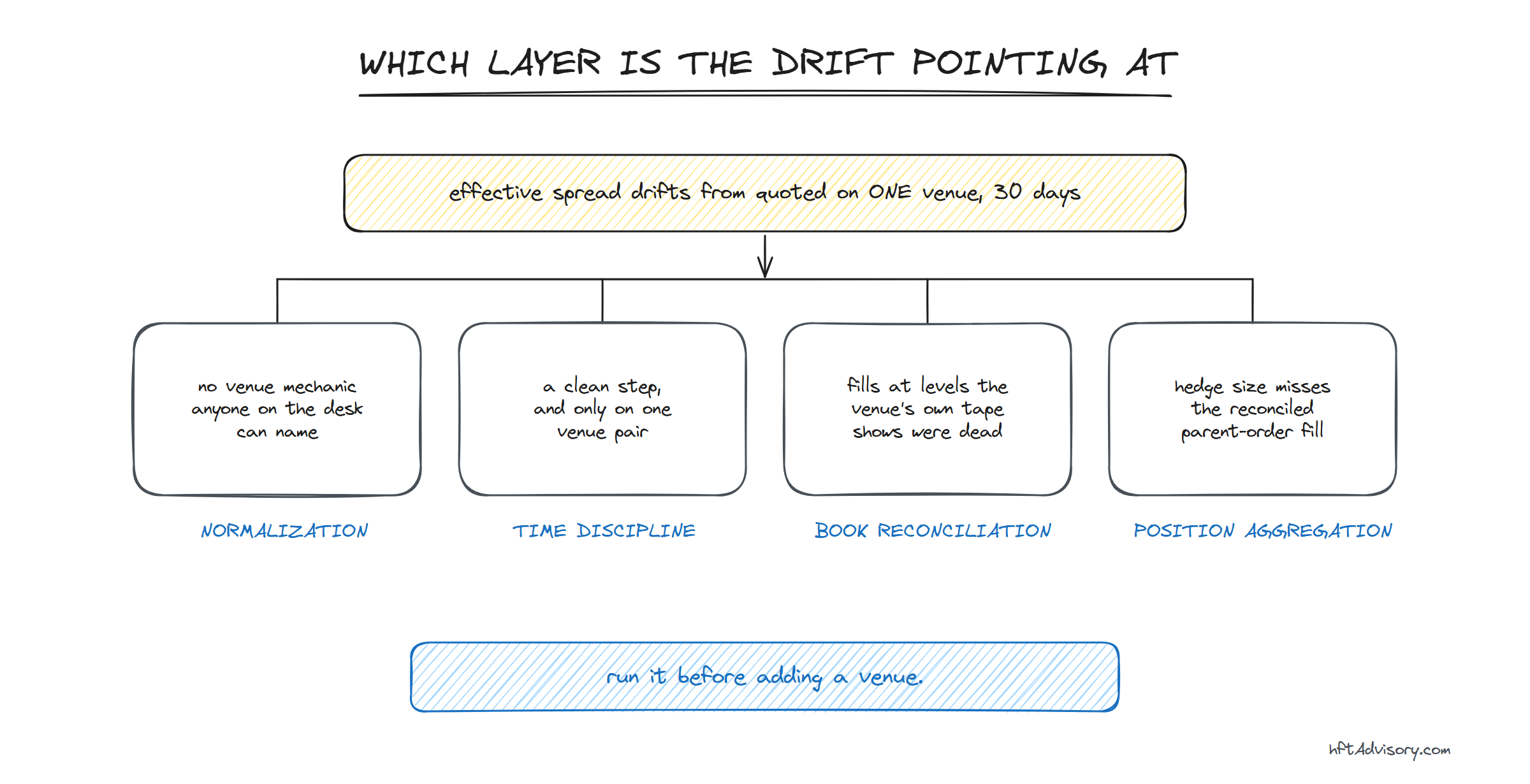
It will not always be normalization. A drift with a clean, venue-pair-specific step-function shape that shows up only in cross-venue latency is a time-discipline artifact. A drift that clusters around fills at price levels the venue’s own tape shows were not tradable at that timestamp is a book-reconciliation gap. A drift that shows up as inconsistent hedge sizing against the eventual reconciled position points at aggregation. The test flags that something in the chain is wrong and gives a starting thread to pull. Narrowing it to one layer takes the signatures above.
Run it before adding a venue. The layer underbuilt at five venues was underbuilt at two, and volume does not surface it faster. It only makes it more expensive to find.
Where This Still Breaks
Where I have not closed the loop: instruments with no liquid effective-spread benchmark, thinly traded crypto pairs early in life, some fixed income, anything without a consolidated tape to measure against. The self-audit above needs a reference spread to compare to, and for those instruments that reference does not exist yet in a form I would defend the same way. I do not have a substitute measurement for that case.
Multi-venue access stays the edge. The four layers underneath it decide whether that edge compounds or leaks out through a router making confident decisions on bad inputs. Most desks with this problem do not know they have it until the effective-versus-quoted gap is pulled and nobody can explain it in one sentence.
This article expands on a post originally published on LinkedIn on July 27, 2026. Read the original post on LinkedIn.
Never Miss an Update
Get notified when we publish new analysis on HFT, market microstructure, and electronic trading infrastructure. No spam.
Subscribe by EmailAriel Silahian is a senior technology executive in institutional electronic trading, with 30+ years across the buy and sell side (New York, Miami, London, Hong Kong). He is the author of "C++ High Performance for Financial Systems" (Packt) and the creator of VisualHFT, the open-source microstructure analytics stack. He writes on exchange architecture, market microstructure, and execution quality, and advises a select number of trading firms on infrastructure decisions that move P&L. Book a strategy call at hftAdvisory.com