Table of Contents
1. The $2.6M–$5.6M Reality Check 2. Why Great Technology Cannot Save a Broken Business Model 3. The Four Cost Centers That Define Institutional Operations 4. The Crypto HFT Paradox: 5–10ms vs. Microsecond Expectations 5. The Business Plan Framework: What Actually Determines Success 6. Diagnostic Checklist: Institutional vs. Retail Budget Reality 7. The Path Forward: Building With Institutional Standards
The $2.6M–$5.6M Reality Check
A founder approached me recently with a common request: design a business plan for an institutional crypto HFT desk with the smallest chance of failure.
After two decades architecting high-frequency trading systems—from traditional equities to crypto markets—I have seen this movie before. The pattern repeats: founders focus on the technology stack and core strategies while underestimating the capital required to compete at the institutional level.
The result was a comprehensive business plan with a hard truth embedded in the investment section: $2.6M to $5.6M in first-year capital requirements.
That range is not a guess. Based on institutional requirements I have assessed across multiple client engagements building crypto trading operations, this represents the actual cost of entry for a desk that can survive contact with market reality.
Thank you for reading this post, don't forget to subscribe!
Most founders look at this figure and immediately question whether it is necessary. They point to retail operations running on AWS with $50K budgets. They cite YouTube tutorials showing Python bots generating alpha.
The distinction they miss is not technical sophistication. The distinction is survival probability.
| Cost Center | Retail Budget | Institutional Budget |
|---|---|---|
| Infrastructure | $5K–$20K (cloud VPS, REST APIs) | $500K–$1M (colocation, dedicated fiber, FPGA) |
| Talent | $50K–$150K (1-2 generalist devs) | $750K–$1.5M (protocol architects, quant researchers) |
| Compliance | $0–$10K (none or minimal) | $500K–$1M (MiCA licensing, AML/KYC, legal counsel) |
| Data & Research | $5K–$20K (free/retail data feeds) | $250K–$500K (tick-level multi-exchange, alt data) |
| Total Year 1 | $60K–$200K | $2.6M–$5.6M |
When you build an institutional desk with a retail budget, you are not building a business. You are creating a leveraged gambling operation where the first significant volatility event determines whether your investors get capital back.
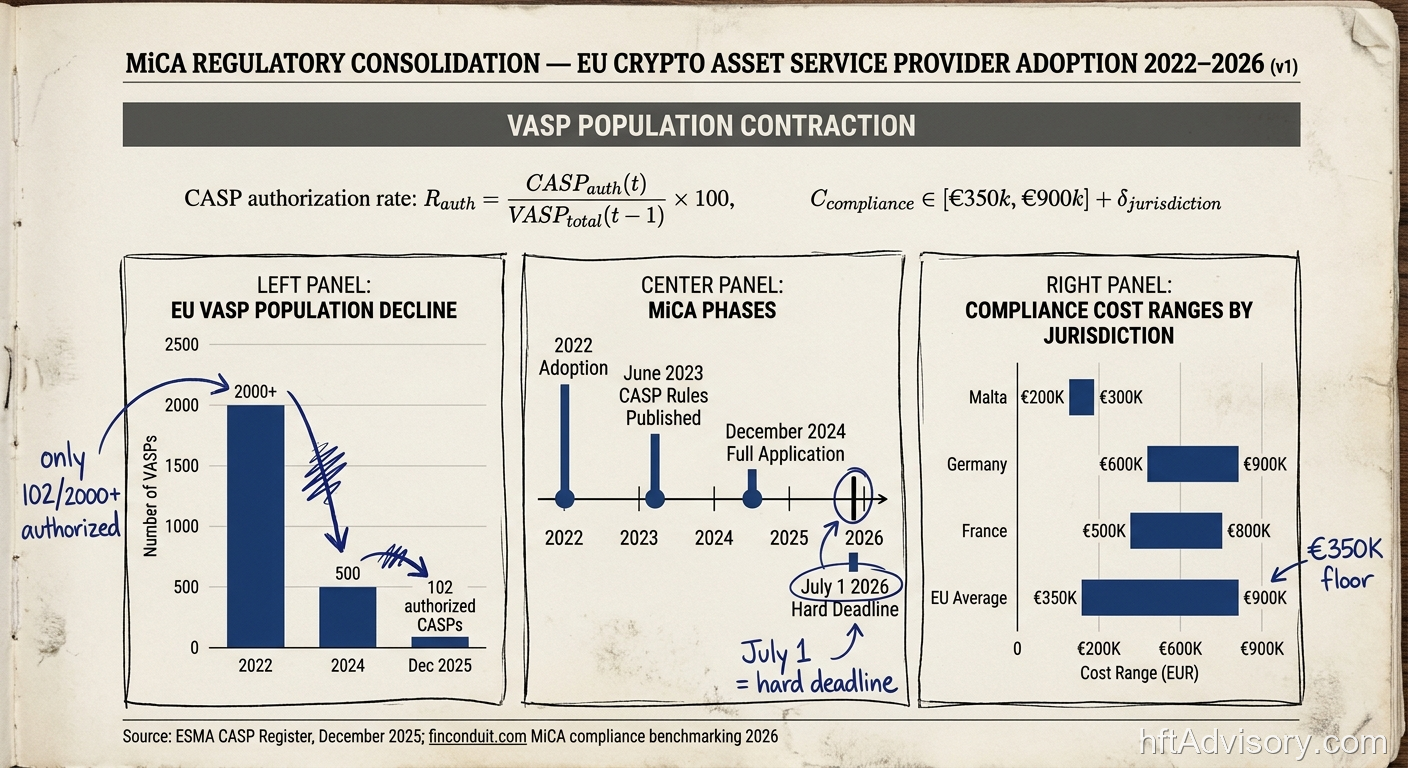
[2026 Update]: The compliance and data cost ranges in this table have moved higher since this analysis was published. MiCA’s transitional period ends July 1, 2026—the hard deadline means no grandfathering. As of December 2025, only 102 crypto-asset service providers (CASPs) held full EU authorization according to the ESMA register. First-year all-in compliance costs for an EU CASP are now documented at €350,000–€900,000 depending on jurisdiction (Germany and France at the higher end; Malta at the lower end), per MiCA compliance benchmarking data from 2026. The institutional infrastructure standard has also risen: Coinbase’s $2.9 billion acquisition of Deribit and Kraken’s $1.5 billion acquisition of NinjaTrader signal that the venues themselves are now operating at institutional scale, which raises the baseline execution quality your desk must match.
Why Great Technology Cannot Save a Broken Business Model
As a Technical Architect, I live in the world of low-latency grids and execution logic. I have overseen tick-to-trade path optimization measured in microseconds—and I have watched FPGA infrastructure failures cost firms millions when the vendor selection was wrong.
The hard lesson I learned building these systems is that great technology cannot save a broken business model.
The data supports this. Research on hedge fund failures (Kundro & Feffer, Capco 2003, study of 100 hedge fund failures) shows that 38% fail due to investment risk decisions, but 50% fail due to operational risk alone. The technology worked. The business structure did not.
Hedge Fund Failure Modes (Capco, 2003):
- 50% — Operational risk alone (compliance failures, undercapitalization, talent attrition, infrastructure inadequacy)
- 38% — Investment risk decisions (bad alpha models, leverage miscalculation, market regime changes)
The technology worked. The business structure did not.
I have watched technically brilliant teams build sub-millisecond crypto execution engines that failed within 18 months—not because the algorithms were wrong, but because they did not budget for regulatory compliance costs when MiCA enforcement arrived. They did not model talent retention when senior protocol architects started receiving $300K+ counter-offers from established players.
The pattern I see repeatedly: founders allocate 80% of their attention to “Core Strategies” and “Tech Stack” sections of the business plan, then pencil in rough estimates for everything else. They treat infrastructure, compliance, and talent as operational details rather than existential requirements.
In institutional trading, operational details kill businesses faster than bad alpha models.
The Four Cost Centers That Define Institutional Operations
When I break down the $2.6M–$5.6M range for clients, they expect it to be mostly technology infrastructure. The reality surprises them.
Based on institutional assessments I have conducted across crypto trading operations, the capital allocation breaks into four primary cost centers:
Infrastructure: $500K–$1M (First Year)
This is not AWS bills. Institutional infrastructure means:
- Colocation rack space in multiple geographic regions for latency arbitrage and redundancy
- Dedicated fiber connections with guaranteed bandwidth and latency profiles
- Hardware expenditures: servers, switches, security appliances designed for deterministic performance
- Exchange connectivity fees (direct market access, not retail API tier)
- Network engineering for kernel bypass and low-latency packet processing
The crypto markets operate 24/7 with no circuit breakers. Your infrastructure must maintain deterministic performance during volatility spikes when exchange traffic increases 10-40x. That requirement eliminates cloud-based “scale on demand” architectures that introduce latency variance.
I have audited crypto desks running $500M daily flow that lost 15% of their edge to “noisy neighbor” jitter on AWS. The virtualization layer that provides elasticity also introduces microsecond-level variance that compounds into basis points of slippage.
| Infrastructure Component | Annual Cost Range | Why It Cannot Be Skipped |
|---|---|---|
| Colocation (multi-region) | $120K–$250K | Sub-1ms exchange latency; cloud adds 10-50ms |
| Dedicated fiber connectivity | $80K–$200K | Guaranteed bandwidth, no “noisy neighbor” jitter |
| Hardware (servers, switches, FPGA) | $150K–$300K | Deterministic performance under 10-40x load spikes |
| Exchange connectivity (DMA) | $100K–$150K | Direct market access vs. rate-limited REST API |
| Network engineering (kernel bypass) | $50K–$100K | Eliminates OS-level latency variance |
Talent: $750K–$1.5M (First Year)
The second surprise is always talent cost. Founders budget for “2-3 developers” without understanding the specialized skill premium in this market.
Institutional crypto HFT requires protocol-level expertise that commands $250K+ base compensation:
- Protocol architects who understand exchange matching engine implementation (FIX, binary protocols, WebSocket optimization)
- Low-latency engineers with experience in C++, kernel bypass, DPDK, or FPGA development
- Quantitative researchers who can design strategies that survive extreme volatility without blowing up
- Infrastructure engineers who can maintain deterministic performance across distributed systems
This is not “hire smart developers and let them learn.” The learning curve for institutional-grade crypto infrastructure is 12-18 months. By that time, you have either burned through capital on mistakes or lost the market window.
The talent market compounds this. Established players—Citadel, Jump, Tower, Jane Street—run active recruiting with compensation packages that include profit participation. Your institutional desk needs compensation structures that can retain senior talent when they start receiving offers.
Compliance and Legal: $500K–$1M (First Year)
Regulatory compliance is the cost center that founders consistently underestimate by an order of magnitude.
The regulatory landscape for crypto trading shifted dramatically in 2024-2025. MiCA (Markets in Crypto-Assets) in Europe establishes comprehensive requirements for Virtual Asset Service Providers (VASPs). First-year all-in compliance costs for an EU CASP are documented at €350,000–€900,000 depending on jurisdiction.
Based on patterns I observe in client engagements:
- Legal structuring (entity formation, licensing, regulatory strategy): $150K–$300K
- Ongoing compliance infrastructure (KYC/AML, transaction monitoring, reporting): $200K–$400K annually
- Regulatory counsel retainer: $100K–$200K annually
- Audit and certification requirements: $50K–$100K
Market consolidation reflects this reality. In EU markets specifically, the July 1, 2026 hard deadline—with only 102 authorized CASPs as of late 2025—makes the consolidation ratio concrete: the registered population has contracted by an order of magnitude from prior years.
Regulatory Consolidation Timeline:
- 2022: 2,000+ unregulated VASPs operating globally
- 2024: MiCA framework adopted in Europe — first-year CASP compliance costs reach €350K–€900K
- 2025: Jurisdictions tighten VASP licensing — institutional counterparties restrict trading to licensed entities
- 2026: July 1 hard deadline — only 102 EU-authorized CASPs as of late 2025; no grandfathering after this date
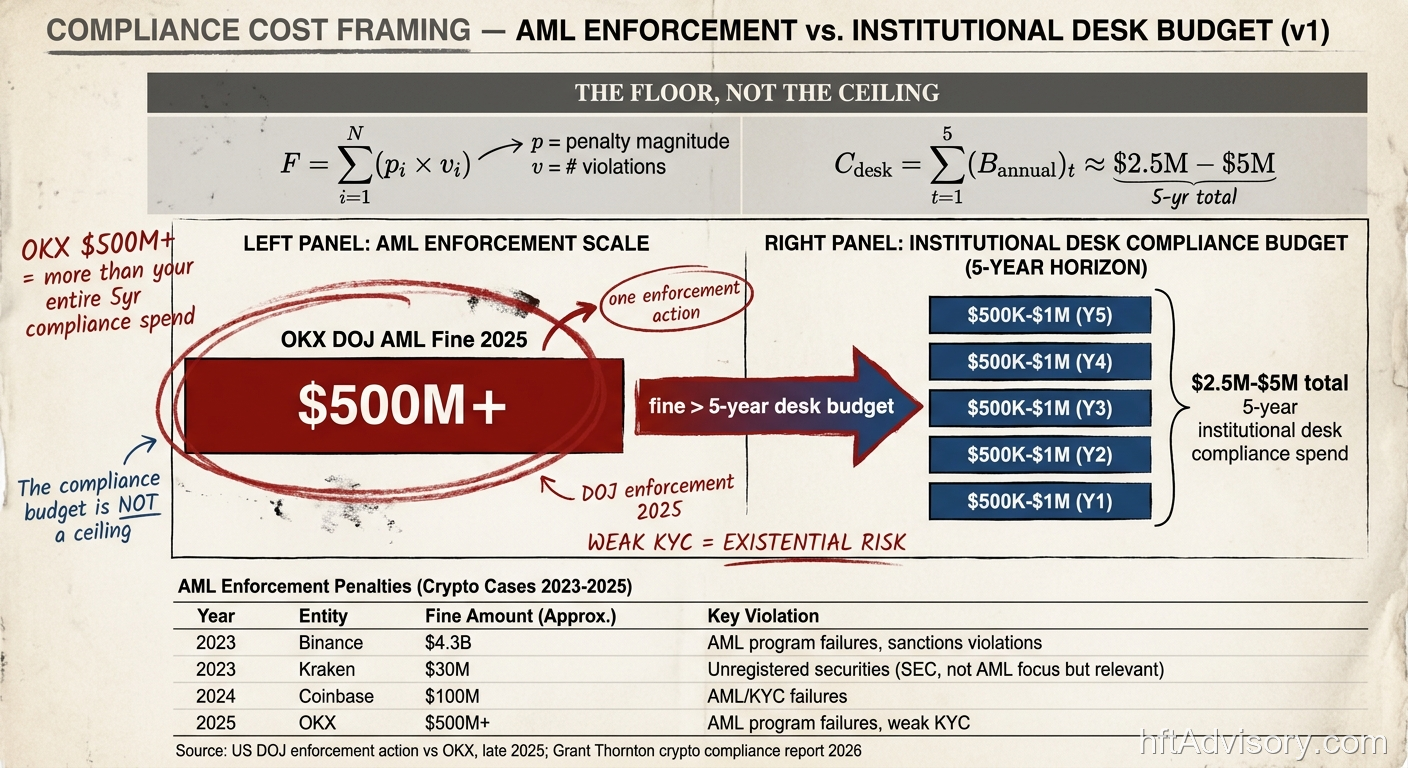
[2026 Update]: The OKX enforcement action in late 2025 provided the clearest cost signal yet: the US Department of Justice fined OKX over $500 million for AML failures, including weak KYC procedures and billions in suspicious transactions. An AML fine of that magnitude exceeds a well-capitalized institutional desk’s entire 5-year compliance budget. The compliance cost in this model is not a ceiling—it is a floor.
Data and Research Infrastructure: $250K–$500K (First Year)
The final cost center separates institutional operations from retail: proprietary data infrastructure.
Exchange data feeds for crypto markets (order book depth, trade tape, liquidation feeds) require:
- Multiple simultaneous exchange connections with normalized data formats
- Historical market microstructure data for backtesting (tick-level, 24/7, multi-exchange)
- Alternative data sources (blockchain analytics, on-chain flow, social sentiment)
- Computational infrastructure for strategy research and backtesting
Institutional-grade historical data requires significant per-exchange investment. Research infrastructure (compute clusters, data storage, analysis tools) requires dedicated capital allocation.
I have watched firms attempt to backtest crypto strategies using free or low-cost retail data, then discover in production that their models failed to account for exchange-specific microstructure quirks that only appear in full-depth order book data.
The Crypto HFT Paradox: 5–10ms vs. Microsecond Expectations
Founders entering crypto HFT typically come from one of two backgrounds: traditional HFT (where they understand microsecond optimization) or crypto trading (where they understand market dynamics). Both groups face a reality gap.
The crypto “HFT” designation creates unrealistic expectations. In traditional equities HFT, we measure execution paths in microseconds—sometimes sub-microsecond for co-located operations. Crypto markets operate at higher exchange latency than traditional venues due to fundamental architectural differences.
Crypto exchanges run matching engines in cloud infrastructure with geographic distribution. The speed of light imposes physical limits. A round-trip from a Singapore colocation facility to a Binance matching engine in Tokyo cannot be faster than the speed of light through fiber (~1ms per 100km, plus switching and processing time).
This creates the first paradox: “HFT” techniques in crypto are not about raw speed optimization. They are about execution quality within a higher-latency environment.
| Metric | Traditional HFT (Equities) | Crypto HFT |
|---|---|---|
| Exchange latency floor | 1–10 microseconds | 15–25ms round-trip (API) |
| Co-location proximity | Same building as matching engine | Geographic distribution (cloud-hosted) |
| Protocol | Binary/FIX (hardware-optimized) | WebSocket/REST (software-limited) |
| Circuit breakers | Yes — halts protect during volatility | None — 24/7 continuous operation |
| Optimization target | Raw speed (sub-microsecond shaving) | Execution quality within latency window |
| Edge source | Latency arbitrage, co-location advantage | Algorithm sophistication, routing logic |
[2026 Update]: The latency picture has been refined by live market data. Independent market microstructure data for Q2 2025 (Kaiko) showed Coinbase API response latency averaging approximately 15ms and Binance approximately 22ms. The “5–10ms” figure cited in earlier analyses reflected matching engine internal processing time rather than round-trip API latency. For practical execution planning, the actionable latency budget is 15–25ms round-trip for most institutional desks. The execution quality thesis remains intact—but the window you are working in is wider than traditional equities while still being narrower than retail execution.
The second paradox: sophisticated algorithmic execution still generates measurable edge despite higher absolute latency.
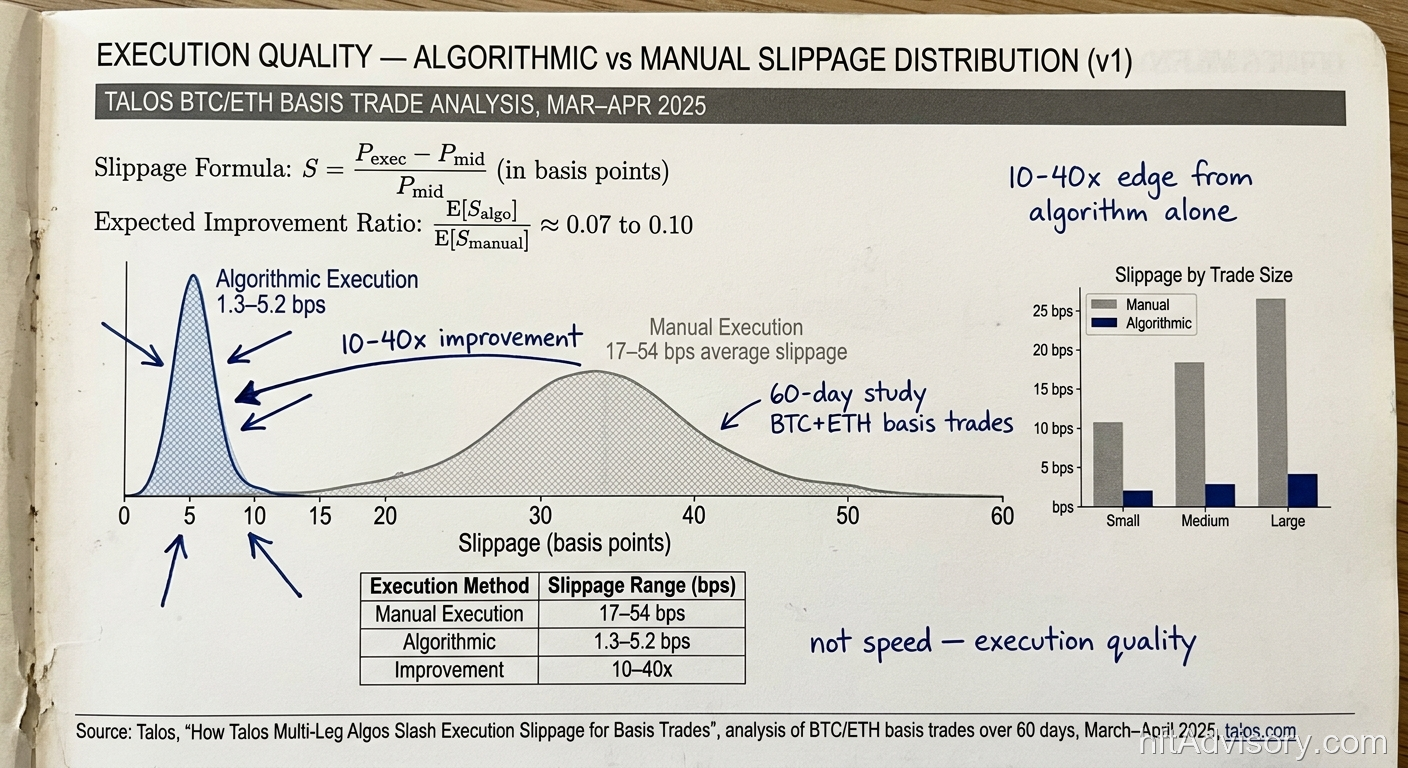
Research I have seen across client engagements shows slippage ranges:
- Manual execution: 17–54 basis points average slippage
- Sophisticated algorithmic execution: 1.3–5.2 basis points average slippage
(Source: Talos, analysis of actual BTC/ETH basis trades over 60 days, March–April 2025)
That 10-40x improvement comes from execution quality optimization within the available latency window—order type selection, liquidity detection, timing precision, multi-exchange routing logic.
The firms that fail in crypto HFT typically make one of two mistakes:
1. Traditional HFT veterans attempt to apply microsecond optimization techniques and spend 18 months building infrastructure that cannot overcome physical latency limits. They optimize the wrong bottleneck.
2. Crypto natives assume speed does not matter and run Python execution engines that lose to competitors executing within the 15–25ms window while they execute in 100–200ms.
Institutional crypto HFT requires understanding both worlds: accepting the latency floor while optimizing everything above it with traditional HFT rigor.
The Business Plan Framework: What Actually Determines Success
When I design business plans for institutional trading desks, founders expect the conversation to start with technology. I start with failure modes.
The business plan I delivered for this crypto HFT desk structured every decision around a single question: Which failure modes eliminate this business, and how do we prevent each one?
That reframing changes the capital allocation. Technology is not the first consideration—survival is.
Investment Structure First, Strategy Second
The $2.6M–$5.6M range appeared in the Investment section of the business plan, not the Technology section. That placement was deliberate.
Capital adequacy determines whether the business can survive the learning period. Every new institutional trading operation goes through a 6–12 month period where capital is deployed but strategies are not yet profitable. The question is whether the operation can sustain:
- Ongoing operational expenses (infrastructure, talent, compliance)
- Strategy development and iteration costs (failed backtests, small-scale production testing)
- Market impact learning (discovering which venues and order types actually work)
Firms that undercapitalize face a death spiral: limited runway forces premature strategy deployment, which generates losses, which depletes capital faster, which forces even more aggressive strategies.
I have watched this pattern kill technically sound operations. They did not fail because the strategies were wrong. They failed because they did not have capital to wait for the strategies to be right.
Capital Adequacy vs. Survival Probability:
| Initial Capital | Learning Period Runway | Survival Probability |
|---|---|---|
| $200K–$500K | 3–6 months | ~15% — forced into premature deployment |
| $500K–$1.5M | 6–12 months | ~35% — limited iteration cycles |
| $1.5M–$3M | 12–18 months | ~60% — adequate for strategy development |
| $3M–$5.6M | 18–24 months | ~80% — institutional runway with drawdown capacity |
The relationship is exponential, not linear. Each additional month of runway disproportionately increases survival probability because it allows more iteration cycles before capital depletion forces closure.
Regulatory Structure as Foundation
The second framework shift: regulatory compliance is not a cost center to minimize. It is a competitive moat.
Market consolidation in crypto trading rewards firms with robust compliance infrastructure. As jurisdictions tighten VASP requirements:
- Institutional counterparties (banks, asset managers, family offices) restrict trading relationships to licensed entities
- Exchange fee structures increasingly favor compliant, high-volume institutional clients
- Access to institutional-grade OTC liquidity requires regulatory credentials
The €350K–€900K annual compliance cost looks expensive until you recognize it as a barrier that eliminates most potential competitors. Firms that treat compliance as a grudge expense miss this strategic dimension.
Talent Retention as Alpha Protection
The third framework element: talent is not a resource you acquire. Talent is alpha that walks out the door if you do not structure retention properly.
I have seen proprietary strategies leak across firms when senior quants or architects leave for competitors. The “non-compete” clauses in contracts are largely unenforceable for knowledge workers. The protection mechanism is economic alignment.
Institutional trading operations that survive long-term structure compensation with:
- Base salary competitive with tier-1 players ($250K–$400K for senior roles)
- Profit participation aligned with long-term performance (2-4 year vesting)
- Equity or synthetic equity in the operation itself (creating golden handcuffs)
This is not generosity. This is alpha protection. The cost of losing a senior protocol architect who understands your exchange connectivity logic is not their replacement cost—it is the 6-12 months of degraded execution quality while the replacement learns.
Diagnostic Checklist: Institutional vs. Retail Budget Reality
Founders consistently overestimate how far retail-level budgets can extend into institutional operations. The gap is not linear—it is categorical.
Use this diagnostic framework to assess whether your capital structure matches your operational ambitions:
Infrastructure Reality Check
- Colocation vs. Cloud: Are you colocated in the same facilities as exchange matching engines, or running on general-purpose cloud infrastructure?
– Institutional threshold: Multiple colocation sites with low-latency access to primary exchange matching engines – Retail indicator: AWS/GCP instances in general regions, 50–200ms latency to exchanges
- Connectivity Type: Do you have dedicated fiber with guaranteed bandwidth and latency profiles, or best-effort internet connectivity?
– Institutional threshold: Dedicated connections with SLA guarantees and latency monitoring – Retail indicator: Internet VPN or standard cloud networking
- Protocol Access: Are you using FIX, binary, or WebSocket protocols with direct market access, or REST API rate-limited endpoints?
– Institutional threshold: Direct market access with protocol-level optimization – Retail indicator: REST API with rate limits measured in requests per second
Quick Infrastructure Assessment:
| Question | Institutional Answer | Retail Indicator |
|---|---|---|
| Where do you run? | Colocated, low latency to exchange | Cloud VPS, 50–200ms latency |
| How do you connect? | Dedicated fiber with SLA | Best-effort internet/VPN |
| What protocol? | FIX/binary with DMA | REST API with rate limits |
If all three answers fall in the “Retail Indicator” column, your infrastructure cannot support institutional-level execution quality.
Talent Structure Reality Check
- Compensation Competitiveness: Can you retain senior protocol architects when they receive $300K+ offers from tier-1 firms?
– Institutional threshold: Compensation packages including base + performance + equity that total $250K–$500K for senior roles – Retail indicator: Flat salary structure under $150K with vague profit-sharing promises
- Specialization Depth: Do you have team members who can debug exchange-specific FIX dialect quirks or protocol timing issues?
– Institutional threshold: Team includes engineers who have built production trading systems at established firms – Retail indicator: Smart generalist developers learning trading systems for the first time
- Redundancy Planning: If your lead architect leaves tomorrow, does execution quality degrade by 50%+?
– Institutional threshold: Documentation, redundant expertise, structured knowledge transfer – Retail indicator: Single points of failure across critical system knowledge
Compliance Structure Reality Check
- Regulatory Licensing: Are you operating as a licensed entity under MiCA, VASP registrations, or equivalent jurisdictional requirements?
– Institutional threshold: Full licensing with legal counsel managing ongoing compliance – Retail indicator: Operating in regulatory gray areas or “waiting to see what happens”
- AML/KYC Infrastructure: Do you have automated transaction monitoring and reporting systems, or manual processes?
– Institutional threshold: Commercial-grade AML/KYC systems with automated screening and reporting – Retail indicator: Spreadsheet tracking or no formal AML procedures
- Counterparty Access: Can you establish trading relationships with institutional counterparties (banks, prime brokers, OTC desks)?
– Institutional threshold: Regulatory credentials that pass institutional due diligence – Retail indicator: Limited to crypto-native counterparties with minimal due diligence requirements
Capital Adequacy Reality Check
- Runway Duration: Can you sustain operations for 12-18 months assuming strategies are not profitable during the learning period?
– Institutional threshold: Capital covers operational expenses + strategy development for 12-18 months – Retail indicator: Capital provides 3-6 months runway, forcing premature strategy deployment
- Drawdown Capacity: If you experience a 30% drawdown in the first 6 months, does the operation shut down?
– Institutional threshold: Capital structure anticipates learning-period losses and maintains operations – Retail indicator: Early losses trigger panic capital preservation or business closure
If you answered “retail indicator” to more than two items in any category, your operation has institutional ambitions with a retail budget. The probability of survival drops exponentially with each additional mismatch.
The Path Forward: Building With Institutional Standards
The case studies are not theoretical. 3AC (Three Arrows Capital) collapsed with $3.5B in debt—not because they lacked trading talent, but because operational structure could not contain leverage during volatility. Alameda Research—whose bankruptcy filing listed $10 billion to $50 billion in liabilities—operated without institutional risk governance.
Both failures shared a common pattern: retail-level operational infrastructure attempting to manage institutional-level capital.
[2026 Update]: More recent failures reinforce the same pattern. The February 2025 Bybit hack—approximately $1.5 billion in assets stolen by the North Korean Lazarus Group in what became the largest exchange theft in history—demonstrated that operational and infrastructure security gaps are existential risks even at exchange scale. The OKX DOJ enforcement action (over $500 million in fines for AML failures) is the compliance equivalent: a top-10 global exchange with substantial resources failed on operational discipline. Neither 3AC nor Bybit was brought down by bad alpha. Both were brought down by operational structure failures.
The path forward for new institutional crypto HFT operations requires inverting the standard founder approach:
Start With the Business Model, Not the Technology
Before you design the low-latency grid, design the business structure that can survive while the technology is being built. Model these scenarios:
1. 12-Month Profitability Delay: Can the operation survive if strategies take a full year to reach profitability? 2. 50% Talent Turnover: What happens if half your team receives offers and leaves in year two? 3. Regulatory Surprise: What if new regulations add $500K in annual compliance costs mid-year?
If any scenario causes business failure, your capital structure is inadequate. Fix that before writing code.
Treat Compliance as Moat, Not Cost
Stop viewing regulatory compliance as overhead. Reframe it as competitive advantage that eliminates most potential competitors.
Institutional capital (family offices, endowments, pension funds entering crypto) increasingly restricts allocations to fully licensed, compliant entities. Early investment in compliance infrastructure positions your operation to capture this capital when less-prepared competitors cannot.
The €350K–€900K compliance cost becomes a strategic weapon when your competitors are attempting to operate in regulatory gray areas with $50K budgets.
Structure Talent Retention From Day One
Do not treat senior engineers and quants as employees you hire. Treat them as alpha-generating assets you must protect from competitors.
Structure compensation with long-term alignment:
- Profit participation vesting over 3-4 years
- Equity or synthetic equity creating economic alignment
- Competitive base compensation that does not force talent to leave for financial reasons
The cost of this structure is high—potentially $1M+ annually for a 5-6 person senior team. The cost of not implementing this structure is watching your proprietary strategies walk out the door to competitors who will pay more.
Accept the Crypto HFT Latency Reality
Stop attempting to achieve traditional HFT microsecond latency in crypto markets. The physics does not allow it.
Focus instead on execution quality within the available latency window:
- Order type sophistication (IOC, FOK, Post-Only optimization)
- Multi-exchange routing with liquidity detection
- Timing precision within the available window
- Queue position optimization where applicable
Research shows this approach generates 1.3–5.2 bps slippage compared to 17–54 bps manual execution (Talos, BTC/ETH basis trade analysis, 2025). That improvement comes from algorithm sophistication, not raw speed.
The Execution Quality Stack:
┌─────────────────────────────────────────────────┐
│  EDGE GENERATION                                │
│  Algorithmic: 1.3–5.2 bps slippage              │
│  Manual:     17–54 bps slippage                 │
│  Improvement: 10–40x                            │
├─────────────────────────────────────────────────┤
│  ALGORITHM OPTIMIZATION LAYER                   │
│  Order type selection (IOC, FOK, Post-Only)     │
│  Multi-exchange routing + liquidity detection   │
│  Timing precision within available window       │
│  Queue position optimization                    │
├─────────────────────────────────────────────────┤
│  EXCHANGE LATENCY FLOOR (Physics-Limited)       │
│  15–25ms round-trip (API latency, 2025 data)   │
│  Cannot be optimized below this threshold       │
│  Focus execution quality ABOVE this layer       │
└─────────────────────────────────────────────────┘
Build for 2026-2027 Institutional Adoption
The institutional capital entering crypto trading in 2026 has different requirements than 2020-2022 retail traders. They demand:
- FIX Protocol and ISO 20022 standard connectivity (not REST APIs)
- Deterministic execution infrastructure (not cloud elasticity)
- Regulatory compliance and audit trails (not “move fast and break things”)
- Professional-grade operational risk management (not founder heroics)
Firms building for 2026-2027 institutional adoption must architect operations that pass institutional due diligence. That requires capital allocation matching institutional standards.
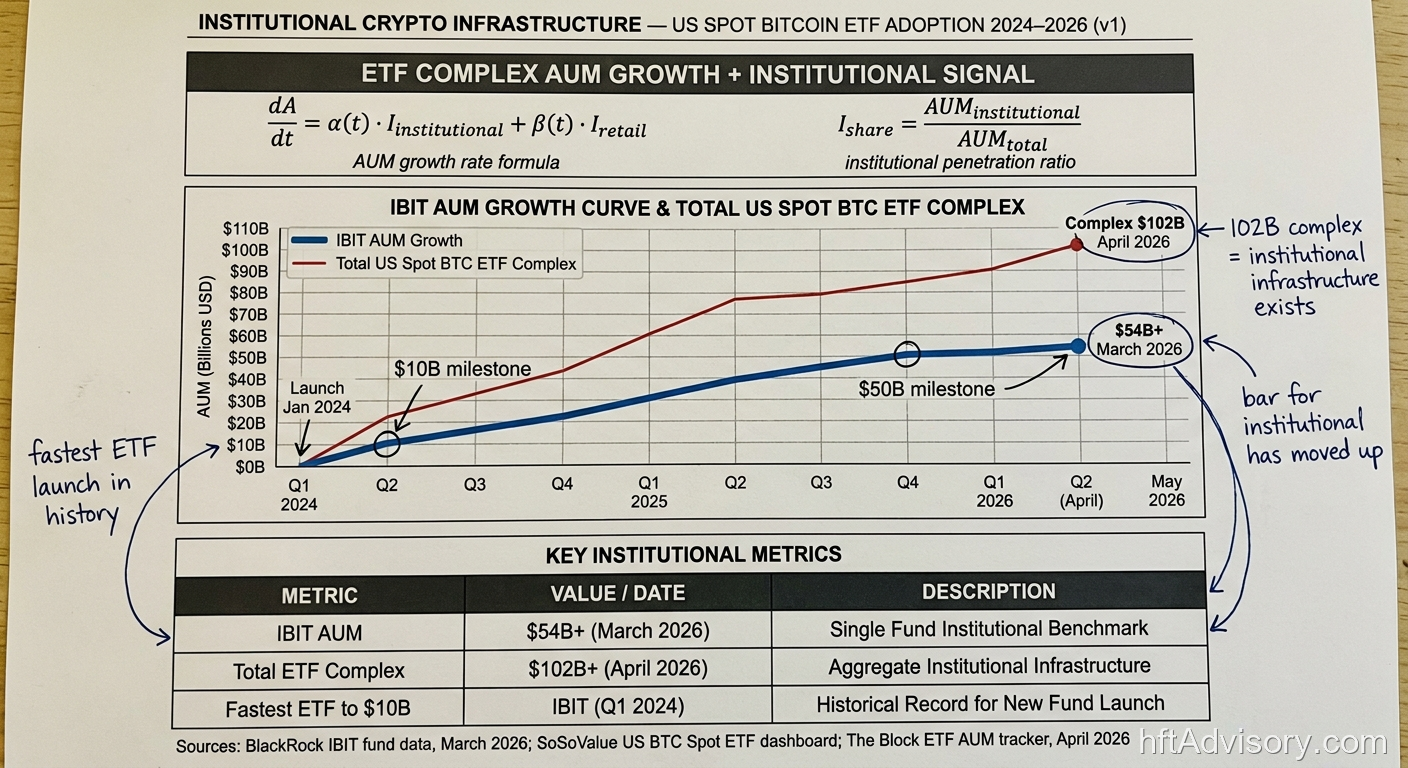
[2026 Update]: The institutional capital picture accelerated materially through 2025–2026. BlackRock’s iShares Bitcoin Trust (IBIT) reached over $54 billion in AUM by March 2026—the fastest ETF launch to that scale in financial history. The total US spot Bitcoin ETF complex crossed approximately $102 billion in AUM by April 2026. This is not just inflow data—it is evidence that institutional custody, compliance, and reporting infrastructure for crypto now exists at a scale that changes counterparty expectations. The institutional desk being designed today is competing for allocations against vehicles that have BlackRock-grade operational infrastructure behind them. The bar for what “institutional” means has moved up.
Conclusion: The Real Barrier to Entry
The $2.6M–$5.6M capital requirement for an institutional crypto HFT desk represents the actual cost of building an operation that can survive contact with market reality.
Most founders resist this figure because they have seen examples of retail operations running on $50K–$200K budgets. What they have not seen is the survivorship bias—the hundreds of undercapitalized operations that failed quietly without making headlines.
The barrier to entry in institutional trading is not technical complexity. The barrier is capital adequacy and operational maturity.
After twenty years building these systems, the pattern I observe is consistent: technical excellence is necessary but insufficient. Operational structure determines survival probability.
If you are designing an institutional crypto HFT operation and attempting to build it with a retail budget, you are not building a business. You are conducting a leveraged experiment with other people’s capital.
The alternative is to start with adequate capital, institutional operational standards, and a business model that can survive the learning period. The diagnostic checklist above is a binary test. If your operation cannot clear the institutional thresholds on infrastructure, talent, compliance, and capital adequacy, the probability of survival in the 18-month learning window is not a question of strategy quality—it is a question of whether the capital structure can absorb the learning cost. The standard is $2.6M–$5.6M in committed year-one capital. If your current plan cannot reach that threshold, it may be time to audit the structure before it audits you.
Originally shared as a LinkedIn post on December 11, 2025. Updated May 2026 with corrected statistics, MiCA compliance data, and 2025–2026 market developments.
Never Miss an Update
Get notified when we publish new analysis on HFT, market microstructure, and electronic trading infrastructure. No spam.
Subscribe by EmailAriel Silahian is a senior technology executive in institutional electronic trading, with 30+ years across the buy and sell side (New York, Miami, London, Hong Kong). He is the author of "C++ High Performance for Financial Systems" (Packt) and the creator of VisualHFT, the open-source microstructure analytics stack. He writes on exchange architecture, market microstructure, and execution quality, and advises a select number of trading firms on infrastructure decisions that move P&L. Book a strategy call at hftAdvisory.com