
Table of Contents
- The Price of US Market Efficiency
- Instrument Adverse Selection First: Why VPIN and OFI Are Not Academic Abstractions
- The OTR Penalty Structure Is a Permanent Cost Layer
- Per-Component Latency Profiling Before Any Hardware Spend
- Single-Venue Markets Do Not Need US-Style Smart Order Routing
- The Practical Framework: Five Diagnostic Questions
- Conclusion
Introduction
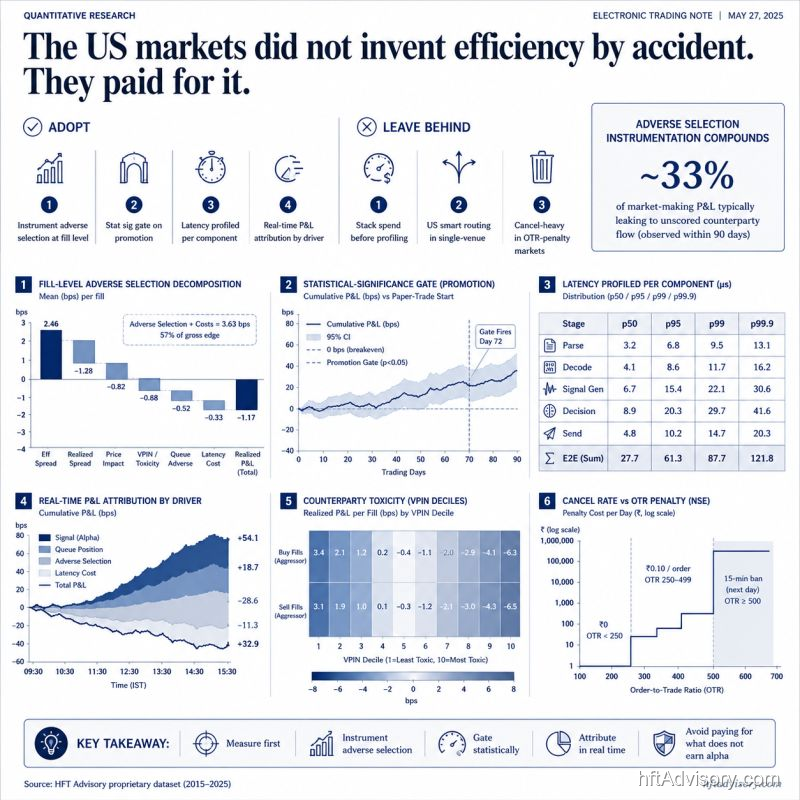
The US equity markets did not invent execution efficiency by accident. They paid for it, over two decades, through a sequence of catastrophic failures, regulatory mandates, and competitive selection that slowly forced discipline onto every participant who wanted to survive.
What you are watching at NSE right now is the same arc in compressed form. NSE announced in September 2024 that it will triple its colocation rack capacity from roughly 1,400 to over 4,000 within three years, while simultaneously scaling message throughput from 5 million to 20 million orders per second. Algorithmic trading now accounts for 53% of NSE cash market turnover, up from 14% in 2010. Colocation already drives 62.1% of equity derivatives turnover, up from 7.3% over the same period.
That infrastructure expansion is arriving at the same moment Indian markets are developing their first-ever algo majority in the cash segment. The risk is straightforward: growing markets are importing US-style infrastructure spending without the discipline layer it took the US 20 years and several expensive incidents to build. Speed without instrumentation is a cost center, not an alpha source.
From 20 years inside US electronic trading, I can map which disciplines transferred cleanly to growing markets and which US-built patterns will cost you when you bring them into a structurally different market. The distinction matters because the two categories look similar from the outside and perform very differently on your P&L.
The Price of US Market Efficiency
The US HFT industry’s discipline did not emerge from foresight. It emerged from sequential failures that imposed costs severe enough to force behavioral change.
Thank you for reading this post, don't forget to subscribe!
The pattern repeated consistently across the 2005-2015 period: a firm deployed infrastructure fast, ran strategies that had not been stress-tested against market structure edge cases, and absorbed a loss that could not be attributed to market conditions alone. The architectural lesson was the same each time: instrumentation and validation should precede infrastructure spend, not follow it.
US efficiency emerged from regulatory and competitive pressure, not from the speed of the hardware. Sequential failures imposed costs severe enough to force every serious participant to instrument execution quality, profile latency at the component level, manage order-to-trade ratios deliberately, and validate strategies against prod-identical environments before go-live. Those disciplines became the minimum operational standard because the cost of operating without them became quantifiable and repeated.
For growing markets, the opportunity is to compress that 20-year arc. The academic research that documented what US markets learned (VPIN, OFI, effective/realized spread decomposition, per-component profiling) is public. The regulatory frameworks that codified US-style discipline (CME Rule 575 on disruptive order practices, Reg NMS on fragmentation) are already published. The architectural lessons do not require reinventing the US failure sequence. They require recognizing which US disciplines travel and which are artifacts of the specific US market structure.
Instrument Adverse Selection First
Why VPIN and OFI Are Not Academic Abstractions
The two most transferable US disciplines are also the two most commonly skipped by desks entering new markets. They are skipped because they look academic from the outside. They are not.
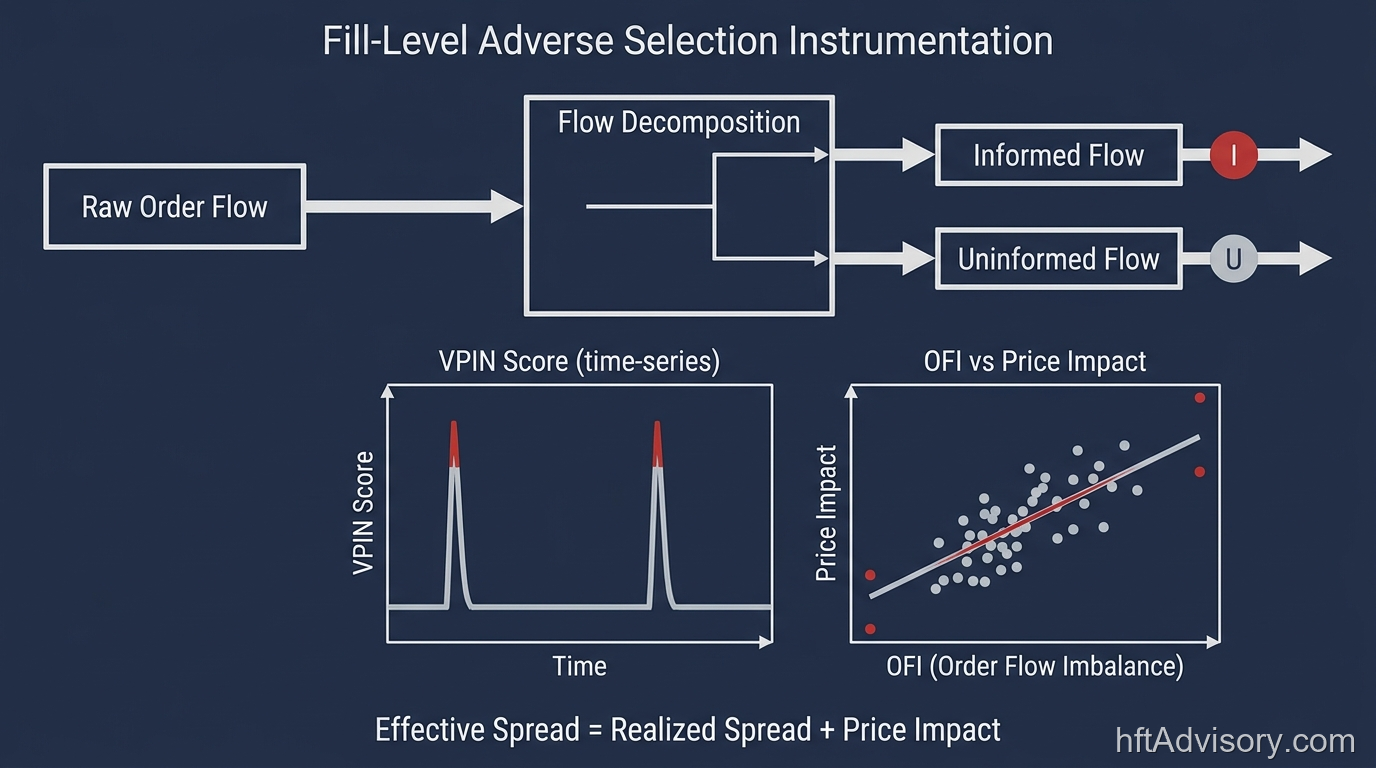
VPIN (Volume-synchronized Probability of Informed trading), developed by Easley, Lopez de Prado, and O’Hara in a 2012 paper in the Review of Financial Studies, provides a real-time proxy for order flow toxicity. The core insight is that informed traders produce volume imbalance at a rate that uninformed traders do not. When VPIN spikes, the probability that the next fill comes from a counterparty with superior information rises sharply. A market maker who does not instrument this is quoting blindly into an adversely selected flow.
Order Flow Imbalance (OFI), formalized by Cont, Kukanov, and Stoikov in a 2014 paper in the Journal of Financial Econometrics, establishes a linear relation between OFI and short-term price changes. The slope of that relation is inversely proportional to market depth, meaning shallow books, which characterize many growing-market instruments, amplify the price-impact signal. OFI is not a signal; it is instrumentation of how your fills interact with the book state.
Effective versus realized spread decomposition, traced in the academic literature to Stoll (1989) and extended by Huang and Stoll (1997), decomposes each fill into its two components: the realized spread (what the market maker captures after the market moves) and the price impact (what the counterparty extracts against the market maker). This decomposition belongs at the fill level, not as an aggregate. Aggregate effective spread numbers hide the distribution of counterparty toxicity across fills.
The combination of these three instruments tells you which fills are leaking and to whom.
The Jane Street case as event forensics. In July 2025, SEBI barred Jane Street from Indian securities markets and froze $566 million, alleging manipulation of Bank Nifty on expiry days. The numbers from the Oxford Business Law Blog analysis of January 17, 2024 illustrate why adverse selection instrumentation is non-negotiable in any market with expiry mechanics: that single day produced a notional options-to-underlying ratio of approximately 350:1 on Bank Nifty, with roughly $89 million in options profit against approximately $7.5 million in cash and futures losses.
What this means architecturally: on a day with that flow profile, every market maker not scoring counterparty toxicity in real time was on the wrong side of a structured position with 350x leverage in the derivatives layer. VPIN and OFI do not prevent this outcome. They give you the instrumentation to see the flow signature before your fills compound the loss. The day had a specific adverse selection signature at the order flow level. Instrumentation is what makes that visible in time to matter.
In my advisory practice, adverse selection instrumentation compounds the fastest of any discipline I install. Across a small sample of desks I have worked with directly (fewer than ten engagements, in markets with moderate market-maker competition), the post-deployment finding has been that 20% to 45% of market-making P&L was leaking to counterparty flow that was not being scored. This is a preliminary observation across a heterogeneous sample, not a calibrated industry benchmark. The dispersion is meaningful: thinner books with fewer active market makers concentrate the leakage faster; deeper books with multiple competing informed flows show lower headline numbers because the signals partially cancel. The headline takeaway is the leakage is non-trivial and currently invisible to desks that do not instrument at the fill level.
The architectural decision sequence I recommend: instrument effective vs. realized spread at the fill level first, then layer VPIN and OFI as the flow-toxicity scoring layer. The decomposition tells you where the leakage is; the flow-toxicity layer tells you which counterparty categories are extracting it.
The OTR Penalty Structure Is a Permanent Cost Layer
The NSE order-to-trade ratio (OTR) framework is not a legacy rule. It is an active cost layer with teeth, and it has been updated as recently as February 2026.
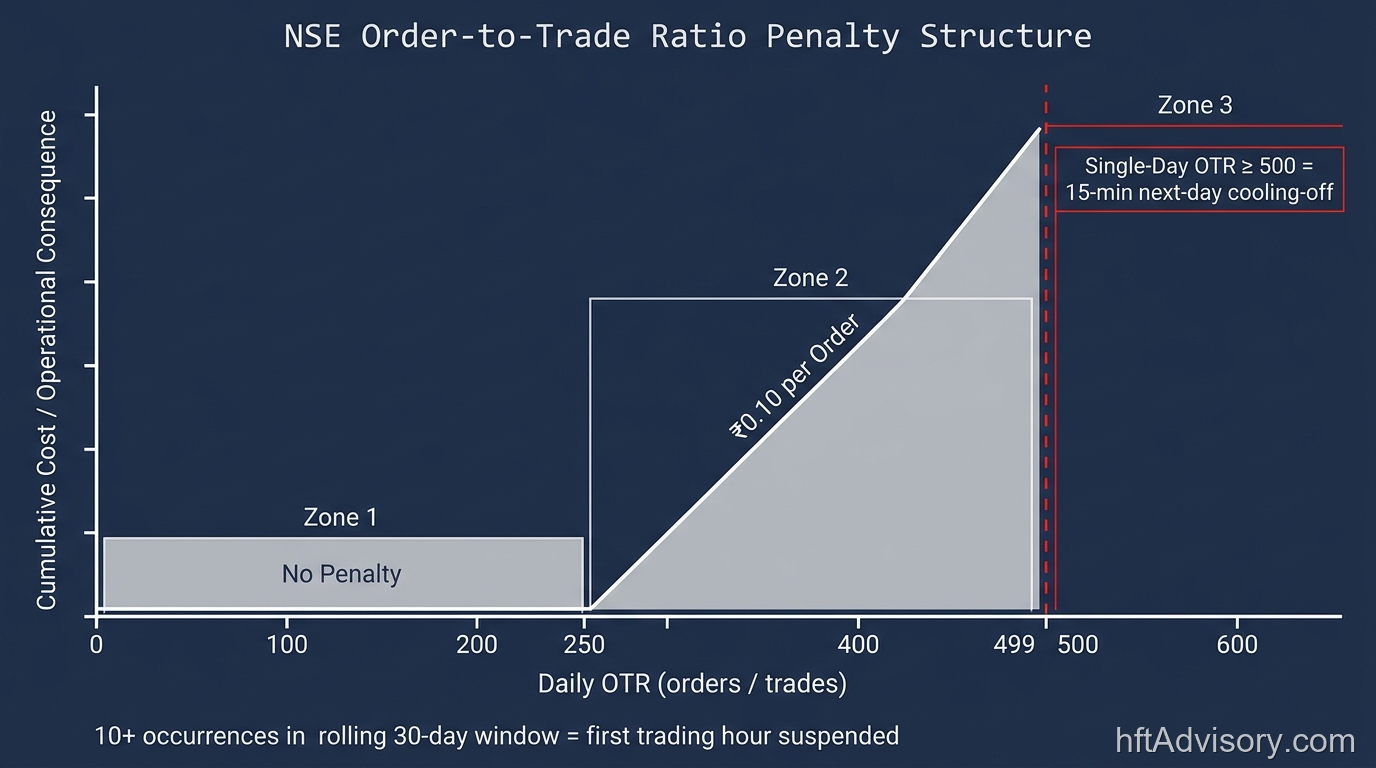
The current structure, verified against NSE circular SURV38122 (implementing SEBI 2018):
- At a daily OTR between 250 and 499: a penalty of ₹0.10 per order applies.
- At a daily OTR of 500 or above on a single trading day: a 15-minute cooling-off period applies on the next trading day.
- If the OTR exceeds 500 on more than 10 occasions in a rolling 30-trading-day window: the first trading hour of proprietary activity is suspended.
The February 2026 SEBI revision (effective April 6, 2026) modified the framework in two specific ways: it exempts Designated Market Makers from OTR computation, and it widens the equity options exemption band to ±40% of last traded price or ±₹20, whichever is wider. The ₹0.10/order penalty and the 250/500 thresholds remain operative for non-MM algo activity in the cash segment.
The US analogue is CME Rule 575, adopted September 2014, which prohibits orders not intended for bona fide transactions. The regulatory objective is the same in both cases: OTR-penalty frameworks are designed to make cancel-heavy quoting strategies explicitly unprofitable rather than merely discouraged.
The architectural point is direct. US-style cancel-heavy quoting strategies (strategies that generate high order volume relative to fills, designed to probe queue position or manage adverse selection through cancellation) become a fee in OTR-penalty markets. The ₹0.10/order penalty accrues at 250 OTR regardless of intent. At 500 OTR, the operational consequence is a next-day trading restriction.
Before any cancel-heavy strategy is deployed in an OTR-penalty market, the architecture review must include a breakeven OTR model: at expected fill rates, what is the all-in OTR cost as a percentage of spread capture? In markets with thinner spreads and lower fill rates, this math frequently shows the strategy is negative expected value before alpha is even measured.
The team configuration implication: the OTR breakeven model is a pre-deployment architecture review, not a compliance function. Risk and engineering sit in this review together before code goes to prod.
Per-Component Latency Profiling Before Any Hardware Spend
The US HFT industry’s latency discipline evolved from end-to-end measurement (total round-trip time from market data receipt to order acknowledgement) to per-component measurement. The distinction is consequential.
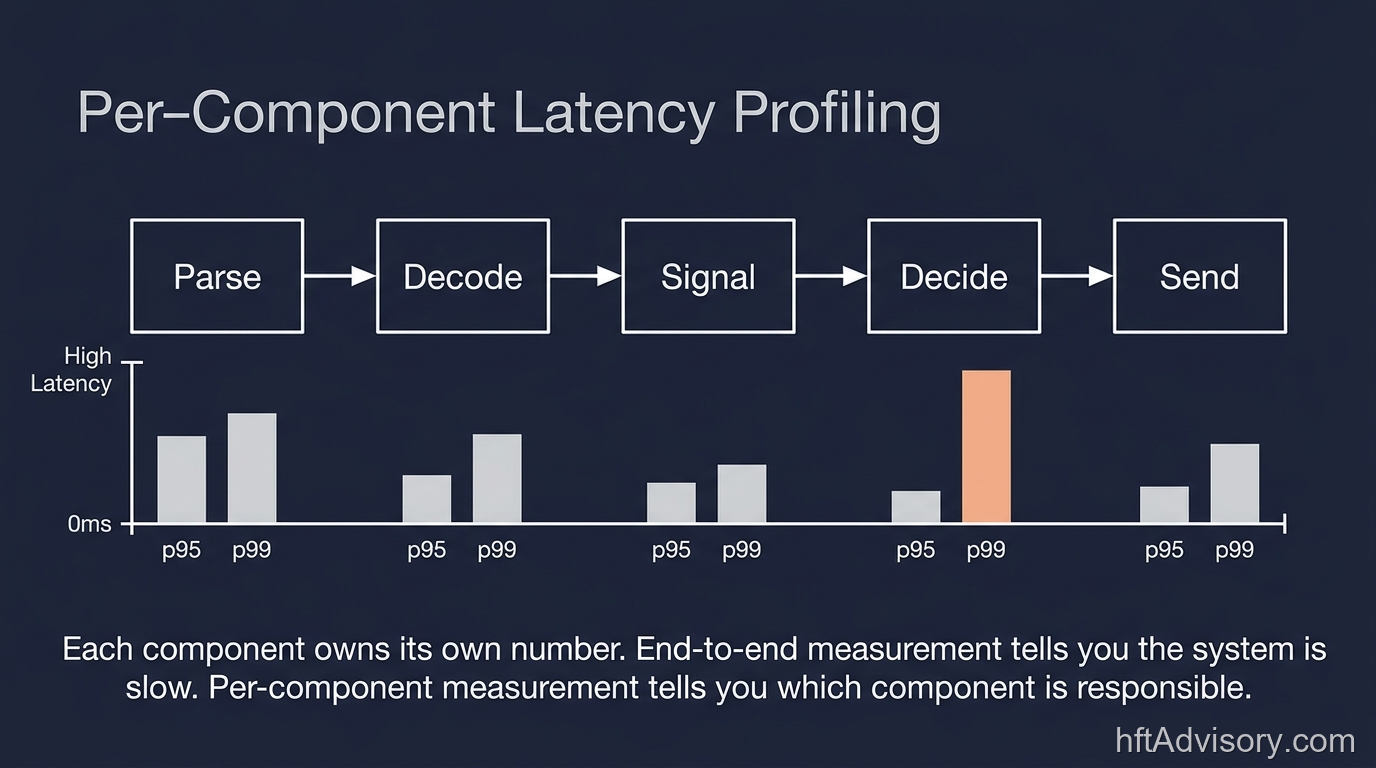
End-to-end latency measurement tells you that your system is slow. Per-component latency measurement tells you which component is responsible. The path through a modern electronic trading system has at minimum five distinct components: parsing the raw market data feed, decoding it into a normalized representation, generating a signal from the normalized data, running the decision logic against the signal, and transmitting the order to the exchange.
Each of these components has an independent latency profile. A system with a 50-microsecond end-to-end p99 may have that budget distributed as 5/8/15/12/10 microseconds or as 2/3/5/5/35 microseconds. Those two distributions have completely different remediation paths. The first distribution suggests the signal computation is the bottleneck. The second suggests the transmission path is. Spending capital on FPGA acceleration for the signal computation in the second case produces zero improvement. Profiling per component tells you where the spend applies before the spend is made.
Hasbrouck and Saar (2013) documents that increased low-latency trading is associated with reduced quoted and effective spreads, increased depth, and lower short-term volatility. The causal path runs through execution quality discipline, not hardware alone. Hardware is the delivery mechanism for a disciplined strategy; it does not substitute for the strategy.
The practical standard before any hardware or infrastructure investment: every component in the trading path must have a named p95 and p99 measurement from production instrumentation. If any component’s p95/p99 is unknown, it cannot be optimized. Profiling is not an engineering-phase activity. It is an ongoing operational requirement.
For markets in their algo-majority phase, NSE’s 4x throughput expansion is a scale event, not a complexity reduction. At 20 million orders per second, message storms become more frequent, not less. Desks that instrument per-component latency before the throughput expansion have a calibrated baseline. Desks that do not will be optimizing against an unknown degraded state during the expansion.
Single-Venue Markets Do Not Need US-Style SOR
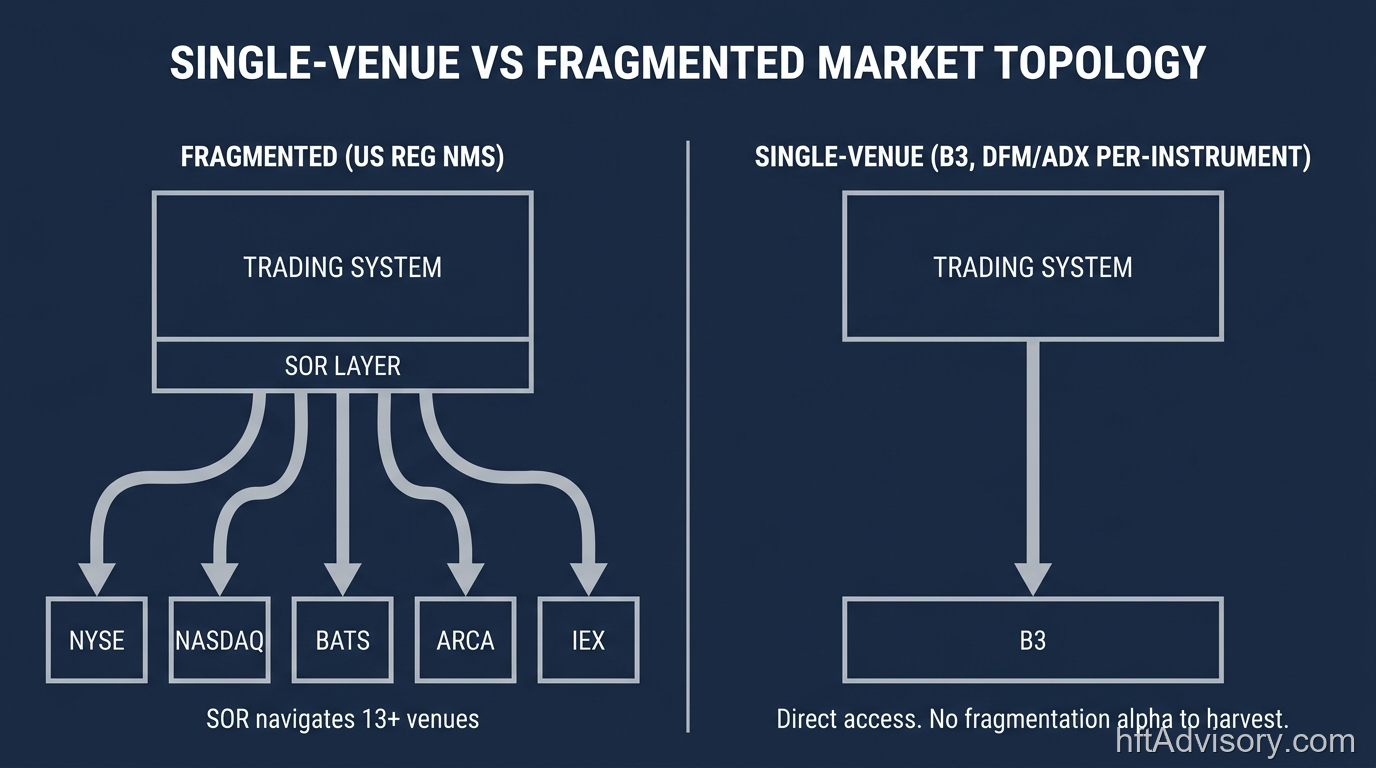
US smart order routing (SOR) was built to navigate a specific structural problem: Regulation NMS (2005) fragmented US equity order flow across 13+ active trading venues simultaneously. In the US, a marketable order for a listed equity may execute at any of those venues at a better price, and the broker has a best-execution obligation to route appropriately. SOR is the mechanism that satisfies that obligation while minimizing latency across the fragmentation.
The SOR logic is venue-specific. Route selection logic, venue order books, fill probability models, and rebate structures are all calibrated to the US fragmentation topology. None of that calibration is portable to a consolidated single-venue market.
Brazil (B3) is the cleanest example. Following the 2017 merger of BM&FBovespa and CETIP, B3 is the single consolidated exchange for Brazilian securities. A peer-reviewed study in the Journal of Financial Economics (2020) examining algorithmic trading around B3’s data center launch is specific to the consolidated venue structure. In a single-venue market, there is no fragmentation alpha to harvest. SOR adds order-routing latency and complexity with zero offsetting fragmentation benefit. Direct access to the single venue is always optimal.
UAE (DFM and ADX) requires a qualifier. For a given listed instrument in the UAE, the routing decision is structurally simple: Dubai Financial Market (DFM) lists Dubai-domiciled issuers, and Abu Dhabi Securities Exchange (ADX) lists Abu Dhabi-domiciled issuers. They do not compete for the same listings. For any single listed instrument, there is one venue and one order book. US-style cross-venue SOR logic that routes a single order across multiple order books has no application within a single instrument’s order flow. Nasdaq Dubai operates separately and lists a different instrument set. The structural point holds: for any individual instrument, the routing decision is binary, not multi-venue.
The contrast with NSE is important to state explicitly. India has both NSE and BSE with extensive dual-listing across many instruments. NSE is not a single-venue market. The SOR versus direct-access decision in India requires per-instrument routing analysis, not a blanket single-venue assumption. This section’s single-venue argument does not apply to NSE.
The architectural decision for B3 and DFM/ADX instruments: direct venue access with no SOR layer. Every millisecond of routing logic is a latency cost with no fragmentation alpha to pay for it.
The Practical Framework: Five Diagnostic Questions
Before advising a desk entering any growing market, I start with five questions. These are not screening questions. They are the diagnostic that tells me where the architecture work begins.
1. Can you decompose every fill by component (effective spread, realized spread, and price impact) in real time?
If the answer is no, adverse selection is not instrumented. The leakage is present; it is simply invisible. The 90-day target for a desk that installs this instrumentation: attribute where your market-making P&L is going at the counterparty level before the quarter closes.
2. Before any latency-stack spend, can you name parse p99, decode p99, signal p99, decide p99, and send p99 separately?
If any of these numbers is unknown, the hardware investment thesis has no diagnostic basis. Spend against an unknown component profile will be allocated to the wrong bottleneck. Profile first, spend second.
3. Before any cancel-heavy quoting strategy, have you modeled the OTR fee at expected order-to-trade ratios?
In OTR-penalty markets, compute the breakeven OTR where the penalty eats the spread capture. If the model shows negative expected value at target OTR levels before alpha is measured, the strategy architecture must change before deployment.
4. Before any SOR build, count your routable venues for the instruments you trade.
If the answer is one venue per instrument, your fragmentation alpha is zero. Direct access is the architecture. SOR adds latency with no offsetting benefit.
5. Within 90 days of go-live, can you attribute today’s P&L by driver (signal versus adverse selection versus queue position versus latency cost) in real time?
If P&L attribution is a post-hoc quarterly exercise rather than a live dashboard, strategy decisions are being made against lagged data. Adverse selection compounds in the direction of the informed flow while the attribution report is being prepared.
These five questions are a filter. Desks that can answer all five have the instrumentation layer in place. Desks that cannot answer one or more of them are operating at the US market’s 2004 level of discipline in a 2026 market structure.
Conclusion
The US markets spent 20 years building execution discipline through a combination of regulatory pressure, competitive selection, and expensive failures. That arc is now documented in peer-reviewed literature, codified in regulatory frameworks, and visible in the market structure data. Growing markets at their algo-majority inflection point have the opportunity to compress that arc.
The four disciplines that transfer cleanly are adverse selection instrumentation at the fill level, per-component latency profiling before hardware decisions, OTR cost modeling before strategy deployment, and direct venue access in consolidated markets. The two patterns to leave behind are US-style SOR in single-venue instrument markets and cancel-heavy quoting strategies in OTR-penalty regulatory regimes.
There is one thing I have not closed the loop on in my advisory practice: the rate at which adverse selection compounds differently across instruments with varying levels of market maker concentration. In deep, highly competitive US equity books, multiple informed flow signals compete and partially cancel. In thinner growing-market books with fewer active market makers, the adverse selection signature may concentrate faster and with less noise. The 20% to 45% range cited in the body comes from a small advisory sample and is too heterogeneous to publish as a calibrated benchmark. If your desk has run the fill-level decomposition across instruments with materially different market maker concentration and measured the compounding differential, that comparison is the data point worth bringing into your next architecture review.
This article was originally shared as a LinkedIn post. View the original post
Never Miss an Update
Get notified when we publish new analysis on HFT, market microstructure, and electronic trading infrastructure. No spam.
Subscribe by EmailAriel Silahian is a senior technology executive in institutional electronic trading, with 30+ years across the buy and sell side (New York, Miami, London, Hong Kong). He is the author of "C++ High Performance for Financial Systems" (Packt) and the creator of VisualHFT, the open-source microstructure analytics stack. He writes on exchange architecture, market microstructure, and execution quality, and advises a select number of trading firms on infrastructure decisions that move P&L. Book a strategy call at hftAdvisory.com

Regulation has always been a great driver of innovation. I’ve authored several patents, and some of the best come from inventing ways around problematic regulation.