
Crypto Fund Execution Infrastructure: The Real Cost Stack at $50M AUM Before Your First OMS Contract
Table of Contents
- The Problem Most CTOs Frame Wrong
- The Real Cost Stack Before Your First OMS Contract
- Fee Tiers Are a Hidden Tax on Manual Operations
- Where Alpha Leaks Without a Reconciliation System
- TCA Data: What Algorithmic Execution Actually Costs vs. Manual
- Build vs. Buy Decision Framework at $50M AUM
- Crypto Execution Infrastructure Readiness Checklist
- Conclusion
The Problem Most CTOs Frame Wrong
A $50M AUM crypto fund walks into an OMS evaluation. The procurement team compiles vendor quotes. The spreadsheet has a line item for custody, a line item for market data, and a large, anxiety-producing line item for the OMS. The internal debate circles around that OMS number.
This is the wrong frame.
When I advise funds at this scale on execution architecture, the first question is not “which OMS?” It is “what is your fully-loaded infrastructure cost before the OMS shows up?” The answer, for most $50M AUM crypto funds operating across three or more exchanges, sits at approximately $119,000 per year. And that number exists regardless of which OMS you select, or whether you select one at all.
The OMS line item in the procurement spreadsheet is real. The enterprise-oriented platforms in this space carry price points that are, in the practitioner consensus, calibrated for funds well above $50M AUM. FalconX operates a prime brokerage model where trading-cost economics are baked into the spread, not into a subscription fee. Hummingbot is open-source under Apache 2.0, meaning zero licensing cost, though commercial support tiers are not publicly priced. None of this changes the $119K annual baseline that runs underneath every configuration.
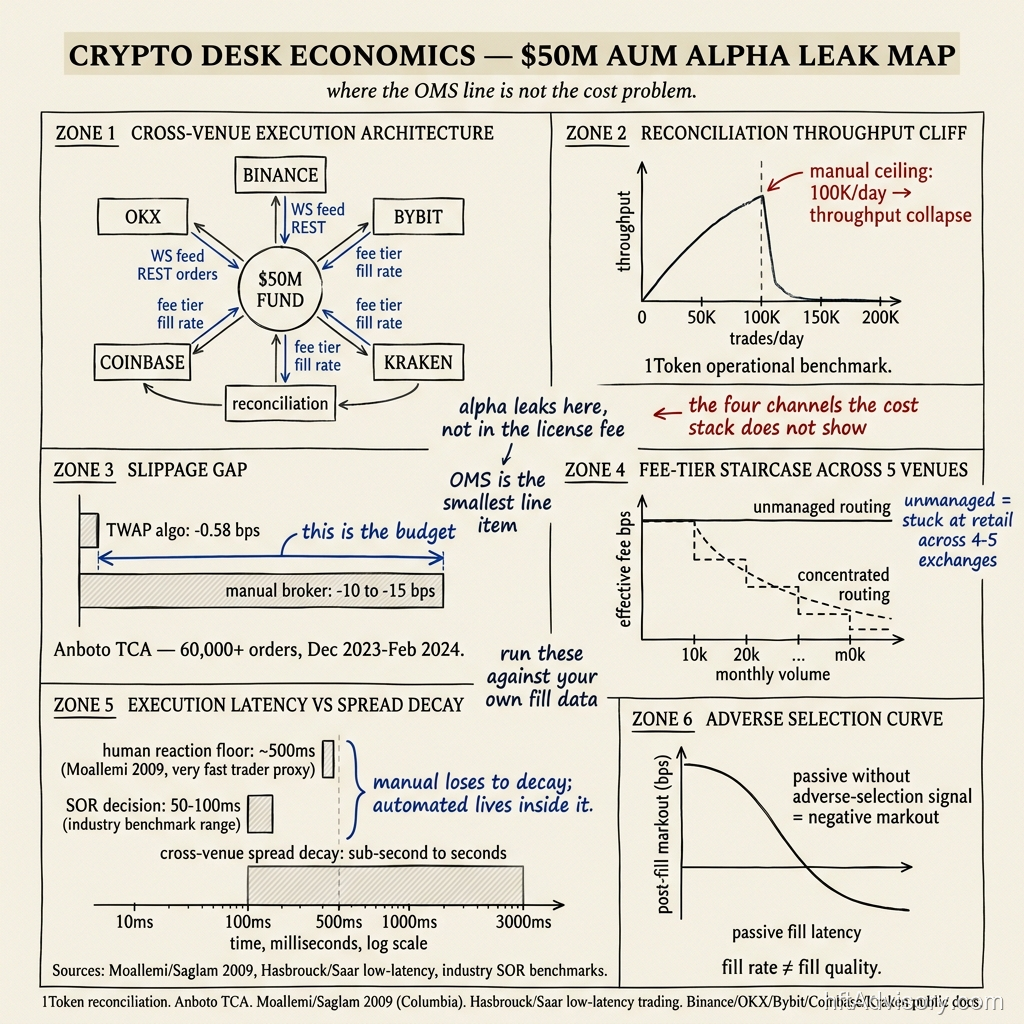
The more expensive problem for a fund at this scale sits in three operational gaps the cost stack does not make visible: fee-tier fragmentation across venues, reconciliation lag that caps throughput, and the execution quality gap between manual and algorithmic order routing. Each is measurable. Each is avoidable. None appears in the OMS procurement comparison.
This article walks through the complete first-year economics, using verified infrastructure data, published exchange fee schedules, and two independent TCA studies. The goal is to give a CTO the cost framework they need before signing anything.
The Real Cost Stack Before Your First OMS Contract
Thank you for reading this post, don't forget to subscribe!
A practitioner-documented, three-region AWS trading infrastructure (Tokyo, Virginia, Singapore) gives a reliable reference point for the compute layer. Based on documented configuration, the monthly breakdown runs:
- Tokyo servers: $280/month
- Virginia servers: $245/month
- Singapore servers: $265/month
- Bandwidth: $150/month
- Monitoring: $200/month
- Developer time (approximately one-third FTE for ongoing maintenance): $5,000/month
Total: $6,140 per month, or $73,680 per year. Call it $74,000 rounded.
This is one practitioner-documented configuration. Your numbers will vary based on instance sizing, data volume, and team allocation. The structure, however, is representative: three-region redundancy plus ongoing developer maintenance is the floor for a fund that needs consistent execution across the Tokyo, New York, and Singapore trading sessions.
Layering in the other cost components:
Custody. Fireblocks institutional pricing starts at $18,000 per year for pro and enterprise plans. Vendr buyer-side data shows the median fund actually pays approximately $39,000 per year at contract, with a low end at roughly $10,826 for the most stripped-down configurations. For planning purposes, $18,000 per year is the floor; the realistic number for a $50M fund requiring institutional-grade multi-party computation custody is likely higher.
Market data. Tardis Professional covers perpetuals and spot via two separate subscriptions: Perpetuals at $900 per month and Spot at $1,350 per month. Combined: $2,250 per month, $27,000 per year. This is the verified list price for the professional tier as of the date of this writing.
Execution framework. Hummingbot is Apache 2.0 open-source. Licensing cost: $0. The cost here is developer time for integration and maintenance, which is already embedded in the infrastructure line above if you are running a single-team shop.
The annual cost stack, before any OMS contract:
| Component | Annual Cost |
|---|---|
| Custody (Fireblocks floor) | $18,000 |
| Market data (Tardis Professional) | $27,000 |
| Infrastructure (3-region AWS + developer) | $74,000 |
| Execution framework (Hummingbot) | $0 |
| Total before OMS | $119,000 |
This is the number your OMS evaluation needs to sit next to, not replace. The question is not “OMS vs. no OMS.” The question is “what does $119,000 per year in baseline infrastructure buy me in terms of execution quality, and where is the next dollar best spent?”
Fee Tiers Are a Hidden Tax on Manual Operations
Exchange fee schedules are tiered by monthly notional volume and, on some exchanges, by native token holdings. The taker fee at Binance VIP 0 is 0.100%. At Binance VIP 3, reached at $20 million or more in monthly notional plus 100 BNB held, the maker rate drops to 0.040% and the taker rate to 0.060%. That is a 4 basis point reduction on taker fees compared to VIP 0.
Bybit operates a parallel structure. Bybit VIP 0 derivatives pricing sits at 0.0200% maker and 0.0550% taker. At VIP 1 (requiring $1 million in spot volume, or $10 million in derivatives volume, or $100,000 in assets held), derivatives taker fees drop to 0.0400% and maker fees to 0.0180%.
The fee-tier problem at $50M AUM is not that the fund lacks the total notional to qualify for better rates. A $50M AUM fund running at reasonable leverage can generate meaningful monthly notional. The problem is venue fragmentation.
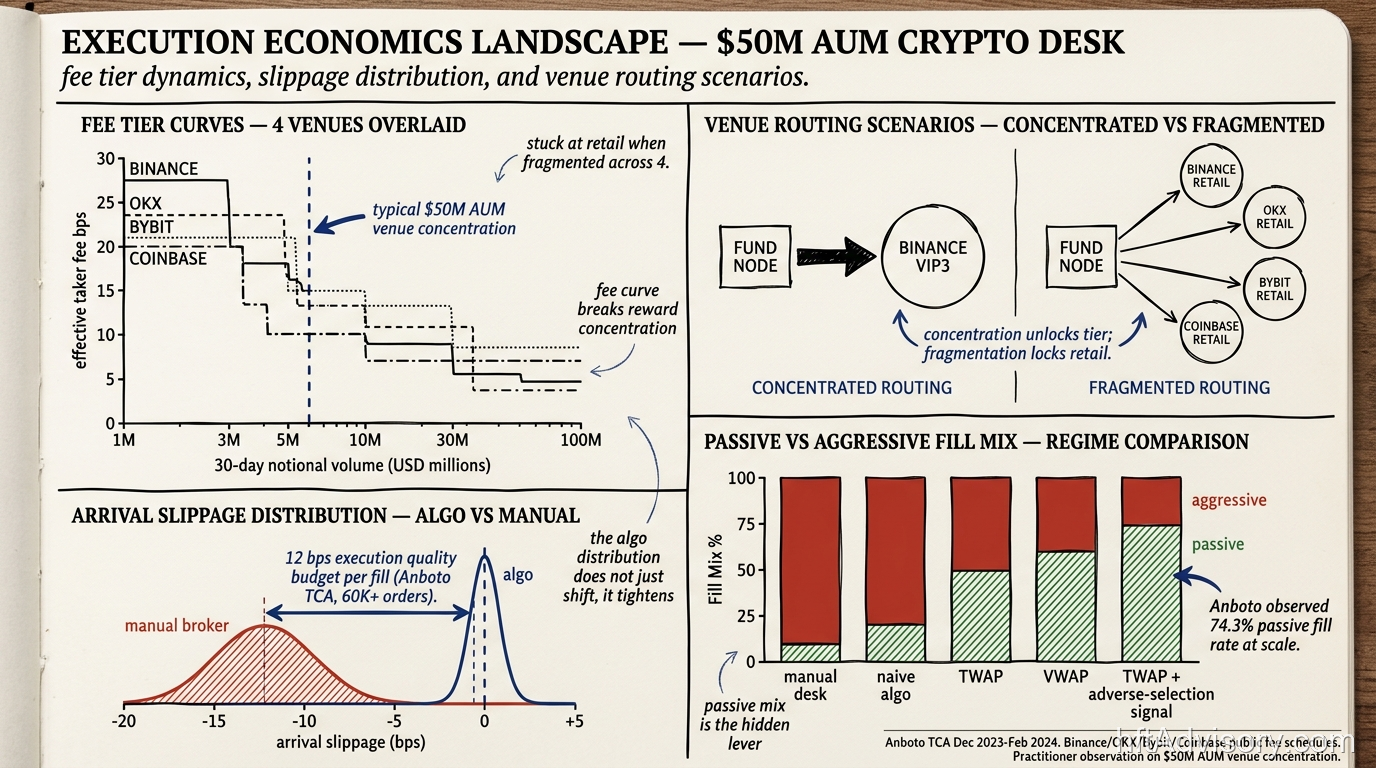
In my experience advising trading desks at this scale, the pattern I observe most frequently is four to five exchange relationships, each with its own fee schedule and tier reset. If that $50M in monthly notional is distributed across four exchanges, each venue sees a fraction of the total flow. The Binance relationship might sit at $12M per month: well above VIP 0 ($1M) but below VIP 2 ($5M). The Bybit relationship might sit below its VIP 1 derivatives threshold. The fund is paying retail-adjacent fees on institutional volume because the volume is diluted across venues that each calculate tiers independently.
The math on this is straightforward. If a desk moves $50M per month in notional across venues and achieves an average taker fill rate: the difference between Binance VIP 0 (0.100%) and VIP 3 (0.060%) on the taker side is 4 basis points. On $50M monthly notional, that is $20,000 per month, or $240,000 per year, sitting in the gap between where the desk currently sits and where consolidated volume would place it. This is a practitioner estimate on structure; your actual spread across venues and passive fill rate will determine the real number.
The fee-tier leak is invisible in most fund reporting because dashboards track total fees paid, not fee-tier delta. A reconciliation and execution system that surfaces the tier gap by venue is the prerequisite for addressing it.
For OKX and Coinbase fee specifics, consult each exchange’s live fee schedule directly; the figures shift with tier resets and promotional structures and were not live-verified in this analysis.
FIX connectivity compounds the venue consolidation problem. Binance launched native FIX API support in production in August 2024. OKX has no native FIX API: third-party bridging is required. Bybit similarly requires third-party bridge infrastructure for FIX connectivity. A fund managing cross-venue execution manually, without a routing layer, cannot rapidly consolidate flow to optimize tier positioning.
Where Alpha Leaks Without a Reconciliation System
Manual reconciliation across four to five exchanges is a throughput constraint that most funds at $50M AUM do not model as a cost. They should.
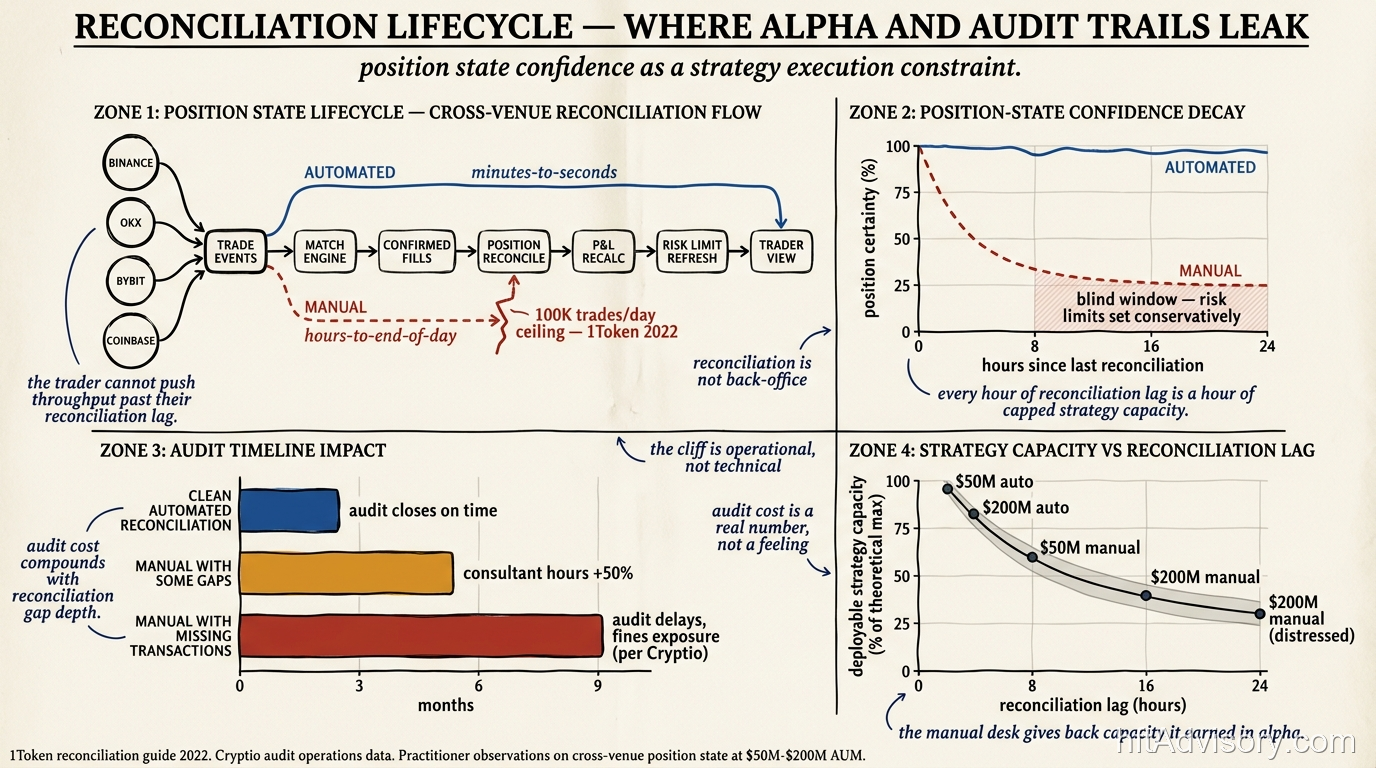
Cryptio, which operates reconciliation infrastructure for institutional crypto funds, has documented the operational impact directly: “Manual backtracking of missing or miscategorized transactions can add months to audit timelines, multiplying consulting hours, costs and internal effort.” The same source notes that incomplete reconciliation “leads to inaccurate financials, misleading dashboards, and flawed decision-making” and that “unexplained gaps or incorrect data can lead to delays in passing audits, fines, or worse.”
These are audit-risk and operational-risk observations. The alpha-leak framing is a separate layer on top.
When reconciliation is manual and lagged, the desk cannot produce intraday position state with confidence. A portfolio manager working from a lagged position view cannot push throughput aggressively without taking on unquantified inventory risk. The practical ceiling on position cycling frequency is set not by strategy conviction but by how far behind the reconciliation workflow has fallen.
As of 1Token’s 2022 operational guide, the manual reconciliation ceiling for fund administrators sits at approximately 100,000 trades per day: the point at which spreadsheet-based processes break. A $50M fund is unlikely to exceed that threshold today. The relevant risk is latency: how many hours after execution does the desk have a clean, matched, reconciled view of positions across all venues?
In my experience, desks that cannot answer “intraday” to that question are implicitly capacity-capped. The trader managing four exchange relationships manually does not have the cognitive overhead to exploit alpha windows that require position-state confidence within minutes of a fill. The reconciliation lag is a strategy execution constraint, not a back-office nuisance.
TCA Data: What Algorithmic Execution Actually Costs vs. Manual
Two published TCA studies give independent reference points for execution quality benchmarks in crypto markets.
Anboto Labs study (Dec 2023 to Feb 2024). Covering 60,000 or more parent orders across 300 or more pairs in futures markets, this study measured two distinct slippage metrics that are frequently conflated:
- Arrival slippage: the comparison of execution price versus the price at order arrival. Anboto’s algorithmic execution measured arrival slippage at -0.58 basis points. The TradFi broker benchmark equivalent sits at -10 to -15 basis points.
- TWAP slippage: the comparison of execution price versus a time-weighted average price benchmark. This is a separate metric, measured at -0.25 basis points by the same study, compared to a TradFi TWAP benchmark of -1 to -2 basis points.
The arrival slippage comparison is the most direct indicator of whether an execution system is taking liquidity efficiently or leaking alpha through poor fill timing. Anboto’s 74.3% passive fill rate across the study period is the structural driver of that improvement: passive fills typically capture 2 to 8 basis points of maker/taker fee spread versus taker fills, in addition to the price improvement from avoiding aggressive crossing.
Algo savings across the study ranged from 2 to 8 basis points per trade, with 50% or more of orders expected to save 4 or more basis points.
Talos TCA study. Covering 1,000 or more parent orders with $1 billion in notional under a TWAP strategy and an average 100-minute order duration, this study documented a 75% maker fill rate. The study identified three execution alpha predictors with the following correlation ranges:
- Volume R-squared: approximately 65 to 75%
- Spread R-squared: approximately 80%
- Volatility R-squared: approximately 25 to 35%
A key architectural observation from the Talos study: “Keeping a prediction fixed for 5 days can cut correlation with reality substantially versus recalibrating daily.” This applies directly to any desk using static execution schedules or fixed participation rates across changing market conditions.
The practical translation for a $50M fund. If a desk is executing $10M per day in notional (roughly $200 trading days per year gives $2 billion in annual notional), the difference between -0.58 bps and -10 bps on arrival slippage is 9.42 bps. On $2 billion in annual notional, that gap is approximately $1.88 million per year in execution quality. This is practitioner-estimated math using verified study benchmarks applied to a hypothetical $10M/day desk. Your actual notional volume and passive fill rate will determine the real number for your operation.
The execution quality gap is measurable, with a dollar figure attached that dwarfs the $119,000 annual infrastructure baseline.
Build vs. Buy Decision Framework at $50M AUM
The build-vs-buy question at $50M AUM has a first-year number that most fund managers have not seen written down in one place.
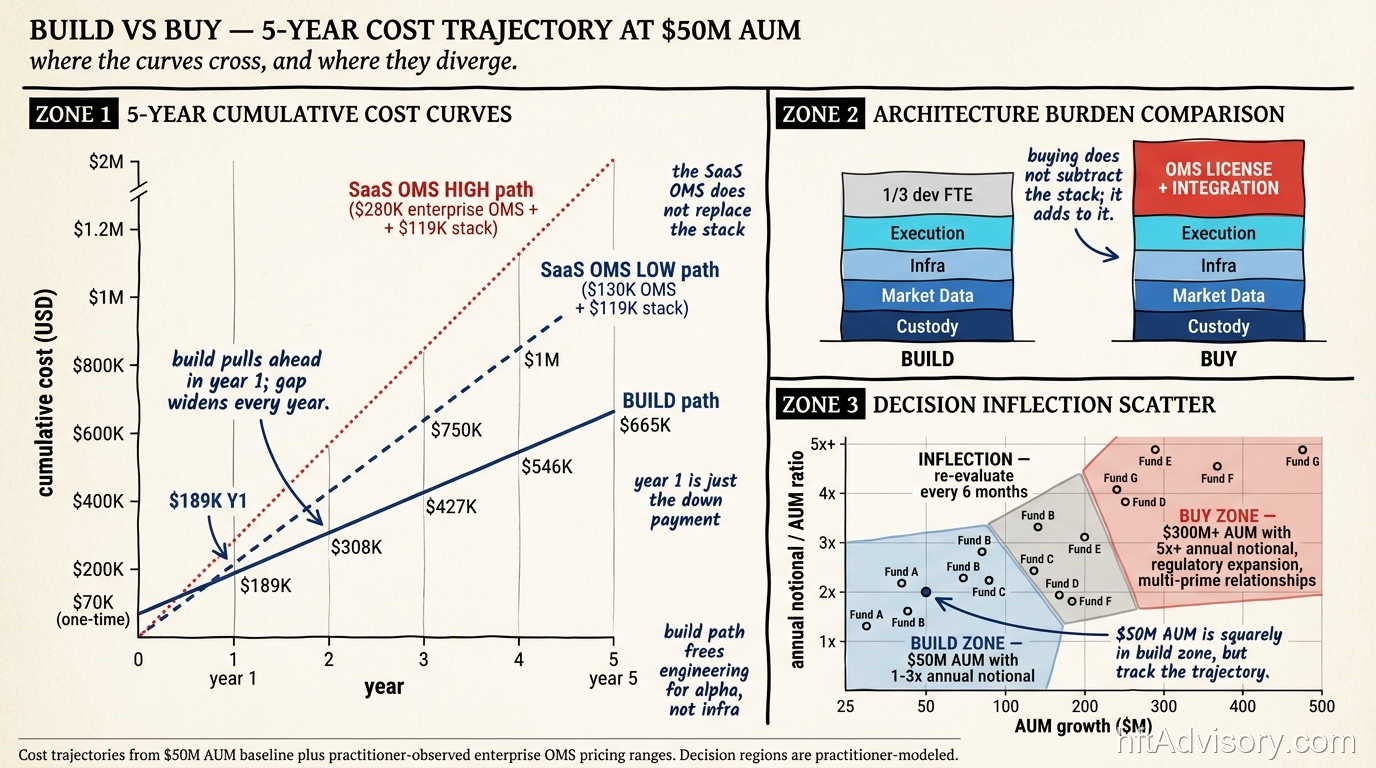
Build option: a practitioner-documented one-time setup cost for three-region AWS trading infrastructure runs approximately $70,000. Add the $119,000 annual run rate documented above and the first-year total cost is approximately $189,000. From year two onward, the infrastructure cost stabilizes at $119,000 per year, assuming team and coverage remain constant.
Buy option (SaaS OMS): the $119,000 annual infrastructure baseline does not disappear with an OMS purchase. The OMS sits on top of custody, market data, and compute. Enterprise-oriented platforms in this space carry entry points calibrated, in the practitioner consensus, for funds well above $50M AUM. What a SaaS OMS eliminates is the build-time investment and ongoing maintenance engineering overhead. What it does not eliminate is the underlying infrastructure cost.
Three questions structure the decision:
1. What is your team’s engineering capacity for maintenance? The build path at $119,000 per year includes approximately one-third FTE of developer time for infrastructure maintenance — already embedded in the $5,000/month line item. If that developer is already allocated, the build path incremental cost is the $70,000 setup. If that developer does not exist yet, the true annual cost is higher: a fully-loaded engineer at this level runs $130,000-$160,000/year in the US market, which restructures the build-vs-buy math significantly.
2. What is your fee-tier optimization strategy? The gap between fragmented-venue retail-tier fees and consolidated-volume institutional-tier fees can represent hundreds of thousands of dollars per year on $50M AUM notional. A build path gives full programmatic control over venue routing. A SaaS OMS gives the routing control the vendor has built, at the cost of vendor dependency.
3. What is your execution quality baseline? If the desk is currently executing manually and the TCA data is approximately right, the arrival slippage gap (versus algorithmic execution) translates to a recoverable dollar figure per year of notional. If that figure exceeds the cost of either build or buy, the execution infrastructure investment has a clear ROI basis.
For funds where the enterprise OMS entry point exceeds the annual build cost by more than the execution quality gap, the build path at $50M AUM is the more defensible economic choice. That arithmetic changes as AUM grows. Above $100M AUM, the cost structure warps: compliance overhead increases, custody complexity scales with counterparty relationships, and the case for an enterprise OMS grows stronger as the engineering-maintenance tax competes with strategy alpha time. The $119K baseline is the right lens at $50M. At $200M+, run the same framework with updated line items against current vendor quotes.
Crypto Execution Infrastructure Readiness Checklist
This checklist is designed as a save-worthy working tool. Run it before signing any execution infrastructure contract.
Baseline cost verification
- Have you documented your annual cost for custody, market data, compute, and execution framework separately? Total should be in the $100K to $150K range before any OMS line item at $50M AUM.
- Is your custody provider pricing based on current institutional plan terms, not a quote from more than six months ago?
- Is your market data cost line based on the specific data products you actually consume (perpetuals vs. spot vs. derivatives vs. historical vs. live), not a bundled estimate?
Fee-tier audit
- Do you know your current fee tier on each exchange relationship by name (e.g., Binance VIP 2, Bybit VIP 1)?
- What is your monthly notional per venue for the last three months? Is that volume above or below each venue’s next tier threshold?
- Have you calculated the annual dollar cost of the tier gap (current tier fee vs. next tier fee times annual notional on that venue)?
- Is your notional fragmented across venues in a way that prevents reaching institutional tiers on any single venue?
Reconciliation lag assessment
- What is the current latency between execution and confirmed, matched position state across all venues? (Answer in hours, not “end of day.”)
- Is your position reconciliation automated or manual? If manual: at what trade volume does the current process break?
- Do intraday risk limits depend on real-time position state, or are they set conservatively to compensate for reconciliation lag?
Execution quality baseline
- Do you have a current arrival slippage measurement per venue per strategy? If not, what is the cost of not having it?
- What is your passive fill rate by venue over the last 90 days?
- Have you compared your execution quality benchmarks against independent TCA study data (arrival slippage, TWAP slippage, passive fill rate)?
Build vs. buy decision inputs
- What is your one-time build cost estimate for your required infrastructure configuration?
- What is your first-year total cost under build (one-time setup plus annual run rate)?
- What is the OMS vendor’s entry price for a fund at your AUM? Does that include the underlying infrastructure cost, or is it additive?
- Does your engineering team have the capacity to maintain a build-path infrastructure without net-new headcount?
Conclusion
The $119,000 annual infrastructure baseline is where cost analysis begins. Every fund at $50M AUM is running this cost regardless of OMS decision. The question is what execution quality that baseline is purchasing.
A falsifiable test: take your last 90 days of fills across all venues. Compute arrival slippage by venue and by strategy. Compare against the Anboto -0.58 bps arrival slippage benchmark. If your number is in the -5 to -15 bps range, the arithmetic on algorithmic execution infrastructure improvement has a floor and a ceiling you can defend to your investment committee. If your number is already below -2 bps, the execution quality gap is not where your next infrastructure dollar goes.
That calculation, run against your actual fill data, gives you the build-vs-buy decision input that no procurement spreadsheet can provide.
Originally shared as a LinkedIn post.
About the author: Ariel Silahian has 20 or more years of experience in HFT and institutional trading systems architecture. He advises electronic trading funds and venues on execution infrastructure, order management architecture, and cost-per-fill optimization.
Never Miss an Update
Get notified when we publish new analysis on HFT, market microstructure, and electronic trading infrastructure. No spam.
Subscribe by EmailAriel Silahian is a senior technology executive in institutional electronic trading, with 30+ years across the buy and sell side (New York, Miami, London, Hong Kong). He is the author of "C++ High Performance for Financial Systems" (Packt) and the creator of VisualHFT, the open-source microstructure analytics stack. He writes on exchange architecture, market microstructure, and execution quality, and advises a select number of trading firms on infrastructure decisions that move P&L. Book a strategy call at hftAdvisory.com