
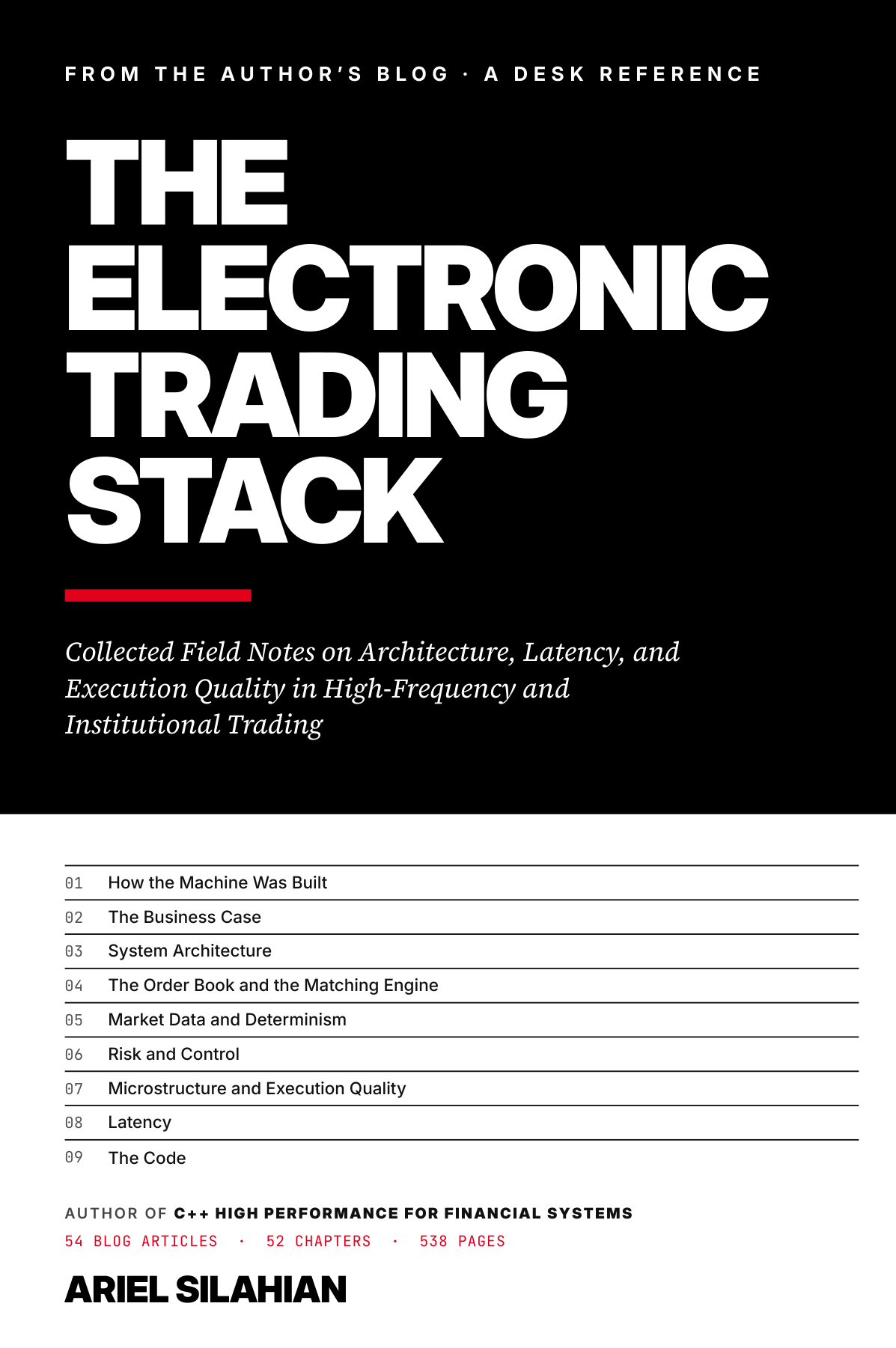
Collected Field Notes on Architecture, Latency, and Execution Quality in High-Frequency and Institutional Trading
Between 2021 and 2026 I published articles about electronic trading systems on my blog, Electronic Trading Hub. The Electronic Trading Stack collects 54 of them in one book, indexed, in nine parts and 52 chapters. The three-part system design series is one chapter, which is why 54 articles make 52 chapters.
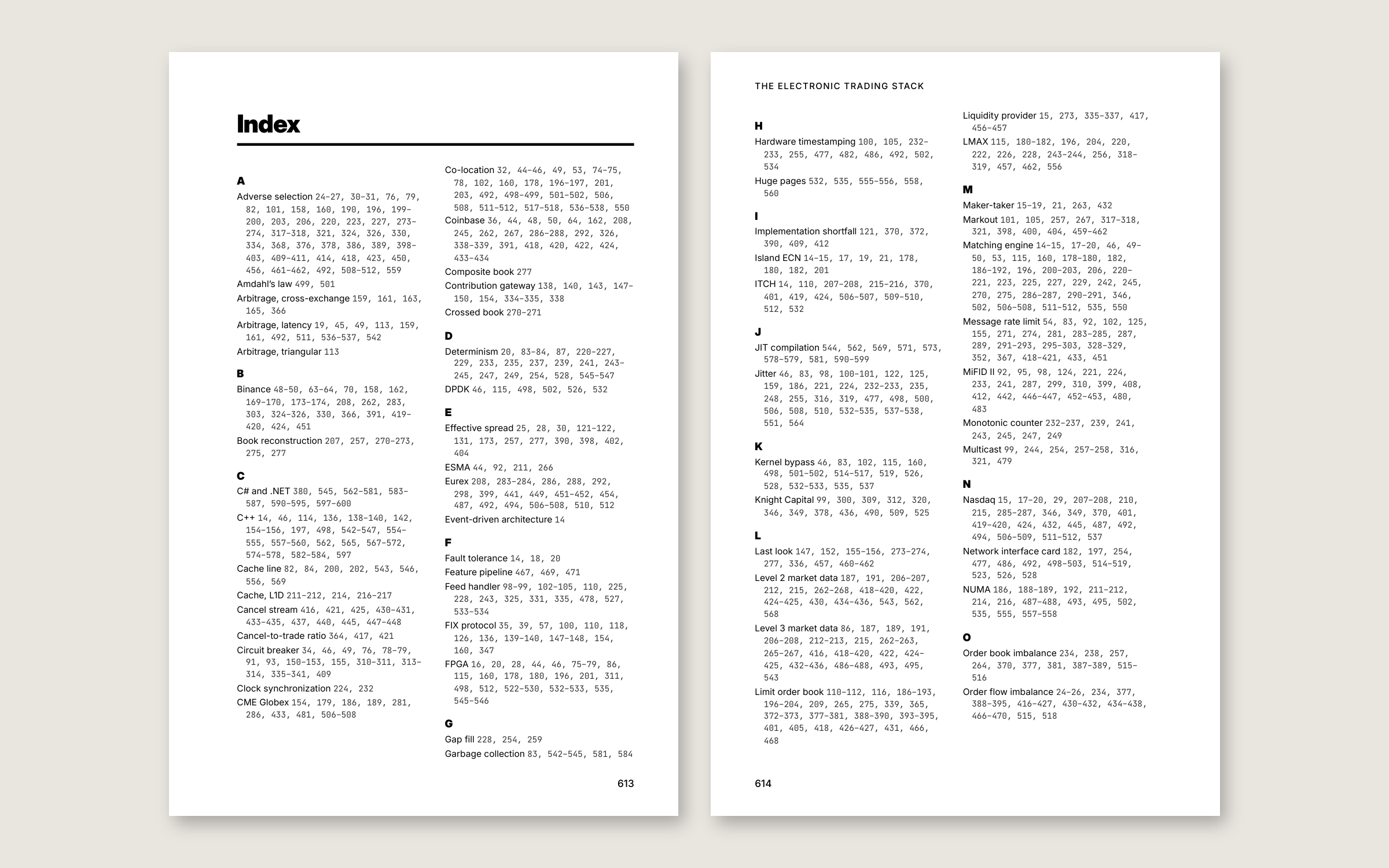
The book is the same material, edited for print. If you have read the blog, you have read this book. The printed book adds an order that runs from the top of the stack down to the code, an index you can search by hand, and paper.
Paperback: 6 x 9 in, 618 pages. Hardcover: 7 x 10 in, 538 pages, same text.
Read it free, or buy it printed
Every article in this book is already on the blog, free, in whatever order you happen to find it. I printed it for one kind of reader: someone who wants the same 54 articles in one order, indexed, in a form they can put on a desk and open without a screen. If that is not you, the blog is enough.
Some readers want a printed reference on the desk to reach for at any time. People also asked me for a printed version.
Open it where the problem is
Thank you for reading this post, don't forget to subscribe!
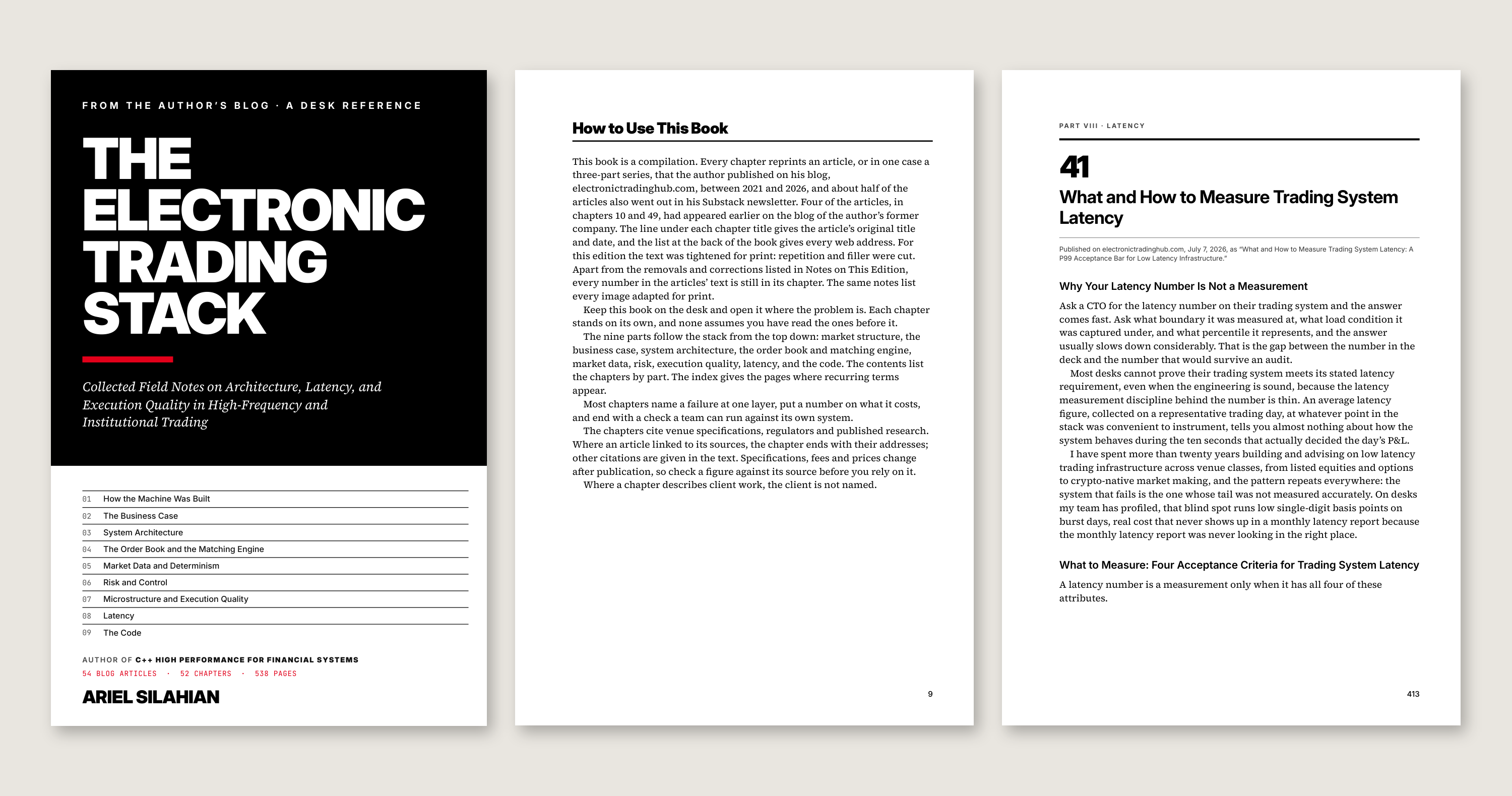
Each chapter stands on its own. Most chapters put a number on what the failure costs and end with a check a team can run.
What is inside
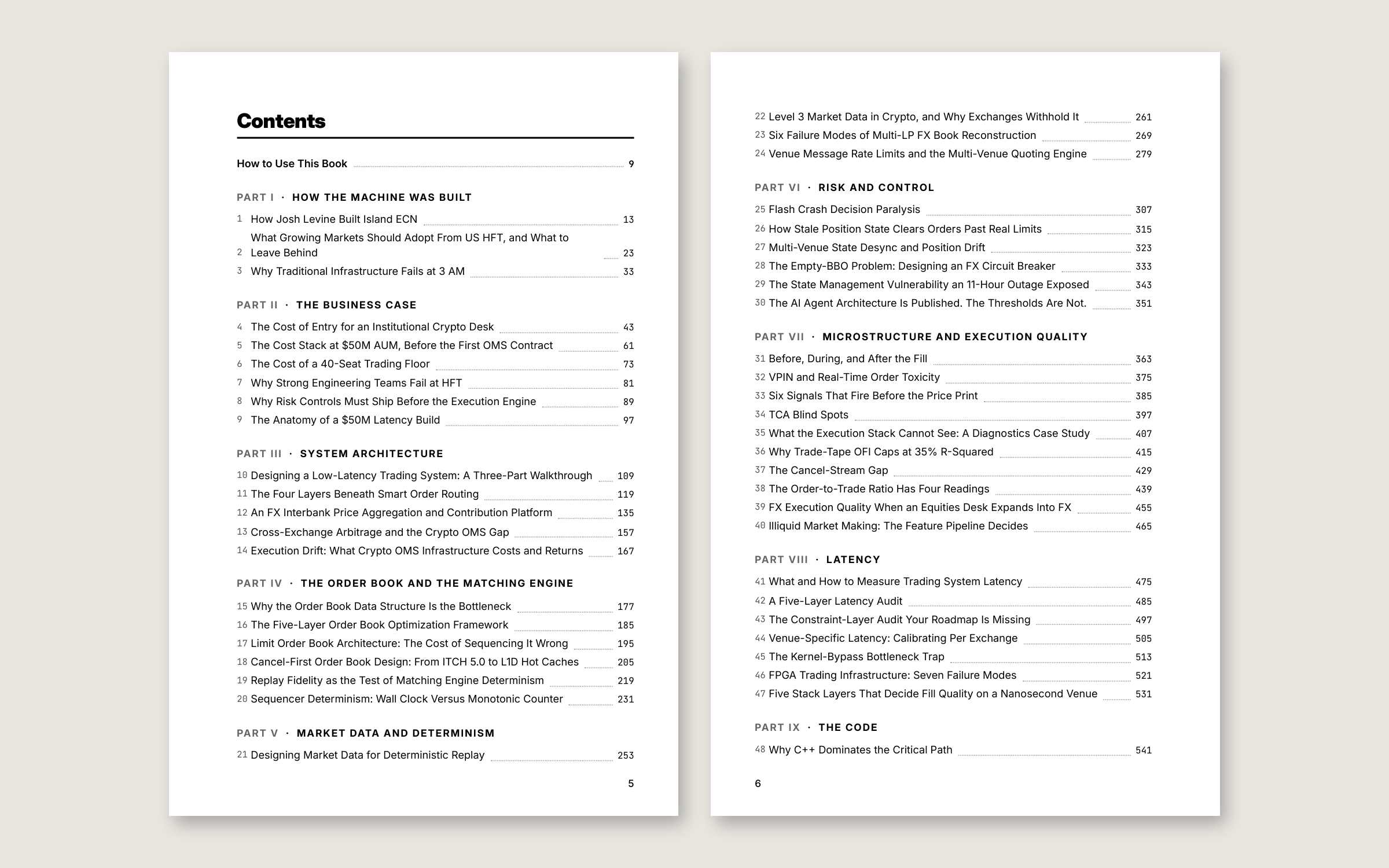
The nine parts run from market structure at the top of the stack to the language runtime at the bottom.
- How the Machine Was Built
- The Business Case
- System Architecture
- The Order Book and the Matching Engine
- Market Data and Determinism
- Risk and Control
- Microstructure and Execution Quality
- Latency
- The Code
About the author
Ariel Silahian has spent more than twenty years building matching engines, feed handlers, order management systems and risk gates for trading firms and exchanges across traditional finance, institutional FX and crypto. He is the author of C++ High Performance for Financial Systems.
Never Miss an Update
Get notified when we publish new analysis on HFT, market microstructure, and electronic trading infrastructure. No spam.
Subscribe by Email