
About this update. This article was first published in 2017 — the original Part II (2017) is still online for reference. The OMS, strategy, and design-pattern fundamentals described here remain valid in 2026. What has changed is the order-entry protocol layer, the shape of the latency-arbitrage window, and the modern reference implementation for lock-free queues. The original structure and voice are intact; inline notes flag what is new.
In the first part, I explained basic concepts of architecting a low latency trading system and some examples on how to implement a very fast order book.
In this second part, I will explain how to implement the next components and the key part: what pattern to use.
3. Order management system: OMS
This module will manage all orders sent to the venues, based on signals generated by your strategy. It will handling sending, canceling and replacing orders as well as accessing information about executed orders, including pending and open orders.
We must send these orders in a very efficient and cost-effective manner, routing each order, depending on one or more of the following:
- the signal strategy
- venue costs
- latencies between venues
- best prices available
- shares or contracts available on each venue
Also, needs to be smart enough to know when an order was:
- Rejected or canceled by the venue
- Partially filled
- Fully filled
Thank you for reading this post, don't forget to subscribe!
So, depending on the above statuses receive, your order management system may execute different paths.
2026 update — order entry protocol. The OMS session layer has shifted since 2017. CME iLink 2 was decommissioned on April 6, 2025. iLink 3 uses FIX Simple Binary Encoding (SBE) over the FIXP session layer, which means the encoding your OMS writes to the wire — the order, cancel, and replace messages — is now binary SBE, not tag-value FIX. The conceptual OMS responsibilities above are unchanged. The wire format that implements them is not.
4. Strategies
As the brain of our system, strategies will take limit order book from each venue and make defined decisions based on different parameter and values.
Some strategies will need to analyze the entire depth of books, others, just top of the book prices, that is the best bid and best ask.
Here, you can apply an almost infinite type of strategies and, of course making sure they will be profitable ideas.
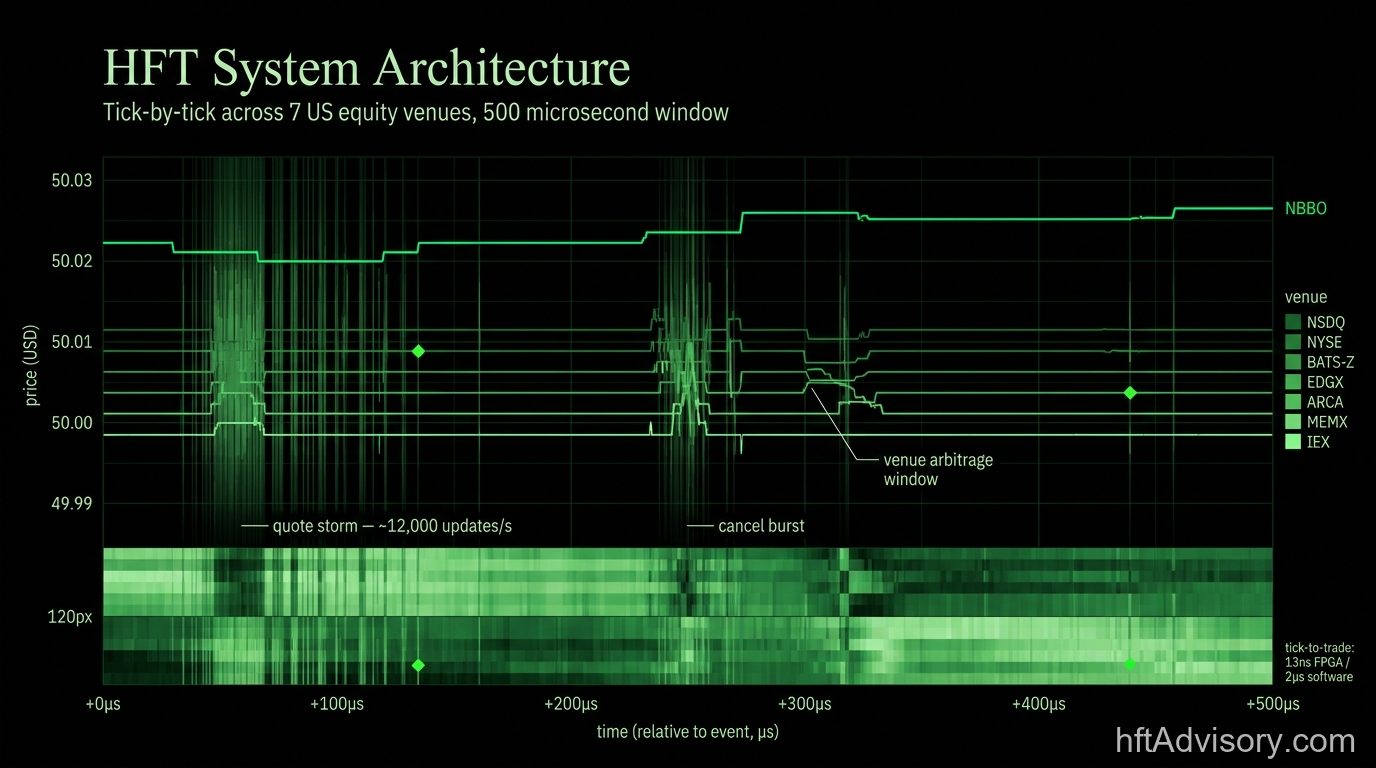
One could be a simple latency arbitrage strategy: each venue receives market information at different times, and if our system can be faster enough we can take advantage of that price gaps. Usually, these discrepancies last no more than 500 microseconds, and after that, all market participants try to balance themselves.
Here’s one example. A big institution is in the market to buy a big order of a given stock. It will have algorithms execute the trade slowly, trying to get the best price and it will take whatever’s available at, say, $4.50 per share, and then what’s available at $4.51, and so on. This is where the “latency arbitrage” may come in. Our strategy can see that this fund’s algorithm is in the market and essentially buy up all the available shares at $4.50 an instant before they do. Now the firm’s algorithm moves on and looks for shares at $4.51. Our algorithm sells all the stock it just bought at $4.50, earning a completely risk-free penny a share.
Sounds small, but if you do this several thousand times per day, we will be adding up to many millions of dollars per trading day, and several billion per year.
2026 update — the latency-arbitrage window has compressed. The 500-microsecond figure reflects the technology of the mid-2010s. Academic research published since then has measured the window more precisely. Aquilina, Budish, and O’Neill (Quarterly Journal of Economics, 2022) studied latency-arbitrage races at the London Stock Exchange and found the modal duration is now 5 to 10 microseconds at top-tier venues — a roughly two-order-of-magnitude compression from the 500-microsecond era. Their estimates place the global cost of latency arbitrage at on the order of $5 billion per year, accounting for approximately 20% of trading volume. The strategic logic in the paragraph above remains correct; the race is just much shorter now. If your system is not in the low-microsecond range at a co-located venue, the window closes before you arrive.
Another example could be the well-known ‘triangular arbitrage’ – this is an arbitrage where there are price discrepancies between 3 currency pairs. Forex is traded in pairs, i.e. EUR/USD EUR/GBP EUR/CHF. What can happen during a big market event, for example, a failed coup in Turkey as an extreme example, EUR/USD will move faster than it should have to keep in ratio with the rate of EUR/GBP. That can be just a market function, traders sell EUR/USD before EUR/GBP without algorithms. Or, large orders can cause the difference between EUR/USD and EUR/GBP to be off slightly. Even if only off by a fraction of a dollar, this can lead millions in profits if you are fast enough.
2026 note — the same arbitrage logic has migrated to crypto. The 2017 article described triangular arbitrage across FX pairs. Since 2023, the same structural dynamic has appeared at scale across centralized and decentralized crypto venues. Wu et al. (arXiv:2507.13023, 2025) measured $233.8 million extracted across 7,203,560 arbitrage events over 19 months on Ethereum alone (August 2023 to March 2025), with three dominant searchers capturing approximately three-quarters of the total volume. The mechanics are identical: price discrepancies between correlated assets, a race to close the gap. The infrastructure requirements — co-location, low-latency execution, high-frequency order flow — are structurally the same as what is described in this series.
5. Software Architecture: Patterns
The fun starts when we want to put all these pieces together, to interact concurrently and with the lowest latency possible between processes.
The basic architecture looks like this:
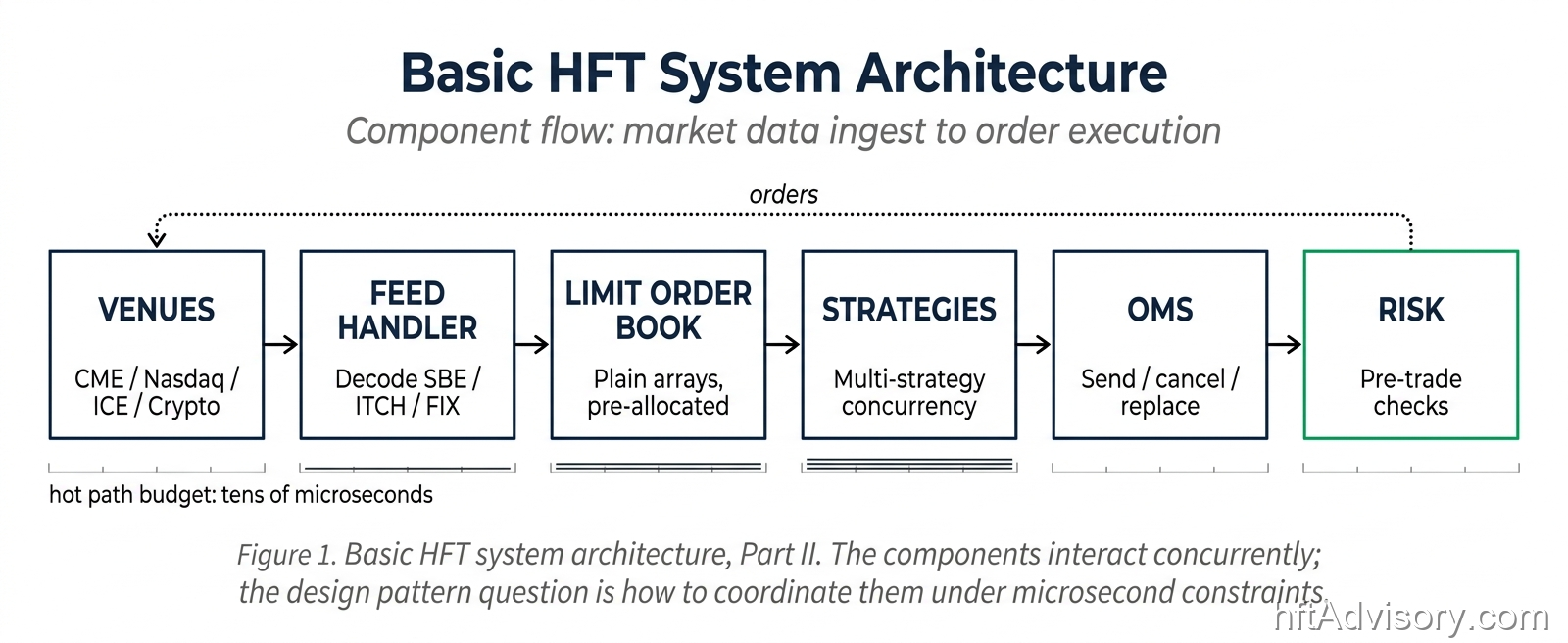
As we already know, concurrency is key, and to have it working properly we will need to use synchronization methods (to concurrently access data in memory) and a design architecture that fits our needs of low latency.
That’s why we need to talk about “software design patterns” and choose the best for our needs.
There are several well-known options we can use here:
Observer Design Pattern: this is a software design pattern in which an object, called the subject, maintains a list of its dependents, called observers, and notifies them automatically of any state changes.
This is fine, but if you have multiple strategies running on the same system, the notification process will be processed one by one. Meaning, the subject will first notify “strategy 1”, do its calculations, send orders if some criteria are meet, and then continue with “strategy 2”, again do the calculation and see if some criteria are met. This sounds like a sequential process!!
So, our order book module will be the subject, and the strategy our observer.
As I show below, the implementation using C++ will look something like this:
// Observer/Subject pattern — C++20
// Subject (OrderBook) notifies all registered Observers (Strategies).
// Serial: notifications fire one by one. This is the problem.

#include <algorithm>
#include <vector>

struct Observer {
    virtual void on_price_changed(double bid, double ask) = 0;
    virtual ~Observer() = default;
};

struct Subject {
    void attach(Observer* o) { observers_.push_back(o); }
    void detach(Observer* o) {
        observers_.erase(std::remove(observers_.begin(),
                                     observers_.end(), o),
                         observers_.end());
    }
protected:
    void notify(double bid, double ask) {
        for (auto* o : observers_) o->on_price_changed(bid, ask);
    }
private:
    std::vector<Observer*> observers_;
};

struct OrderBook : Subject {
    void update(double bid, double ask) {
        bid_ = bid; ask_ = ask;
        notify(bid_, ask_);   // fires strategies one by one — serial
    }
    double bid_{}, ask_{};
};

struct Strategy : Observer {
    void on_price_changed(double bid, double ask) override {
        // evaluate criteria, send orders if met
        // if this takes 2 ms, Strategy 2 waits 2 ms
    }
};
What I did here is setup an observer (the strategy) and the subject (the order book).
The order book will send notifications once any price has changed, so all the strategies can receive it and act on it. If the strategy meets its specific criteria, will trigger orders to the exchange. That process, of asserting if the criteria met, could be more or less complicated, hence could take more or less time.
As you can see, this is a serial process, and if for any reason “strategy 1” takes a couple of milliseconds to do some fancy calculations, then by the time “strategy 2” gets the notification is too late, and so on…. Until we get the notification for the last strategy, which is already making decisions on past information.
That’s the reason why we can’t use this design pattern at all.
Just in case you are thinking of throwing threads on each notification or doing it asynchronously, let me tell you that it will be even worst. The overhead will be such, that doing it sequentially it will be faster.
You can also find this code on my gist repository https://gist.github.com/silahian
Signal and Slots Pattern: used for communication between objects or processes. The underlying implementation is similar to the Observer Pattern, and its concept is that the observer can send signals containing event information which can be received by others using special functions known as slots. Similarly, in C++ callbacks (function pointers), but signal/slot system ensures the type-correctness of callback arguments.
Since this pattern also is derived from kind of observer pattern, I prefer not to use it either.
All types of event/messaging/signal patterns are kind of observer pattern, so is not suitable for my purposes of low latency.
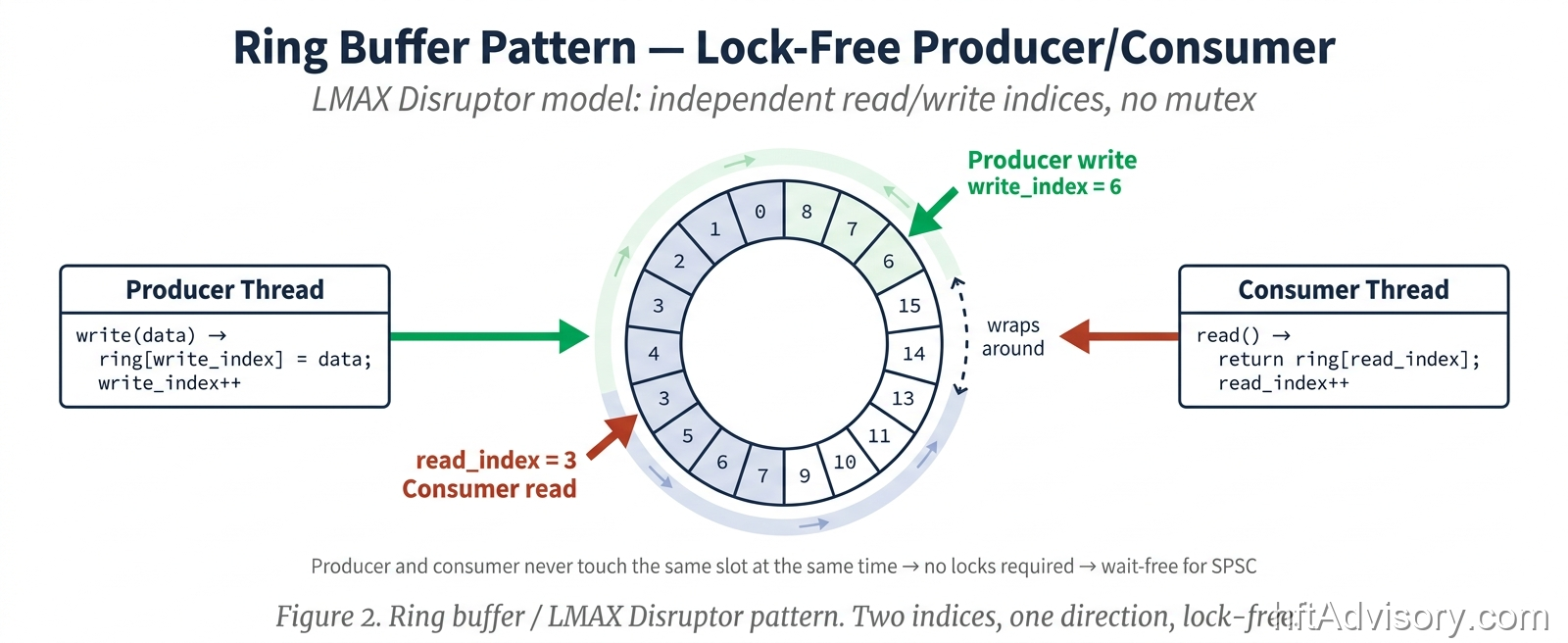
Ring buffer pattern: now, we are getting closer. This pattern’s very performance effective, and it is implemented in many low-level applications. The ring buffer is a circular queue data structure. It has a first-in-first-out (FIFO) characteristic. It also has two indices, indicating from where your process can read, and from where it can write. So, no collisions will be in place, which will be translated in no need to synchronization. This kind of structures are called “lock-free”, and its performance is beyond other patterns.
One big adopter of this pattern is LMAX with its disruptor. Below an image of their implementation using this pattern.
2026 update — the ring buffer reference implementations. LMAX Disruptor is still maintained — v4.0.0 was released September 29, 2024 (Java). For C++ production, the modern reference is Erik Rigtorp’s SPSCQueue: header-only, wait-free, single-producer/single-consumer. On an AMD Ryzen 9 3900X, SPSCQueue benchmarks at 362,723 ops/ms versus boost::lockfree::spsc at 209,877 ops/ms and folly::ProducerConsumerQueue at 148,818 ops/ms. Rigtorp also documented that caching the read and write indices locally (avoiding inter-thread cache-line ping-pong on every operation) lifts SPSC ring throughput from roughly 5.5 million to 112 million items per second on commodity hardware. The architectural advice from 2017 still stands — ring buffer / lock-free queue is the right shape. The C++ tooling has matured considerably.
// 2026 SPSC ring buffer — Rigtorp-style, cache-line aware
// Single producer, single consumer. Wait-free. No locks.
// Key discipline: cache the remote index locally to avoid
// cross-thread cache-line ping-pong on every operation.

#include <array>
#include <atomic>
#include <cstdint>
#include <new>   // std::hardware_destructive_interference_size

template<typename T, std::size_t N>
struct SPSCQueue {
    static_assert((N & (N - 1)) == 0, "N must be a power of two");

    alignas(std::hardware_destructive_interference_size)
        std::atomic<std::size_t> write_{0};
    alignas(std::hardware_destructive_interference_size)
        std::atomic<std::size_t> read_{0};
    std::array<T, N> buf_{};

    // Producer side
    bool push(const T& val) {
        const auto w = write_.load(std::memory_order_relaxed);
        const auto next = (w + 1) & (N - 1);
        if (next == read_.load(std::memory_order_acquire))
            return false;        // full
        buf_[w] = val;
        write_.store(next, std::memory_order_release);
        return true;
    }

    // Consumer side
    bool pop(T& val) {
        const auto r = read_.load(std::memory_order_relaxed);
        if (r == write_.load(std::memory_order_acquire))
            return false;        // empty
        val = buf_[r];
        read_.store((r + 1) & (N - 1), std::memory_order_release);
        return true;
    }
};
This kind of pattern is ideal for socket communications where serial data has to be managed, so, in this case, is not suitable either for our trading architecture.
In the next article, I will explain what I would choose as architecture in an ultra low latency system like we intend to build
To be continued …
This is the 2026 update to the original 2017 article — same structure, same voice, same examples. Inline notes mark what has changed.
Never Miss an Update
Get notified when we publish new analysis on HFT, market microstructure, and electronic trading infrastructure. No spam.
Subscribe by EmailAriel Silahian is a senior technology executive in institutional electronic trading, with 30+ years across the buy and sell side (New York, Miami, London, Hong Kong). He is the author of "C++ High Performance for Financial Systems" (Packt) and the creator of VisualHFT, the open-source microstructure analytics stack. He writes on exchange architecture, market microstructure, and execution quality, and advises a select number of trading firms on infrastructure decisions that move P&L. Book a strategy call at Turnkey Trading Systems (HFT Advisory)