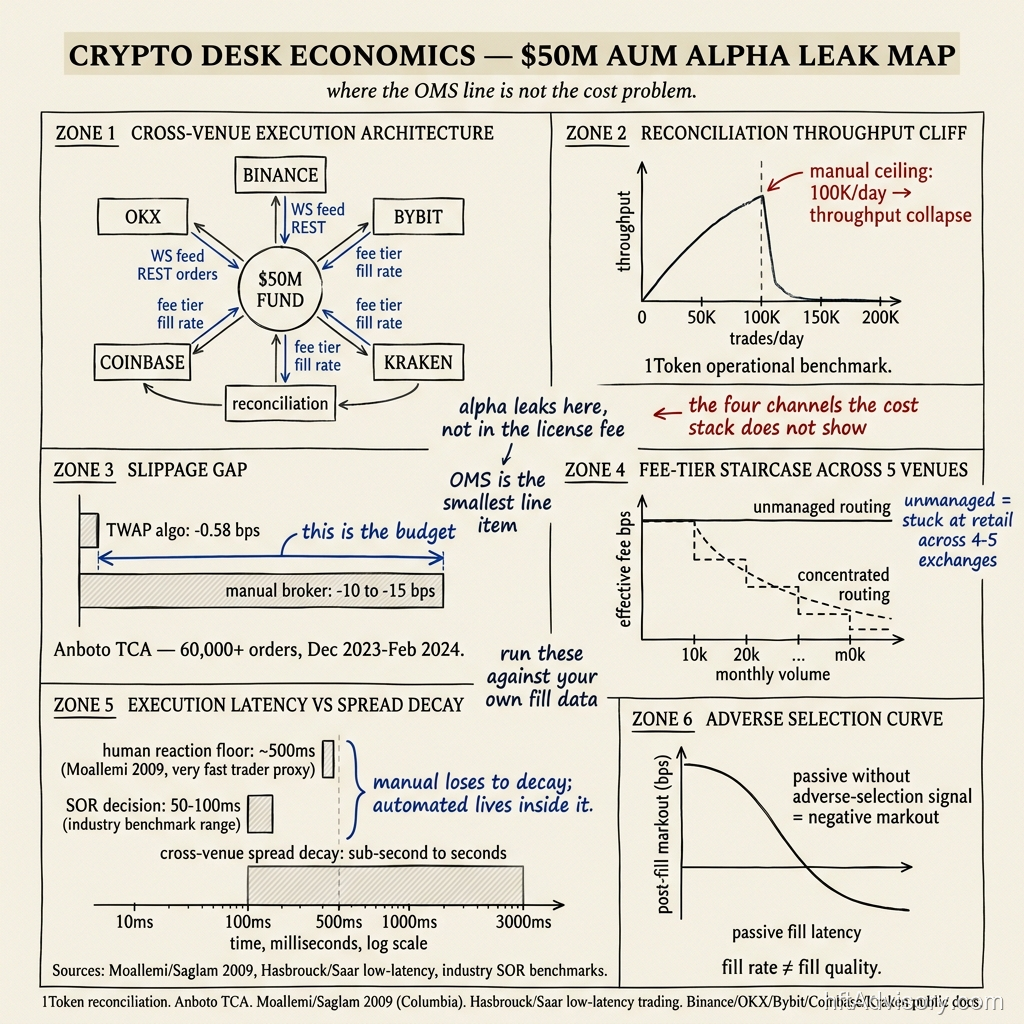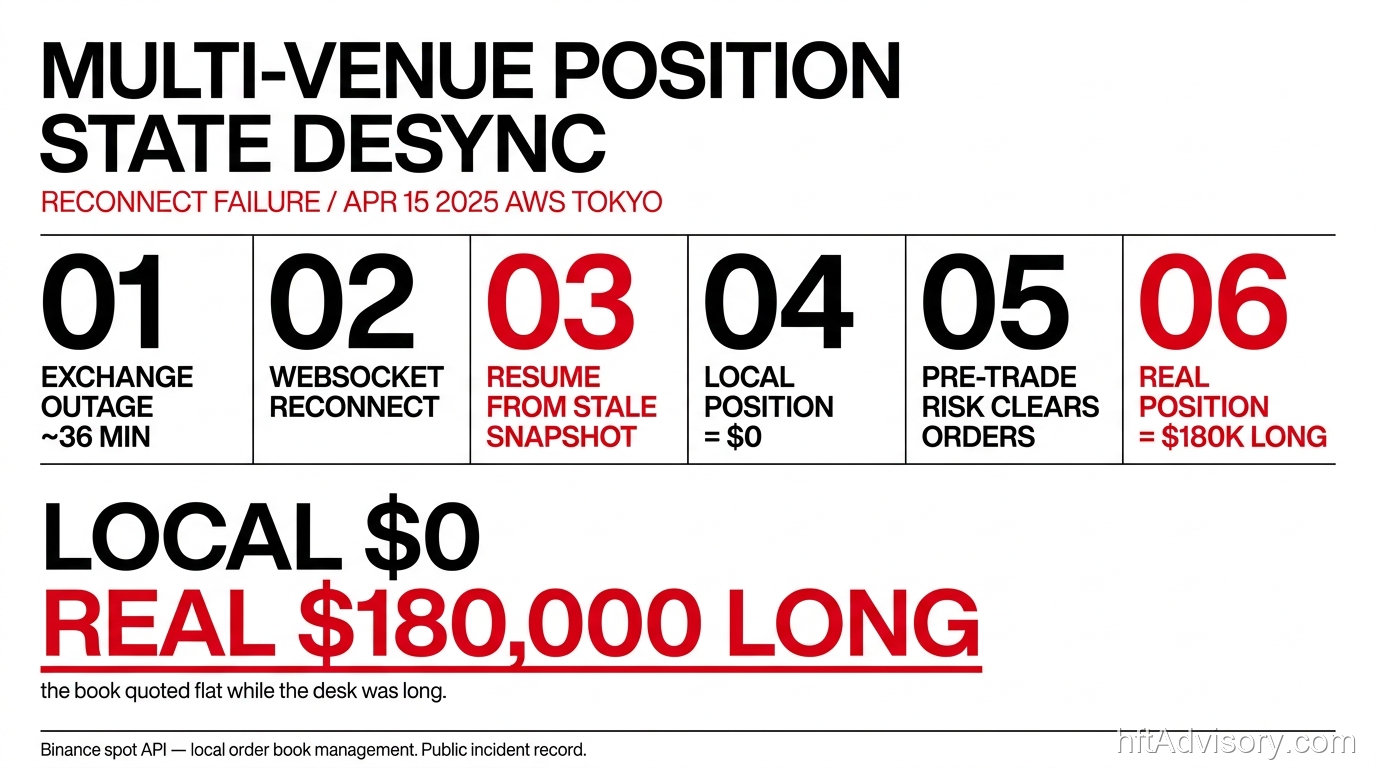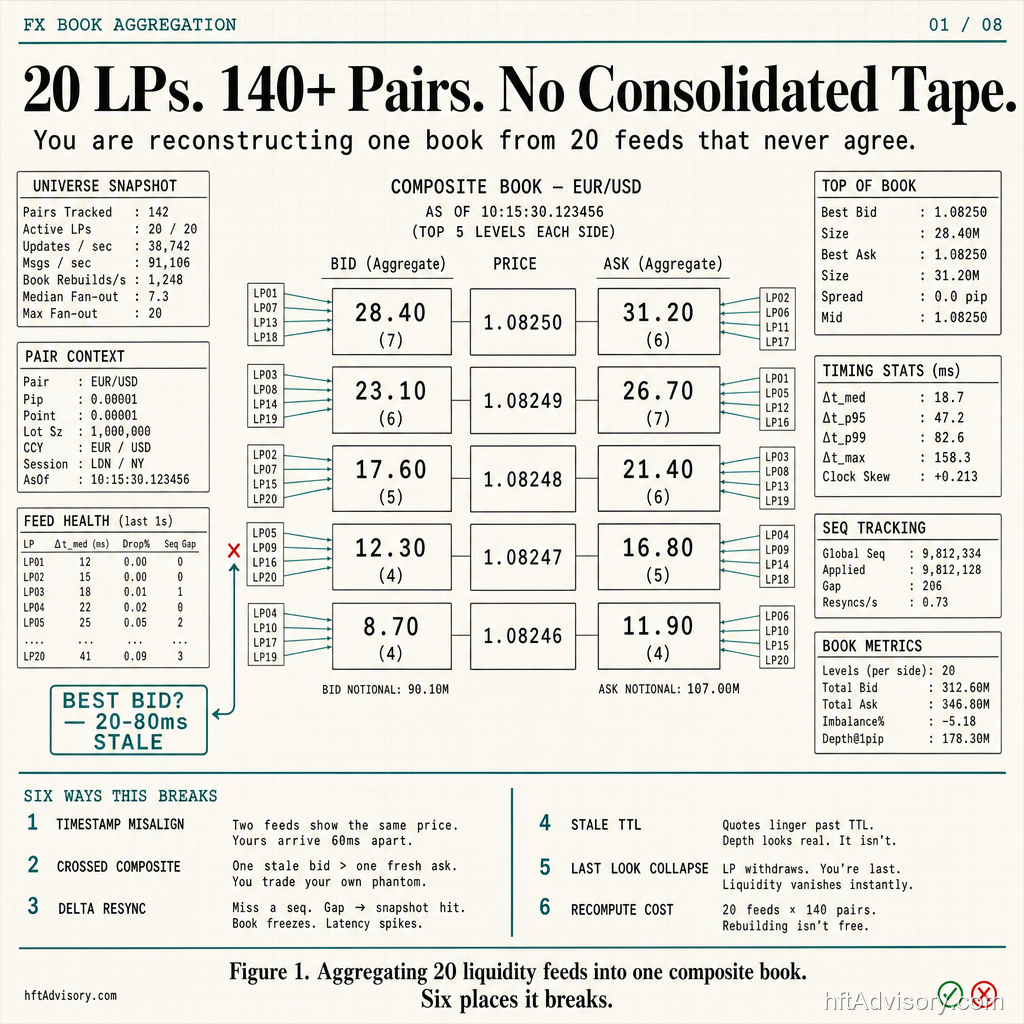

In spot FX, you are never looking at a real order book. You are reconstructing one.
Global spot FX turnover reached roughly $3 trillion per day in April 2025, according to the BIS Triennial Survey. There is no consolidated tape. No single venue clears the market. In the setups I have worked with, you are ingesting feeds from 20 or more liquidity providers across 140-plus currency pairs — spot, NDF, and EM crosses from multiple ECNs — and assembling something that is supposed to look like a coherent price for your execution logic to act on.
The word “supposed” is doing a lot of work in that sentence.
What you are building is a composite book: one synthetic order book stitched from 20 feeds that never fully agree. The reconstruction is an inference, not an observation, and every place the inference can be wrong is a place your execution loses money quietly, without throwing an error.
This article walks through six specific failure modes in multi-LP FX aggregation, in the order they surface in production, plus a seventh problem I have not solved cleanly. Each has a distinct signature, and each is a structural property of the aggregation problem rather than a bug you can patch. If you are building an FX aggregation stack — greenfield or inherited — or auditing one already running, this is the map. The execution work stays in the engagement; the map is free.
Table of Contents
- Timestamp Misalignment → Phantom Best-Bid
- Book Reconstruction → Crossed Composite
- Delta Resync → Silent Depth Drift
- Stale TTL → Latency Arb Window
- Last Look Spike → LP Count Collapses
- Protocol Heterogeneity → Recompute Cost
- The Part I Have Not Solved Cleanly: Per-Venue TTL Calibration
- Practical Framework: Six Failure Mode Audit
Failure 1 — Timestamp Misalignment → Phantom Best-Bid
This is the failure teams most consistently underestimate, because it is invisible until you instrument for it.
Thank you for reading this post, don't forget to subscribe!
Every LP timestamps their feed differently. The encoding varies — one venue sends nanosecond exchange time over FIX, another sends a millisecond gateway timestamp over a WebSocket frame, a third sends a REST snapshot with a timestamp that reflects when the response was serialized rather than when the price was live. The clock on their gateway is not your clock, and the network path from each matching engine to your aggregator adds latency that is asymmetric: it differs by venue, by time of day, and by market state.
Now stack 20 of those feeds on top of each other and ask for a single best-bid. The best-bid you surface is the maximum bid across all 20 books at the instant you read them. But those 20 books were not observed at the same instant. The bid that won may have been valid on LP-7’s feed 40 milliseconds ago and already gone. You have surfaced a price that no single venue is actually showing right now. In the practical sense of the word — a price you can hit and get filled at — it does not exist. It is a phantom best-bid, typically 20 to 80 milliseconds stale.
The spot/futures settlement basis compounds this. There is a systematic, well-documented pricing offset between FX spot and the near-dated futures contract, driven by the settlement-date difference and the interest-rate carry embedded in it. Teams that build aggregation against futures-referenced prices without correcting for that basis will regularly surface a “best” bid that looks like a free arbitrage and is actually an accounting artifact of comparing two instruments that settle on different dates.
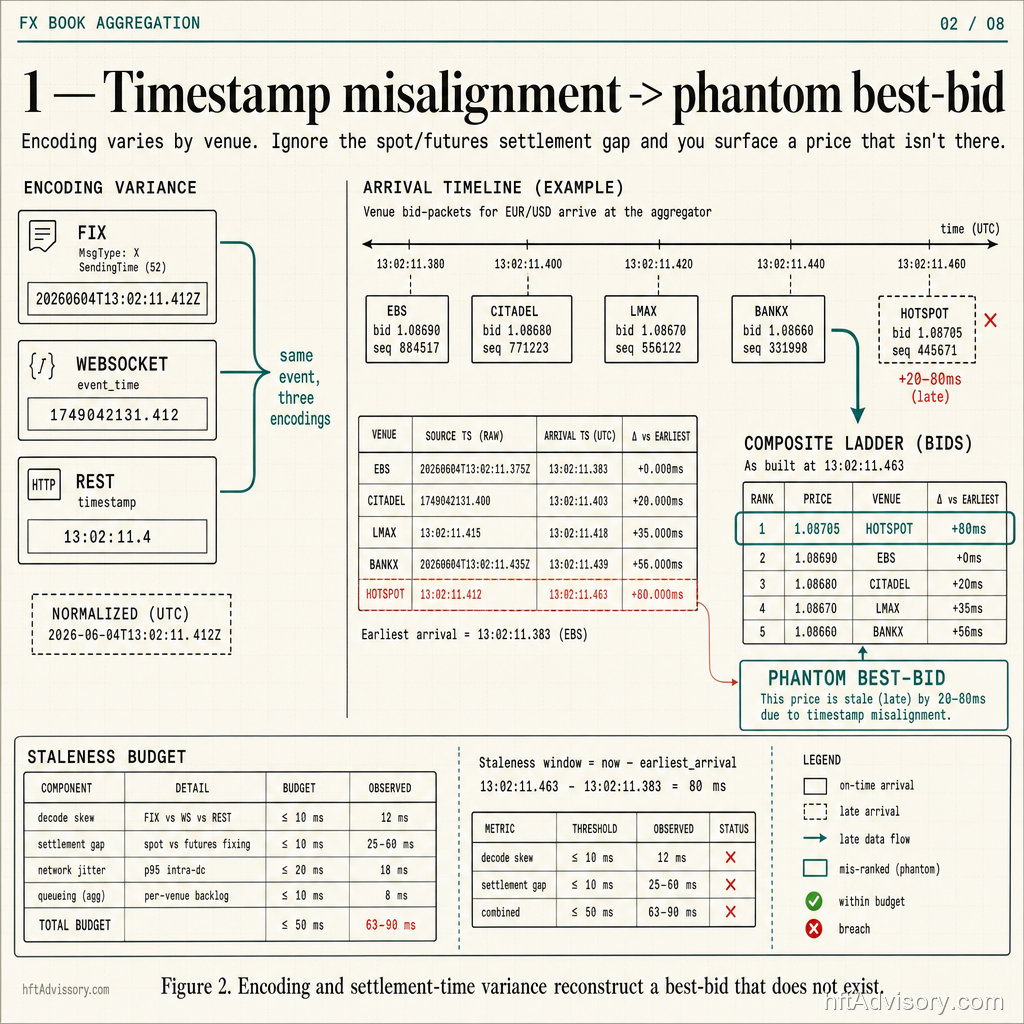
This is not a problem you fix once; it is a budget you maintain. Every LP you add widens the distribution of arrival times, and if that spread exceeds your time-to-live setting for the fastest-moving pairs, your composite best-bid is structurally behind the market — not mis-tuned, behind. (The instrument for this is question 1 in the audit framework below.)
Failure 2 — Book Reconstruction → Crossed Composite
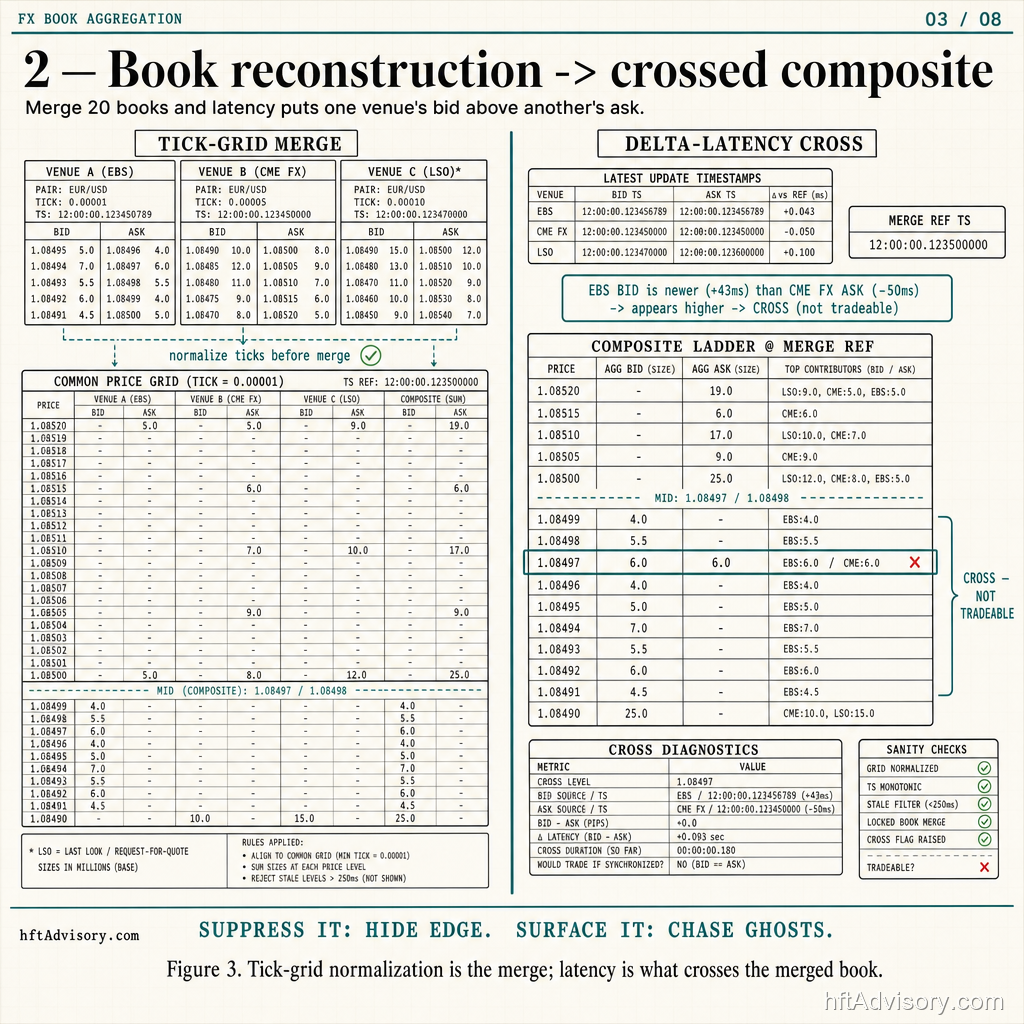
Merge 20 order books and latency will, sooner or later, put one venue’s bid above another venue’s ask. The composite shows a crossed market: a bid higher than an ask, which on a single real venue would be an instantly arbitrageable spread. On your composite it is usually a mirage. Venue A’s bid arrived fast; Venue B’s ask is stale and was already consumed or pulled. The tradeable spread the composite is showing you is not tradeable.
This is a genuine architectural dilemma, and the slide frames it bluntly: suppress the cross and you hide edge; surface it and you chase ghosts. In thin or slow markets, real dislocations between venues do briefly exist, and a fast aggregator can capture them — suppress every cross and you blind yourself to that edge. Surface every cross and your execution fires orders at fills that evaporate before your message reaches the LP, paying for the round trip in latency and signaling every time.
There is no universal right answer, only a measured one: what fraction of the crosses you observed in the last 30 days were real and capturable versus stale and phantom, by pair and by volatility regime. Without that measurement you are guessing at a parameter that leaks money in both directions.
The October 2016 sterling flash event shows the extreme end of this. GBP fell roughly nine percent against the dollar in early Asian trading before largely recovering. The BIS Markets Committee report concluded that “a range of factors — rather than a single driver — catalysed the move,” and identified an automatic pause in sterling futures trading as a key mechanism: with the futures contract halted, cash-market makers lost their pricing anchor and withdrew, hollowing out the bid side in an already thin Asian session. An aggregator running through that window was merging books where large sections of depth were simply not there, while still publishing a confident-looking price.
The crypto parallel is direct, since the same teams increasingly run both. On major centralized exchanges, WebSocket throttling compresses the depth you can see during high-velocity periods: the exchange rate-limits updates, so your view of one venue’s ask goes stale relative to another venue’s bid, and crossed composites appear through the same mechanism. During a liquidation cascade, the throttling bites hardest at exactly the moment composite accuracy matters most.
Failure 3 — Delta Resync → Silent Depth Drift
The first two failures are about the top of the book. This one is about everything underneath it, and it is the quietest of the six.
Almost no venue sends you a full book on every update. They send a snapshot once, then a stream of incremental deltas: add a level, remove a level, change a size. You apply those deltas in sequence to maintain your local copy of each venue’s book. The deltas carry sequence numbers, and each venue sequences on its own clock and its own counter. There is no shared ordering across venues.
Miss one delta from one venue — a dropped UDP packet, a reconnect that skips a message, a slow consumer that overflows a buffer — and from that point forward you are applying subsequent deltas to a book that is already wrong. The level you think is there was removed by the message you missed. Your reconstructed book for that venue has drifted from the venue’s true book, and nothing in the stream tells you. The composite keeps publishing. The depth it quotes for that venue is stale, and it stays stale until you detect the gap and force a resync from a fresh snapshot.
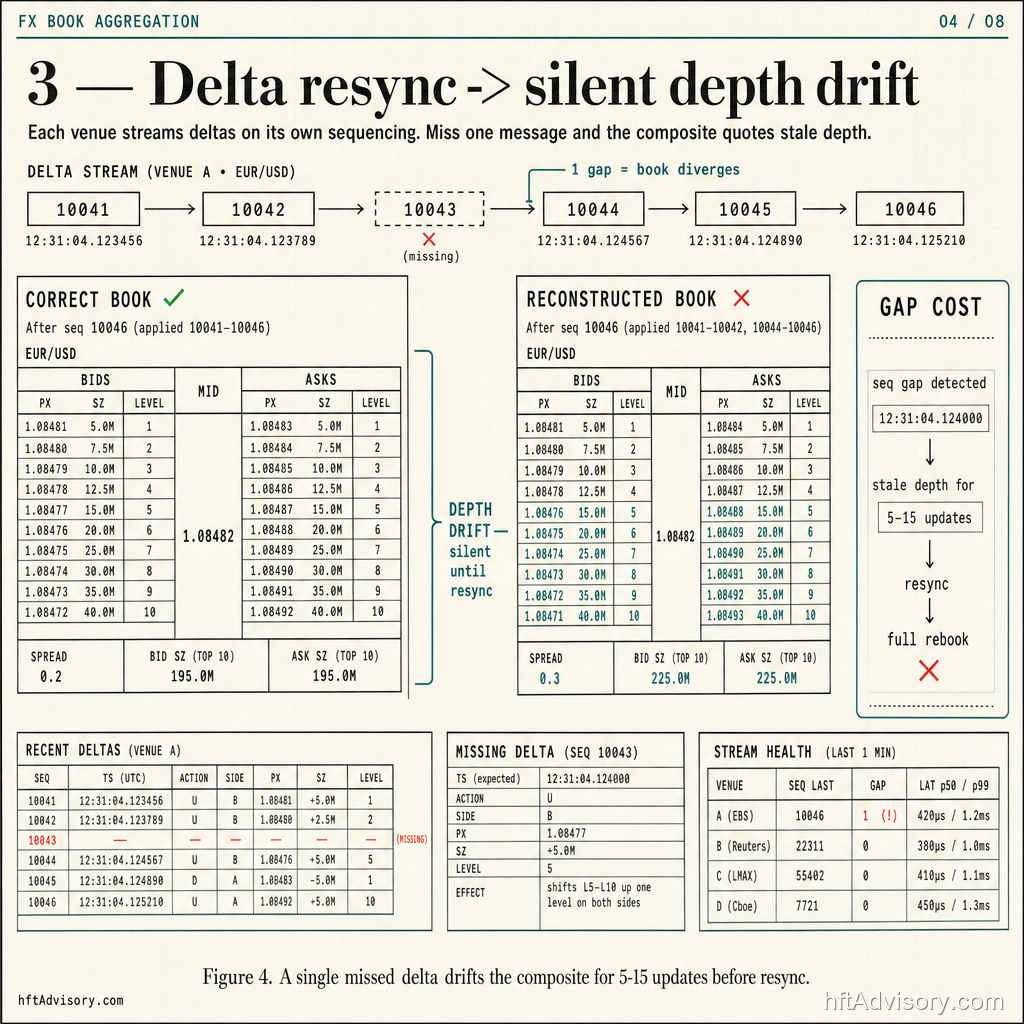
The cost has two components, and the slide separates them well. There is the drift itself: every routing or pricing decision made against the drifted venue between the missed message and the resync is made on bad depth. And there is the gap cost of the resync: while you rebuild that venue’s book from a new snapshot, you either quote stale depth or drop the venue entirely, and either choice degrades the composite for the duration. On a fast pair, a one-to-five-update resync gap is enough to misprice through a move.
The point for an architect: the failure is not the dropped message (drops are inevitable), it is not detecting the drop. If you are not tracking sequence-number continuity per venue and cannot quantify how long a venue’s depth stays stale during a resync, you have silent depth drift in production right now with no instrument pointed at it. The fix is not exotic; it is sequence-gap detection with a measured, bounded recovery procedure per venue. What is rare is teams measuring the staleness window rather than assuming it is small.
Failure 4 — Stale TTL → Latency Arb Window
Every quote in your aggregated book needs an expiry. Time-to-live (TTL) is the parameter that says how long a quote from a given LP stays valid before you discard it as stale and stop acting on it. In the setups I have worked with, TTL runs from tens to hundreds of milliseconds, set per pair. The spread is not arbitrary: G10 majors update constantly and trade tight, so a short TTL fits; EM crosses and NDFs update slowly and jump in wider steps, so their TTL has to be longer or their side of the book is perpetually empty.
The failure mode here is specifically the TTL that is set too wide for the pair’s actual quote velocity. Set a G10 major’s TTL too wide and, during a fast move, a dead quote survives five to fifteen updates past the point where the LP has already repriced. For that window, your book is advertising a price the market has left behind — and you have just published a latency-arbitrage window to anyone faster than you. They lift your stale bid or hit your stale offer, and you are filled at a price you would not have shown if your TTL had expired the quote on time. The adverse selection is not random; it is structurally pointed at your slowest-to-expire quotes.
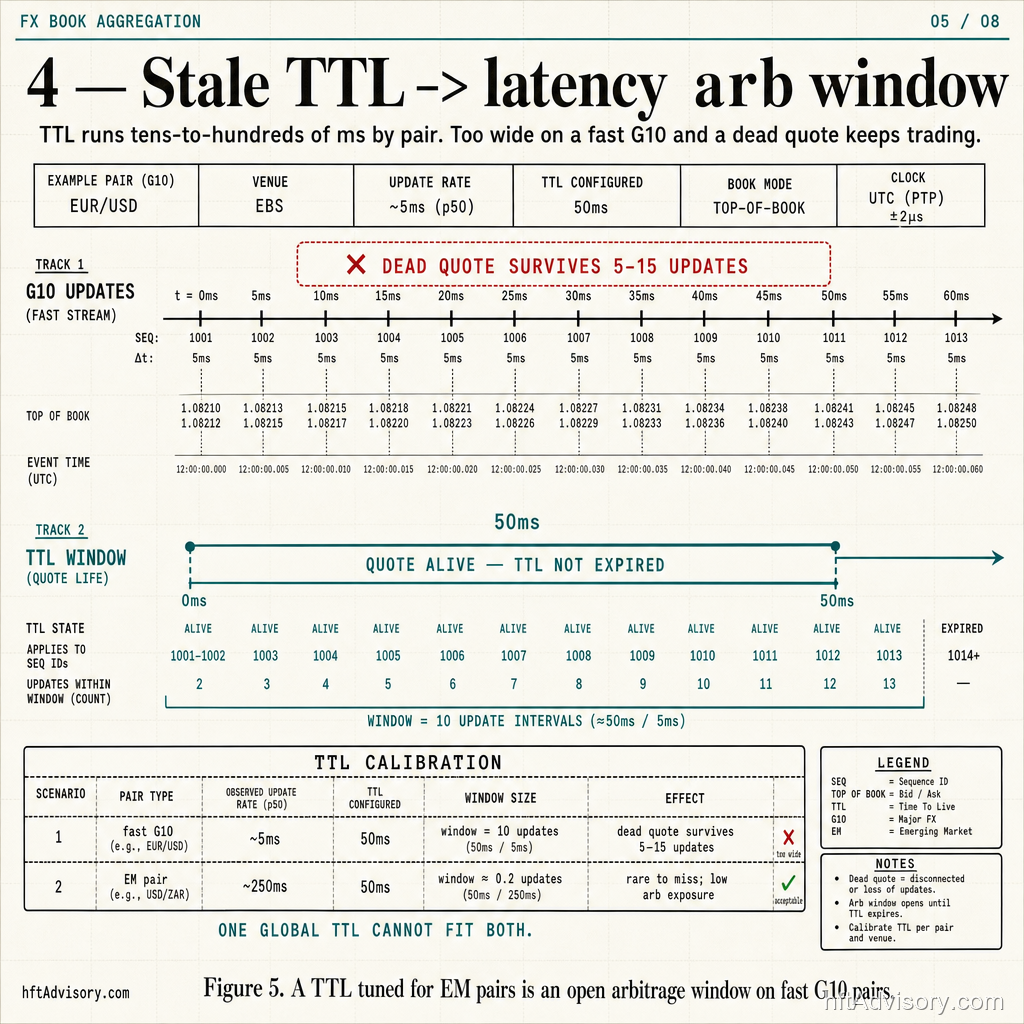
Set TTL too narrow and you get the opposite leak: in normal conditions you discard quotes that were still live, thinning your apparent liquidity and rejecting fills you could have captured. So a single static TTL is wrong in both directions depending on the regime — too wide in fast markets, too narrow in slow ones. Most teams set TTL once at integration time and never revisit it, which means it is mis-set for every regime except the one they happened to test in.
Failure 5 — Last Look Spike → LP Count Collapses
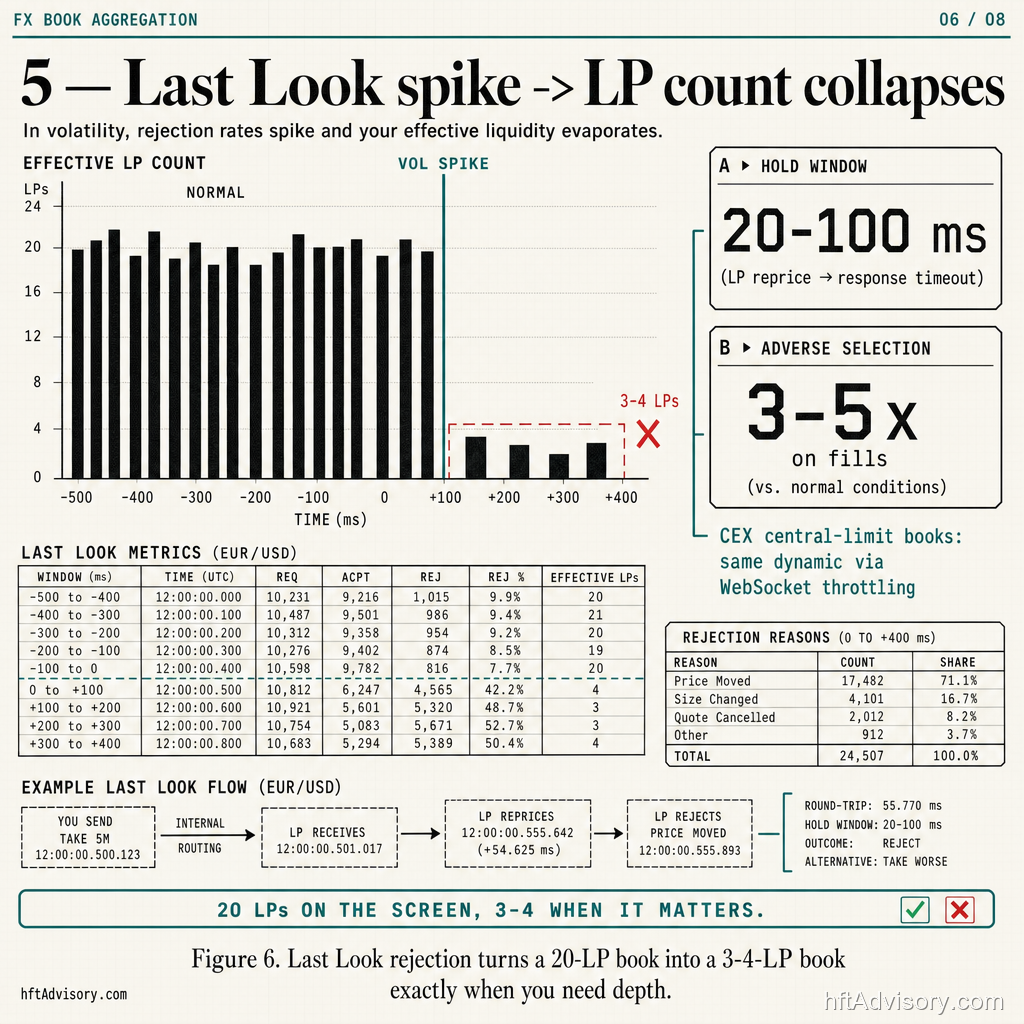
Last look is the mechanism by which a liquidity provider, after receiving your order against their quote, retains a brief window to reject it before filling. The LP holds your order for a hold window — industry-documented ranges run roughly 20 to 100 milliseconds — and uses it to check whether the market has moved against them since they quoted. If it has, they reject.
In calm markets this is background noise. In a volatility spike it becomes an architectural crisis, and it is the failure that makes the other five worse. When the market moves fast, rejection rates climb across your LPs at once. In the aggregations I have monitored, what reads as 20 active LPs in normal conditions can collapse to three or four effective counterparties in a spike, because the other 16 or 17 reject nearly everything they receive. Your aggregation logic still believes it has 20 LPs of depth; it does not. Adverse selection on the fills you do get climbs sharply, because the book you are actually trading against is radically thinner than the one your composite is showing.
This is not theoretical, and the regulatory record is explicit about the abuse end of it. The New York Department of Financial Services investigation into Barclays documented systematic last-look abuse from at least 2009 through 2014. Per the NYDFS, hold windows at Barclays ran “tens and hundreds of milliseconds,” staff were directed to “obfuscate and stonewall” client inquiries about rejection rates, and Barclays paid a $150 million penalty to NYDFS for the conduct, part of $635 million in FX-related enforcement against the bank.
The industry’s self-regulatory answer, the FX Global Code (updated December 2024), flags “high reject rates” and “differences in the time taken to accept or reject” trades as potentially unacceptable, and names “significant market movement against the client when a request-to-trade is rejected” as a signal of misuse. The academic work matches what practitioners see: Cartea, Jaimungal, and Walton (2018) showed that a last-look venue can rationally quote wider spreads than a no-last-look venue — counterintuitive until you account for the adverse selection the LP is managing. The direction keeps tightening: IOSCO issued its Final Report on Pre-Hedging (FR/14/25) in November 2025, and by May 2023 a majority of the top-25 LPs had already removed explicit hold-time language from their documentation.
What none of that addresses is the operational gap on your side: your routing, spread models, and adverse-selection estimates were all calibrated assuming N effective LPs. When last look quietly collapses effective depth to N/5 in the conditions where execution matters most, the architecture does not re-calibrate itself — and most stacks have no instrument that even reports effective LP count under stress as distinct from nominal count. The same compression shows up on crypto venues through WebSocket throttling rather than an explicit hold window.
Failure 6 — Protocol Heterogeneity → Recompute Cost
The first five failures are about correctness. This one is about throughput, and it is the tax nobody budgets for until it becomes the binding constraint.
FX ECN infrastructure runs across three simultaneously active protocol surfaces: FIX, REST, and WebSocket. Framing differs across all three, and tick sizes are not standardized across venues. To merge depth from multiple venues into one composite ladder, you normalize every venue’s prices onto a common grid — and every incoming update from every venue triggers a recompute across the pairs it touches. The cost is mechanically a function of the number of venues, the number of affected pairs per update, and the rate of incoming updates, and it scales non-linearly as those grow. In a high-update-rate regime — a major G10 data release, a coordinated macro event — throughput degradation in the normalization-and-recompute path can become the limit on your aggregation latency, ahead of the network or the matching logic. The slide’s recompute-load curve against active pairs is the shape to watch: it does not bend gently.
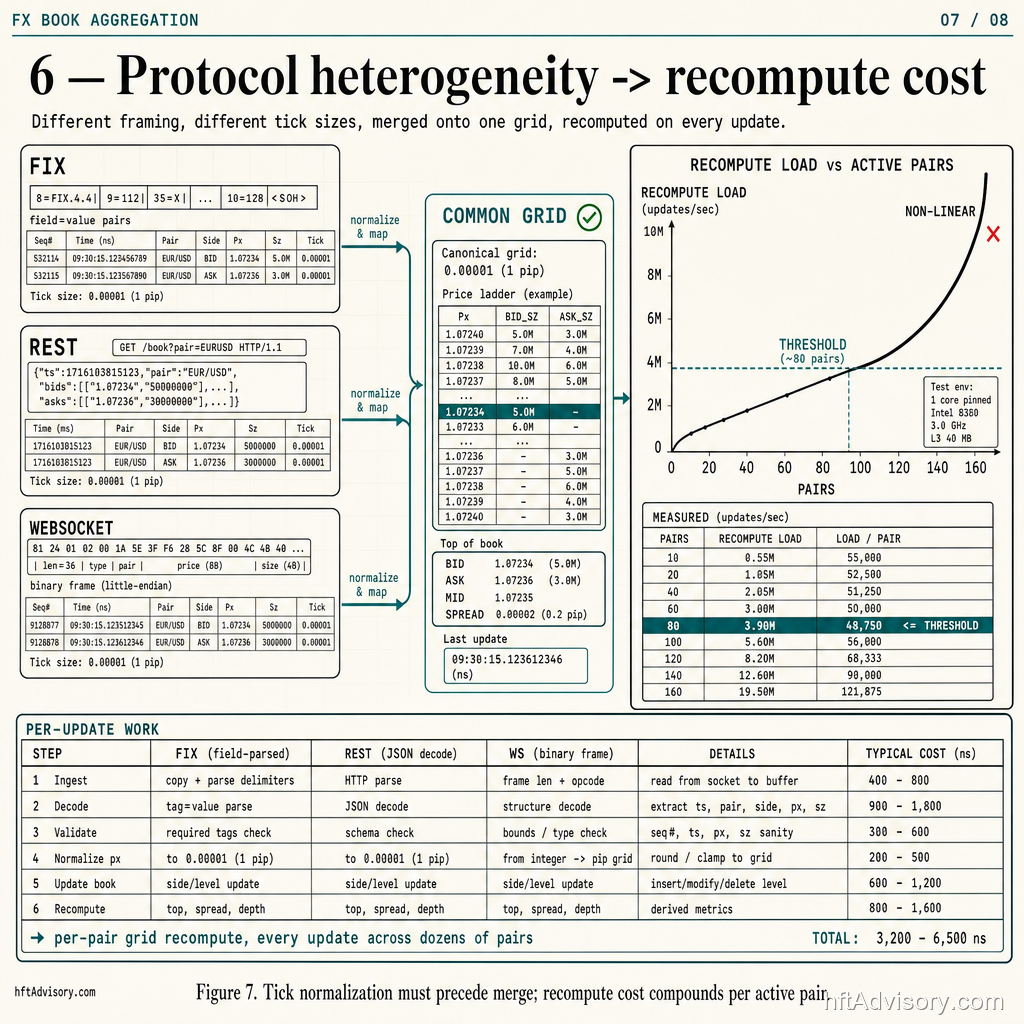
The surface also keeps changing underneath you. LSEG shelved its FX Matching replatforming in late 2024, judging that the client-migration timeline would be too long and risk alienating the existing user base — so the incumbent venue you integrated against is not on the modernization path you might have assumed. Meanwhile CME FX Spot+, positioned as a “firm, all-to-all spot FX central limit order book” running in CME’s Chicago matching engine, adds a third protocol topology to budget for, with connectivity characteristics different from the established EBS/Refinitiv venues. Every new venue is another framing to normalize and another recompute contributor.
The strategic context makes the tax sting more: dealer banks now internalize more than 80 percent of customer flow within their own pools, per the BIS Q4 2025 Quarterly Review. The ECN slice you can aggregate is a shrinking fraction of total FX activity. So you spend non-linearly more compute to reconstruct an increasingly partial view of a smaller share of the real market — a trade worth making explicit when you size the system.
The Part I Have Not Solved Cleanly: Per-Venue TTL Calibration
Failure 4 was about a static TTL being mis-set. The obvious response is to make TTL adaptive: calibrate it per venue, per pair, against observed quote velocity. As quote rate rises, tighten TTL; as it falls, widen it. I have built toward this, and I will be honest about where it breaks.
The problem is feedback-loop stability in thin markets. Quote velocity in a thin pair is a poor predictor of the next quote. Tighten TTL aggressively in response to a velocity burst that turns out to be a single cluster rather than a regime change, and you discard a large fraction of your valid depth during the quiet stretch that follows. The book thins artificially, and that thinning changes downstream routing decisions in exactly the stressed conditions where routing matters most. An unstable adaptive TTL can behave worse than a well-calibrated static one, because it injects its own variance into the book precisely when you need the book stable.
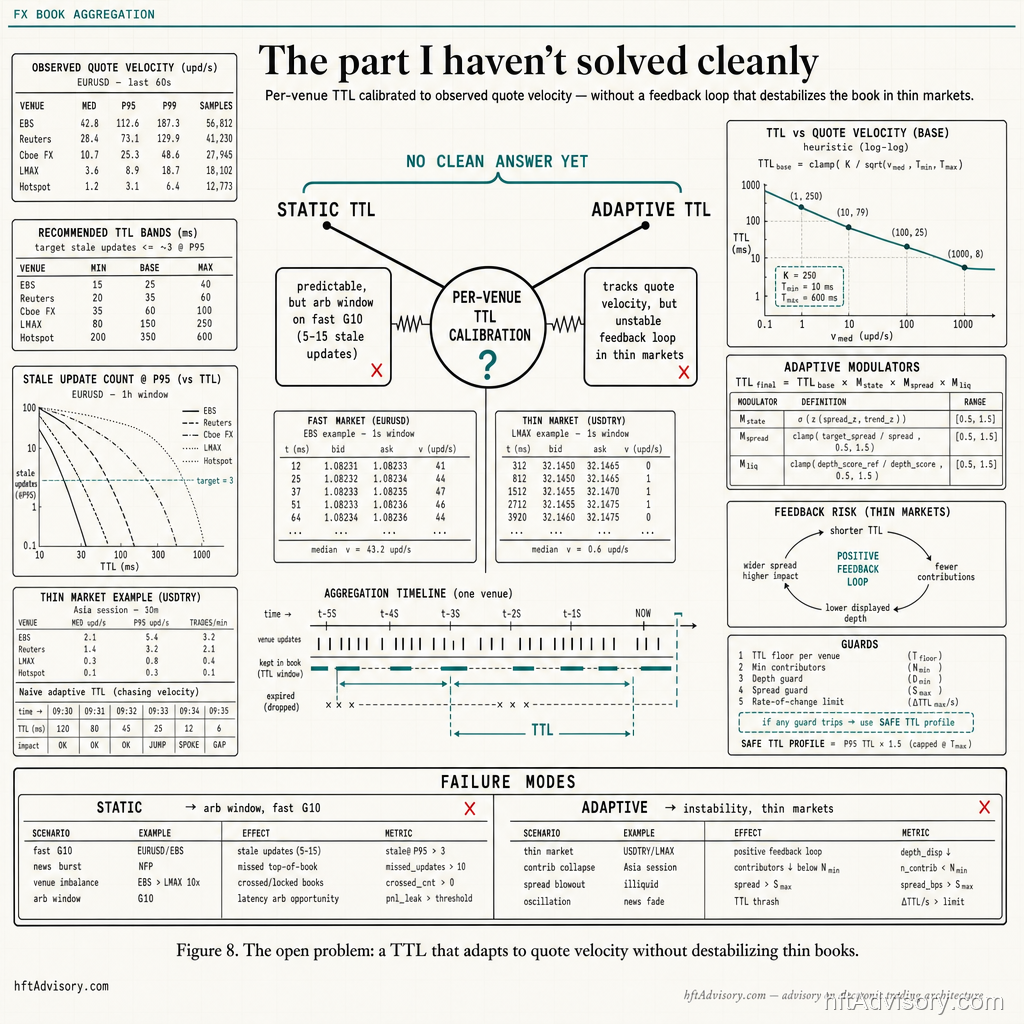
So the honest state of the art, at least in my hands: static TTL fails in volatile markets, adaptive TTL introduces its own failure mode in thin markets, and the clean resolution seems to require per-venue regime detection — distinguishing a real velocity regime change from a transient burst before acting on it. But regime detection needs sufficient per-venue history to calibrate, and that is exactly the history you lack on a newly added LP or a thinly traded pair. The dependency is circular, and I do not have a resolution I would call clean. If you have built a per-venue adaptive TTL that stays stable through a thin-market velocity burst without over-discarding, I would genuinely like to compare notes — the trade between responsiveness and stability is the one I keep running into.
Practical Framework: Six Failure Mode Audit
Each failure mode has a distinct, measurable signature. Stress-test your stack against these six questions. The ones you cannot answer with a number are where your next leak is.
1. Timestamp alignment. Is the spread of message-receipt latency across your LP feeds — measured against one common reference clock — wider than your TTL for your fastest pairs? If yes, your composite best-bid is not guaranteed valid when you act on it.
2. Delta sequence integrity. Do you track sequence-number continuity per venue and have a number for how long a venue’s depth stays stale during resync? If not, you have silent depth drift in production.
3. Cross accounting. What fraction of composite crosses in the last 30 days were real and capturable versus stale and phantom, by pair and regime? The ratio tells you whether your suppression threshold is leaking edge or chasing ghosts.
4. TTL calibration. On one active pair, how often does a quote expire by TTL before a fresh quote replaces it, versus survive past TTL while still valid? One skew means too tight, the other too wide — and when did you last check?
5. Last look collapse. Replay a volatility window from the last 12 months: how many LPs stayed effectively active in the first 60 seconds, and what happened to fill rates and effective spread? Without this you know your nominal LP count, not your effective one under stress.
6. Protocol recompute. Under peak update load, not average, what is the end-to-end latency from feed receipt to composite publication? If it degrades non-linearly under concentrated bursts, protocol heterogeneity is your binding constraint, and adding venues makes it worse before better.
Conclusion
An FX aggregation stack that passes monitoring in calm conditions can fail in five ways at once during a volatility spike — and one of those modes, last look collapse, manufactures the exact conditions in which the other four accelerate. These failures are not independent; they interact, and they interact worst when you can least afford it.
The standard is this: your composite book should correctly represent the set of fills you can actually execute, at the prices shown, within your latency budget, under the conditions that exist at the moment of routing — not the conditions that existed when the quotes were ingested. If your architecture cannot guarantee that property through a volatility event, the six questions above are where the gap shows itself first. The ones you cannot answer with a number are your map for the next quarter.
Ariel Silahian advises electronic trading firms on execution architecture and microstructure diagnostics at hftAdvisory.com.
Originally shared as a LinkedIn post. View the original post.
Never Miss an Update
Get notified when we publish new analysis on HFT, market microstructure, and electronic trading infrastructure. No spam.
Subscribe by EmailAriel Silahian is a senior technology executive in institutional electronic trading, with 30+ years across the buy and sell side (New York, Miami, London, Hong Kong). He is the author of "C++ High Performance for Financial Systems" (Packt) and the creator of VisualHFT, the open-source microstructure analytics stack. He writes on exchange architecture, market microstructure, and execution quality, and advises a select number of trading firms on infrastructure decisions that move P&L. Book a strategy call at hftAdvisory.com