
In April, I opened the cancel stream as an alpha input. The Cancel-Stream Gap argued that a signal stack built on the trade tape alone is modeling a minority of the events in the book it is trying to predict, and that closing that gap is a data-access decision, not a research problem. That was the first reading, and it was true.
It was also incomplete. The same adds, modifies and cancels a quant desk mines for directional pressure are read by four ledgers that have nothing to do with alpha. On the desks I have reviewed, at most one of the four was ever open.
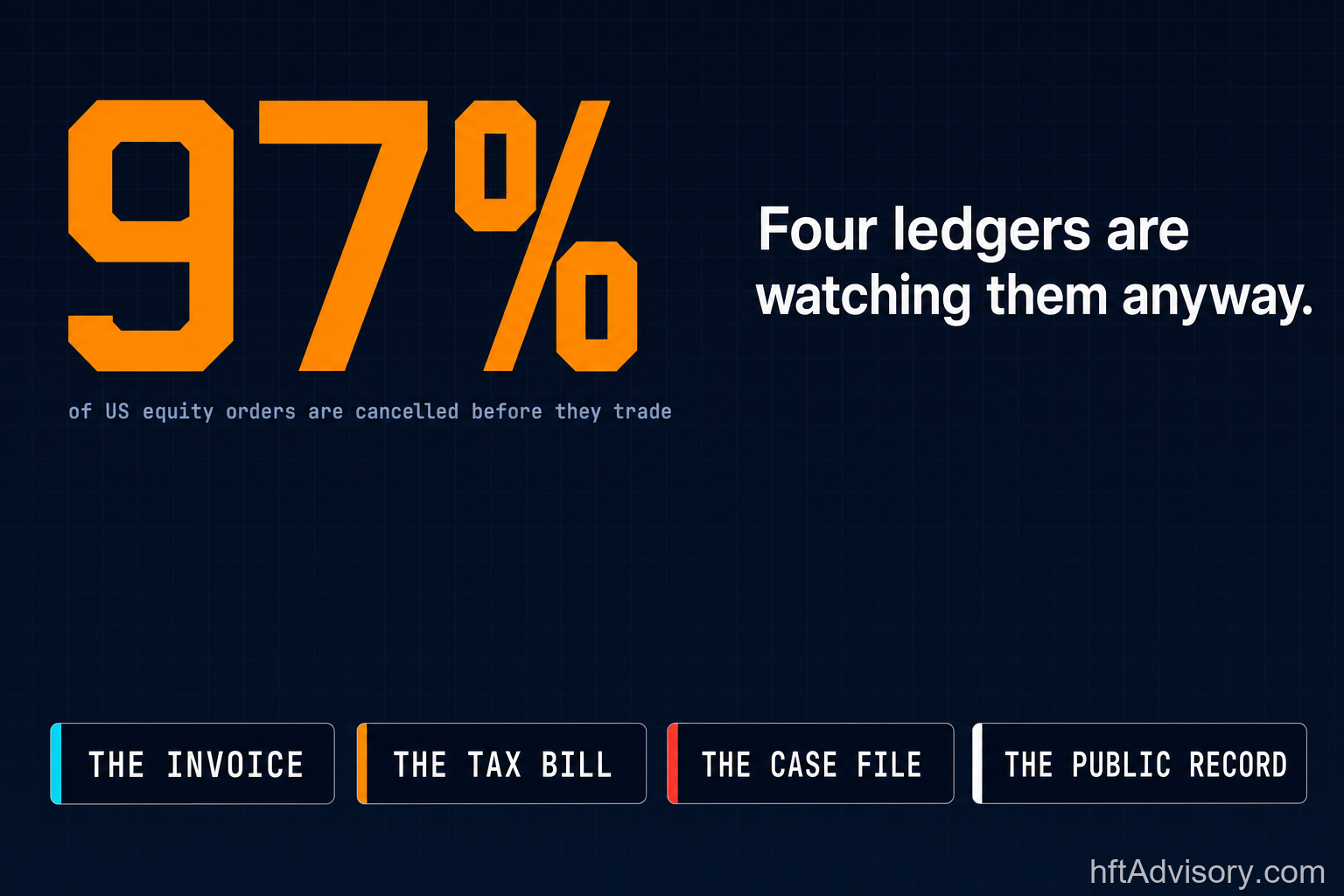
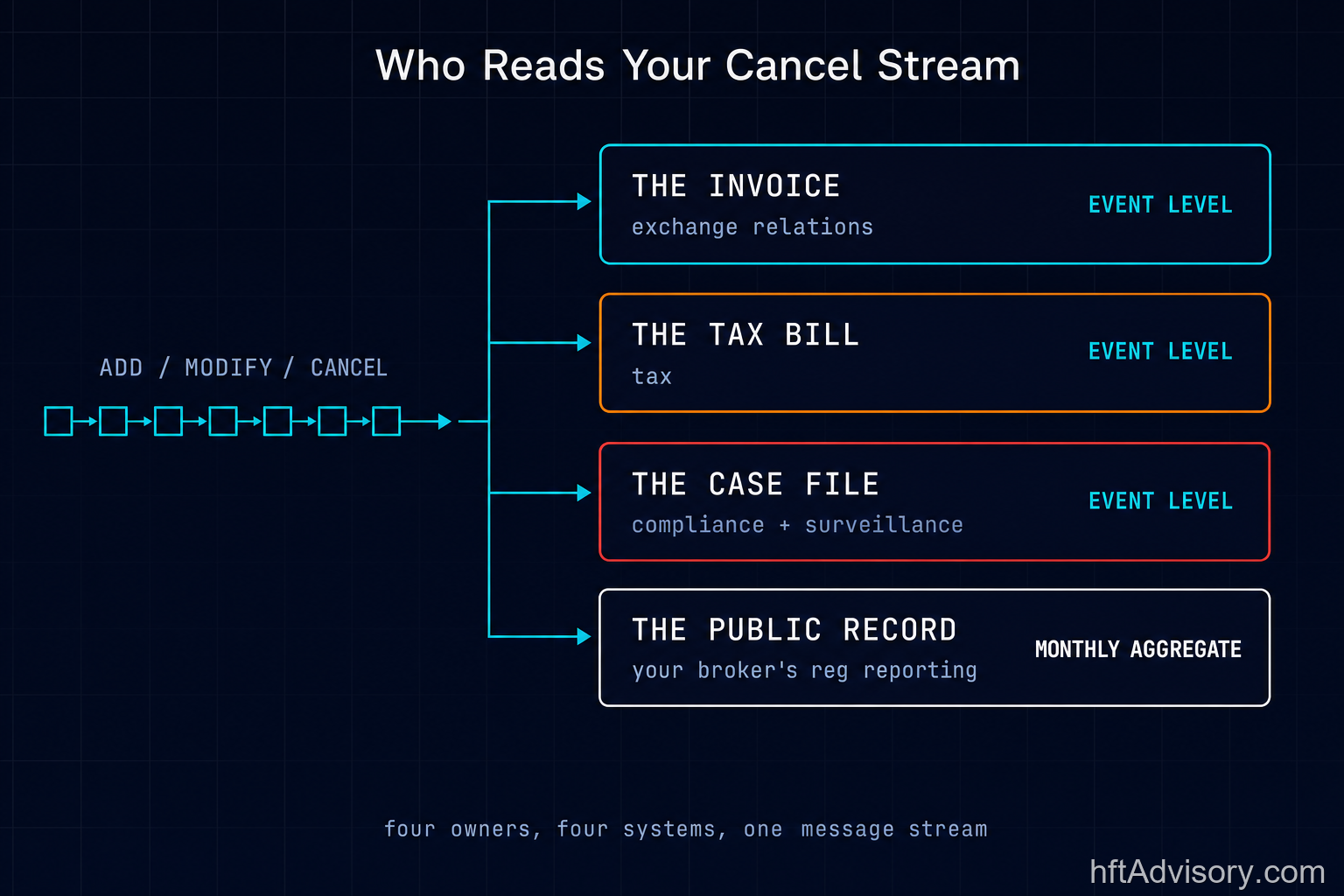
The venue that carries those messages prices them, and bills monthly. That is the invoice. Two European statutes tax them by name, on a ratio your own system either computes or does not. That is the tax bill. Regulators read them as the evidentiary record of intent, which is why a separate body of law requires you to reconstruct every one of them to a clock accuracy fixed by how your activity is classified. That is the case file. And three days before this article published, a fourth began reporting a slice of them to the public every month. That is the public record.
Four ledgers, one tape. Worth asking who owns each of them where you work. In the firms I have advised the answers come back from four different places: connectivity and exchange relations hold the invoice, tax holds the statute, compliance and surveillance hold the case file, and somebody else’s regulatory reporting team files the public one. The seam is that no single person reads all four against the same message stream, which is how a desk ends up optimizing hard against one of them while another accrues unwatched.
This piece is the second reading: the invoice, the tax bill, the case file and the public record sitting underneath the alpha argument. How many of the four actually bind you depends on what you trade, where you are established, and who executes for you. That is worth working out before assuming either that all four apply or that none of them do, and this article flags the boundaries as it goes.
Table of Contents
- The Bill the Venue Already Sends
- The Legal Root Almost Nobody Reads
- Two States Tax the Cancel Itself
- The Same Messages Are the Evidentiary Record
- You Are Required to Reconstruct It
- The Public Ledger, and What It Actually Counts
- The Honest Complications
- What Transfers to Crypto Venues
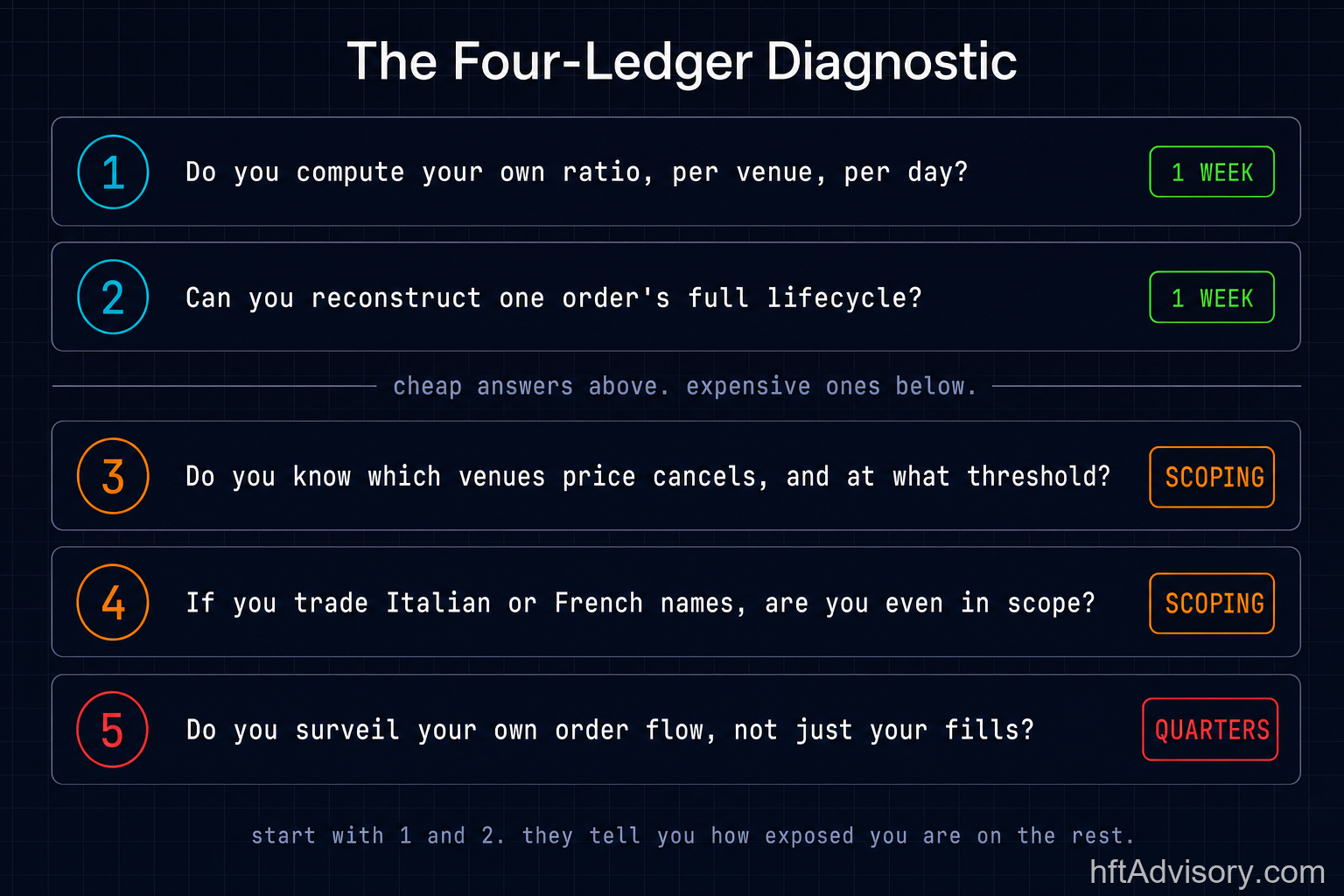
- Practical Framework: The Four-Ledger Diagnostic
- Conclusion
The Bill the Venue Already Sends
Thank you for reading this post, don't forget to subscribe!
Start with what is already priced, scheduled and dated. This is not proposed rulemaking. It is live billing.
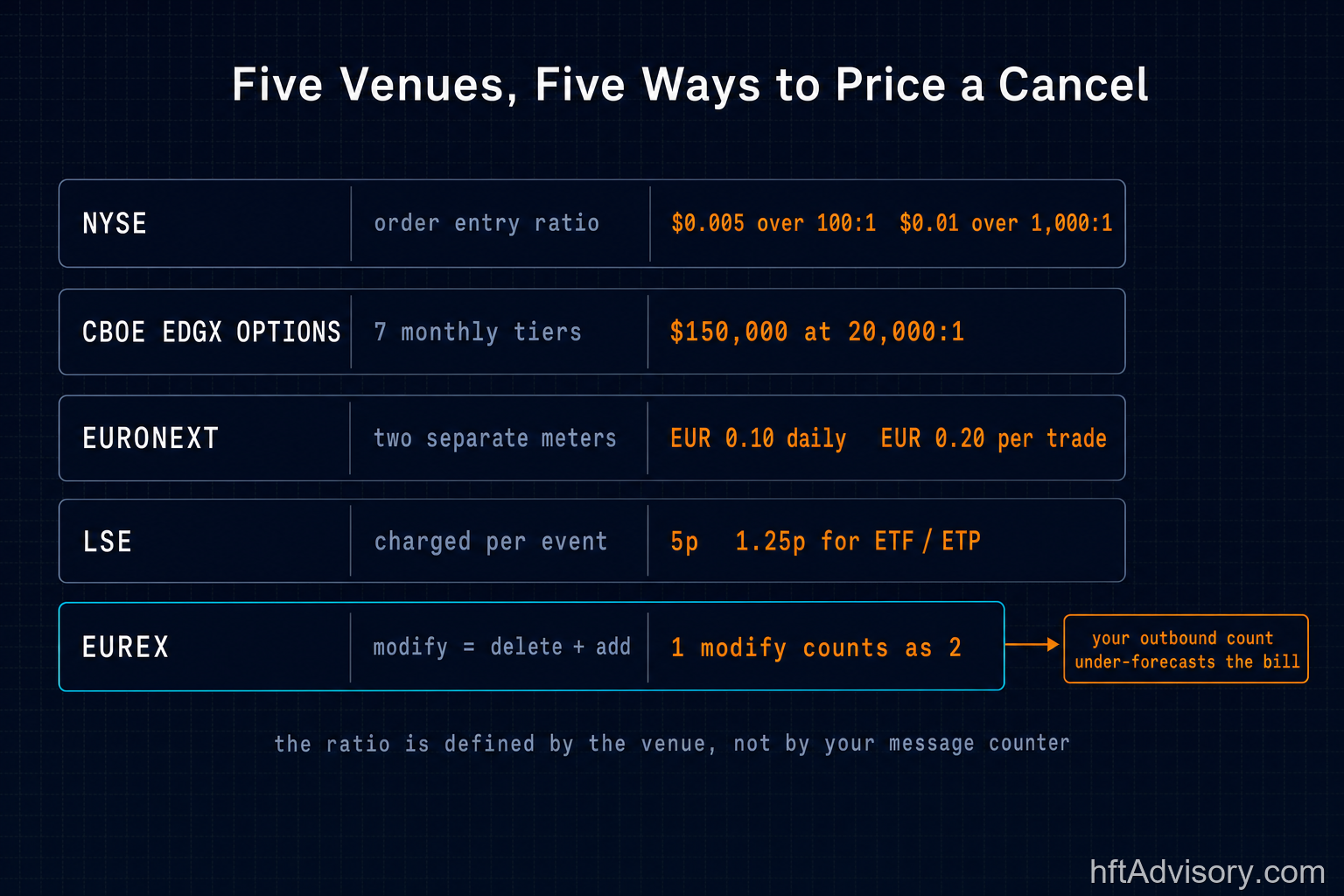
NYSE’s Price List, last updated August 3, 2026, prices the Order Entry Ratio in two bands: cross 1,000-to-1 orders-to-executions and every order that pushed you over costs $0.01; cross 100-to-1 but stay under 1,000-to-1 and it costs $0.005 on every order that caused the breach. Cboe EDGX Options runs a seven-tier monthly Market Maker Order-to-Trade Ratio Fee, total orders including every modify message divided by total trades. Tier one, under 1,000-to-1, costs nothing. Tier seven, 20,000-to-1 or higher, costs $150,000 for the month. Sit in tier seven all year and that single line on a single venue’s options book is $1.8 million, which is arithmetic on a published rate rather than a modelled estimate. It is a ceiling, not a forecast, but it is the ceiling stated in the units a budget is actually written in.
Euronext runs two separate, non-substitutable mechanisms. A daily 100-to-1 ratio applies at the member group level, surcharged at €0.10 per order above it. Separately, every trade carries five free orders; each order past a 5-to-1 ratio on that trade costs €0.20. One is a daily portfolio cap, the other a per-trade allowance; a desk tracking only one is blind to the other.
The London Stock Exchange charges by event, not ratio: every order or quote entry, modification or deletion beyond a per-trade allowance (500 events per electronic trade in FTSE 100 names, 2,000 in ETFs and ETPs, 500 per reported trade in EQS names, none elsewhere) costs 5p, reduced to 1.25p for qualifying ETF and ETP events.
Eurex tells you exactly how it counts, which makes it the most architecturally honest fee here. Order-to-trade ratio is ordered volume divided by traded volume, minus one, and Eurex states plainly: “A modify of an order or quote is treated as a ‘delete’ followed by an ‘add.’ Thus, the original order and the new order will both be counted towards the ordered volume.” A single modification costs two against your ratio, not one; a desk modeling exposure from its own outbound message count will under-forecast the bill every time. The Excessive System Usage Fee behind that ratio has run since December 1, 2013, forgiving a breach under four times a month per product as “accidental” and charging every violation past three as “systematic.” Eurex loosened the parameters after the February 24, 2022 volatility shock and partially retightened them effective February 1, 2023.
On December 15, 2025, Eurex changed what it would treat as equivalent: “Aggressive and passive volume factors will be asymmetric, hence the aggressive volume factor is smaller than the passive volume factor,” applied so far only to Fixed Income Futures and Equity Index Futures. Passive, liquidity-providing cancellation now costs less against the ratio than aggressive, liquidity-taking cancellation on the same venue. Hold that thought; it resurfaces later.
The Legal Root Almost Nobody Reads
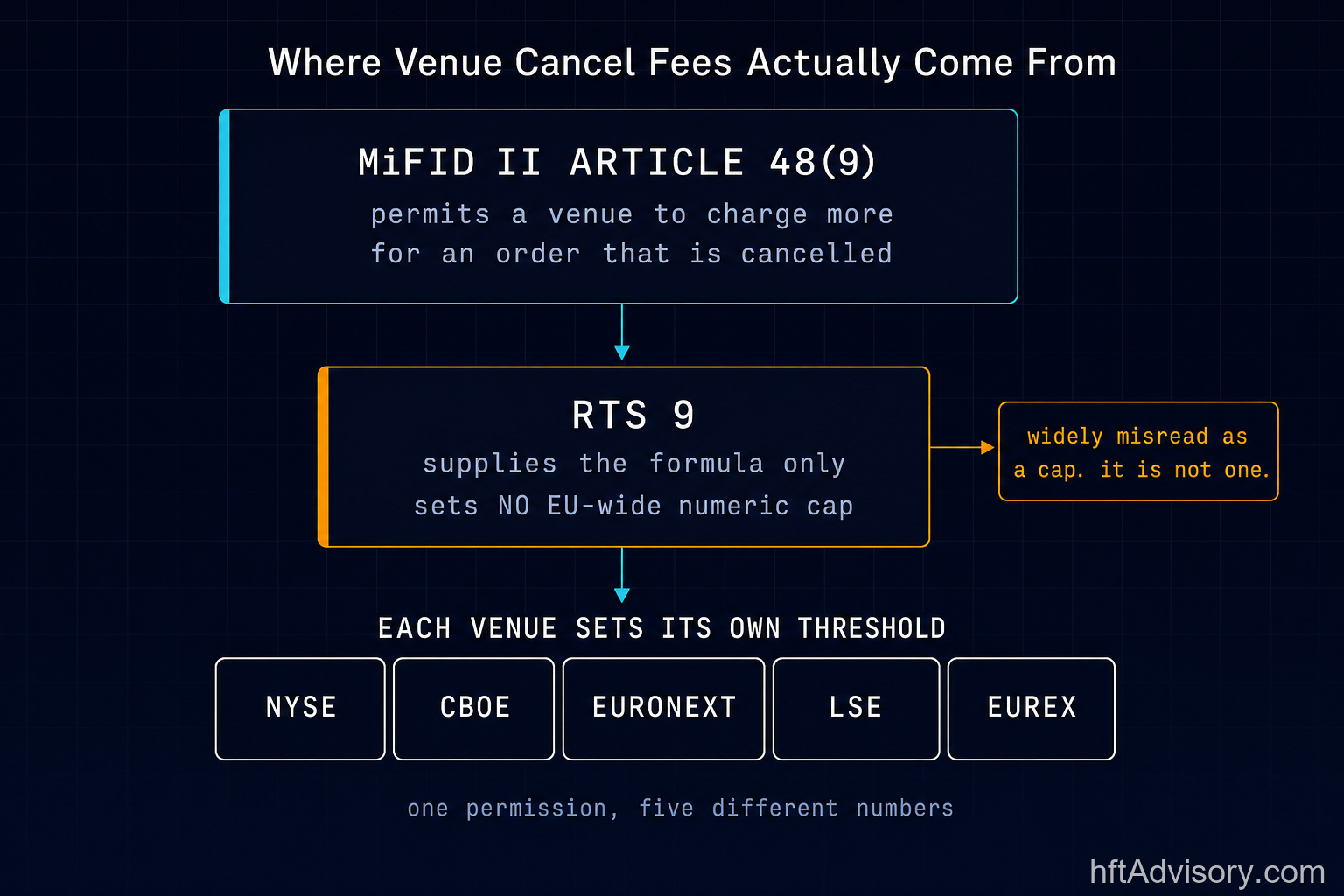
Every fee schedule above traces to one sentence in EU law. MiFID II Article 48(6) requires regulated markets to maintain “systems to limit the ratio of unexecuted orders to transactions that may be entered into the system by a member or participant.” Article 48(9) is the permission slip behind the pricing: “Member States may allow a regulated market to impose a higher fee for placing an order that is subsequently cancelled than an order which is executed and to impose a higher fee on participants placing a high ratio of cancelled orders to executed orders and on those operating a high-frequency algorithmic trading technique in order to reflect the additional burden on system capacity.”
What Article 48(9) does not do is set a number. RTS 9 supplies only a formula, total order volume divided by total transaction volume minus one, with the maximum ratio “calculated by the trading venue.” There is no EU-wide cap, despite a common misreading of that formula as one. It resolves to a method, not a number, which is why each venue’s threshold lives in its own rulebook and the five fee structures above look nothing alike.
Two States Tax the Cancel Itself
Venue fees are the cost of doing business with one counterparty. Two European tax authorities went further and wrote the cancel into the statute itself.
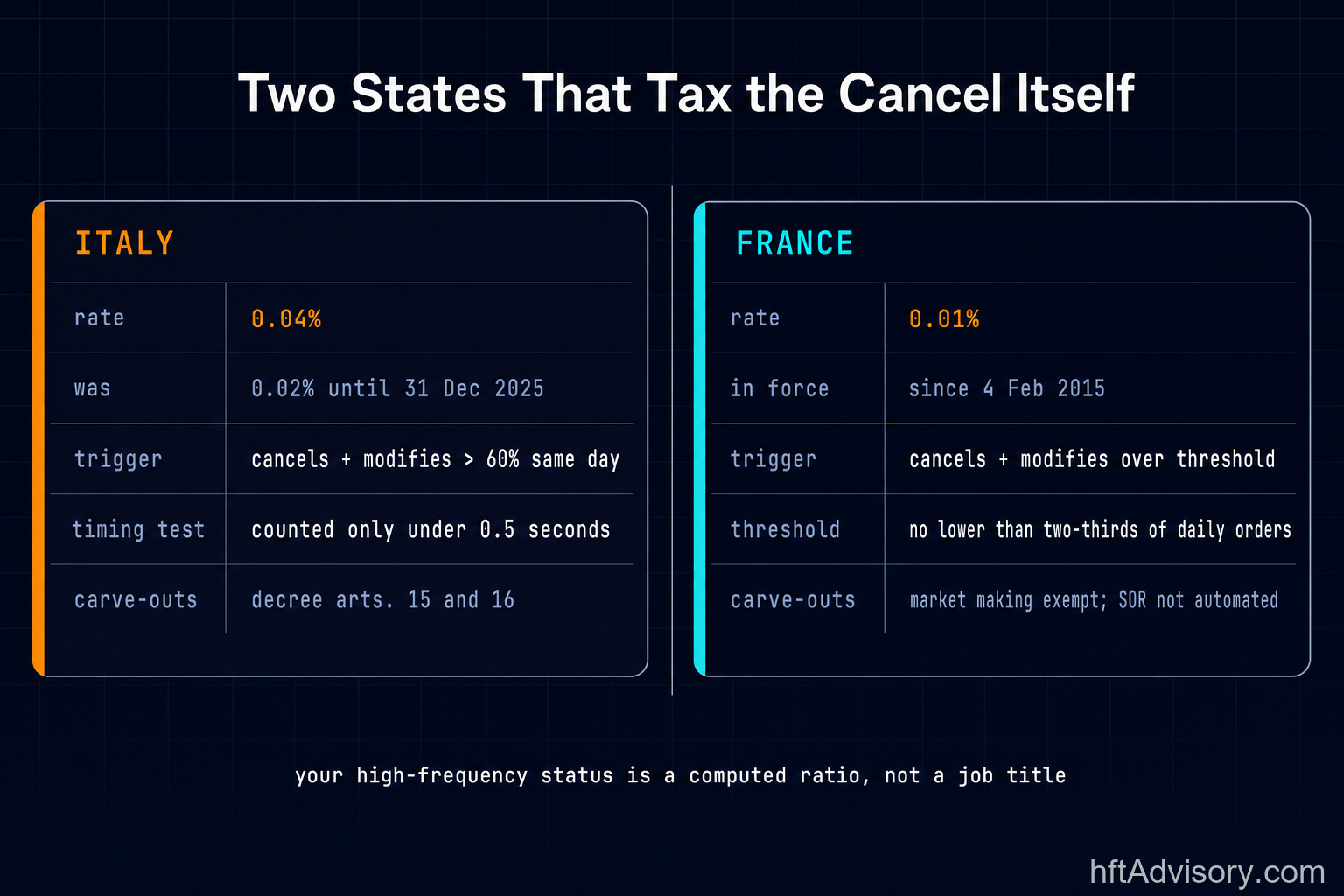
Italy’s financial transactions tax carries a specific HFT component, doubled from 0.02% to 0.04% for transactions carried out after December 31, 2025. It applies whenever the same-day ratio of cancelled-and-modified orders to entered-and-modified orders exceeds 60% on a given instrument, and only activity happening in under half a second counts toward that ratio; anything slower is explicitly excluded. Your “high-frequency” status under Italian law is not a business-model label. It is a ratio your own system either computes correctly or does not.
France runs a related but structurally different mechanism. Article 235 ter ZD bis of the Code général des impôts, in force since February 4, 2015, charges 0.01% of the value of cancelled or modified orders once they exceed a threshold the statute requires be set no lower than two-thirds of the orders transmitted that trading day.
Before you compute either ratio, work out whether the statute reaches you at all, because both carry scope conditions that are easy to miss and expensive to assume away. France applies its tax only to operations carried out by “une entreprise exploitée en France,” a business operated in France, which the tax authority’s own doctrine extends to the French branches of foreign companies while explicitly excluding the foreign branches of French ones. Market making is exempt outright: “l’activité de tenue de marché… est exonérée de la taxe.” The tax reaches equity securities rather than the full instrument set. And in a carve-out that matters more than it sounds, the doctrine states that a smart order router is not treated as an automated device for the purposes of this tax, which means routing logic that looks algorithmic does not by itself put you in scope. Italy’s implementing decree of 21 February 2013 carries its own lists of exemptions and exclusions at Articles 15 and 16, which I am not going to summarise here because the version that matters is the one your tax counsel reads against your actual activity. The general point stands: these regimes have edges, the edges are written down, and a desk that computes the ratio without first establishing whether it is inside the perimeter has done the harder half of the work and skipped the easier one.
Put Italy’s half-second definition next to what the SEC’s own MIDAS surveillance found about how cancellations happen in US markets. From the SEC’s 2024 Rule 605 adopting release: “30.5% of cancelled executable NMLOs are cancelled between 1 and 100 milliseconds after submission,” and “70.6% of cancelled orders are cancelled in less than 1 second, only 34.2% of executions happen within the same time frame.” Italy drew its half-second line roughly where the bulk of the cancellation distribution actually sits, not around some exotic tail. I read that as directional rather than arithmetic, since these are two regimes measuring different things in different markets, but it says something about legislative aim: these statutes were not drawn around a narrow edge case.
The Same Messages Are the Evidentiary Record
Move from cost to consequence. The same add-modify-cancel sequence a venue bills you for is, under a different statute, the entire definition of a federal offense.
Dodd-Frank Section 747 added a provision to the Commodity Exchange Act, now codified at 7 U.S.C. §6c(a)(5)(C), prohibiting conduct that “is, is of the character of, or is commonly known to the trade as, ‘spoofing’ (bidding or offering with the intent to cancel the bid or offer before execution).” The offense is defined by intent to cancel, not by market impact, not by profit, not by a pattern repeated over time.
The CFTC’s 2013 interpretive guidance confirmed how far that reaches. Because the statute requires intent to cancel before execution, “the Commission does not interpret reckless trading… as constituting a ‘spoofing’ violation,” which sounds narrower than it is: the same guidance holds “even a single instance of trading activity can violate [the statute]… provided that the activity is conducted with the prohibited intent.”
No pattern is required as a matter of law. In practice, intent gets proved circumstantially, so the cases that actually get brought are built on pattern and profit rather than on one order. Hold both facts at once. The gap between what the statute permits and what has ever been charged is the difference between your theoretical exposure and the shape of the cases you can actually read.
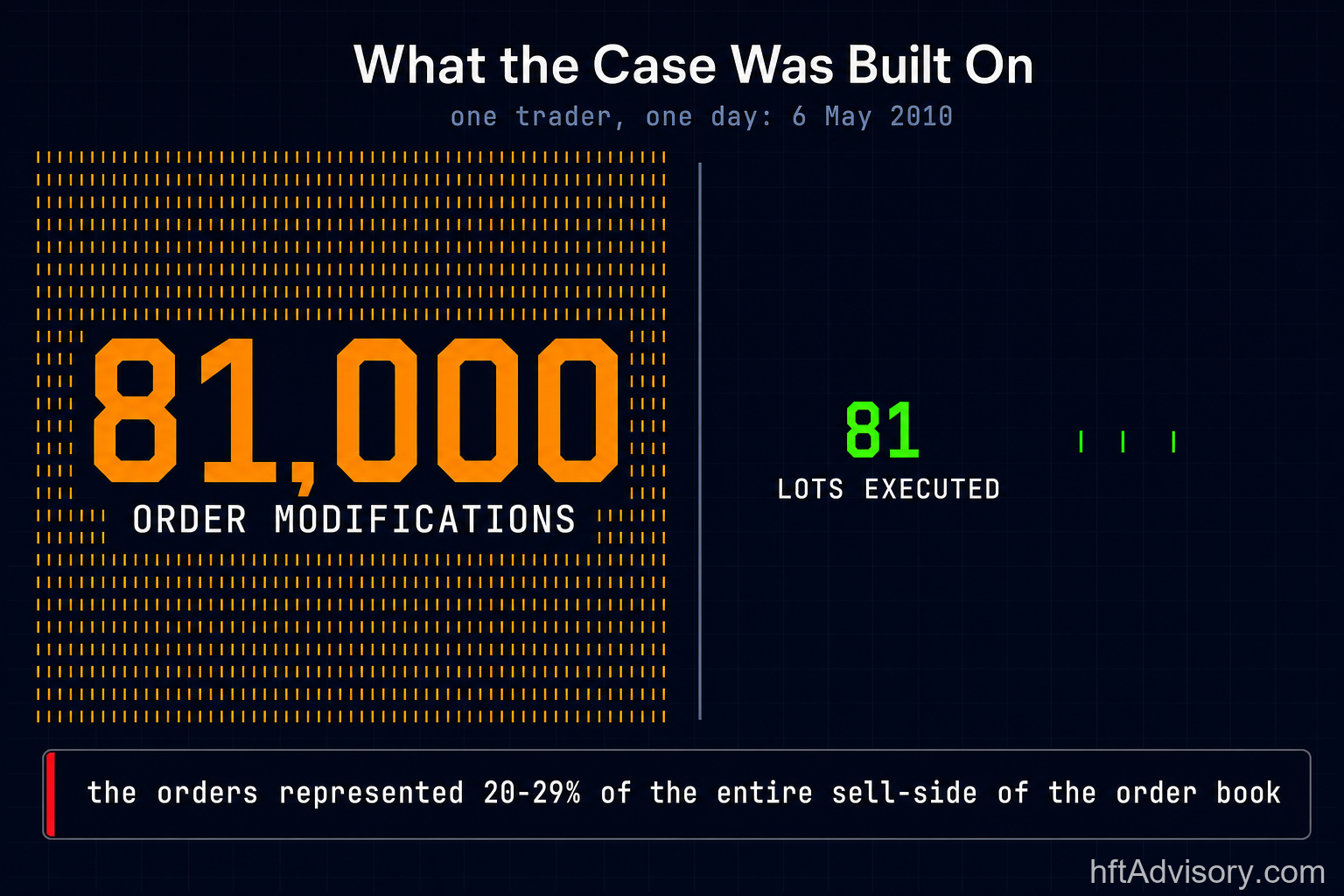
Sarao’s May 6, 2010 layering program makes the point without argument. Per the CFTC’s consent order, his orders “were modified over 81,000 times that day, with only 81 lots resulting in executed trades,” and before cancellation at 1:40 p.m. CT they “represented approximately $170 million to over $200 million worth of persistent downward pressure… and represented 20-29% of the entire sell-side of the order book.” Eighty-one lots traded. Eighty-one thousand modifications built the case. Sarao pleaded guilty November 9, 2016 to one count of wire fraud and one count of spoofing, conduct spanning January 2009 to April 2014 in E-mini S&P 500 futures, admitting at least $12.8 million in illicit gains. The CFTC’s consent order carries a $25,743,174.52 penalty, $12,871,587.26 in disgorgement, and a permanent trading ban.
You already know the rest of that reel. Coscia in 2016, the first criminal conviction under the provision, three years in prison. JPMorgan in 2020, $920.2 million, which the CFTC called the largest amount of monetary relief it had ever imposed. If you sit anywhere near compliance you have seen those numbers on a slide.
The more useful observation is what the recent filings count. On September 9, 2025 the CFTC settled with Brett Falloon and Flatiron Futures Traders LLC over 2022 conduct in E-mini S&P 500 and E-mini Nasdaq 100 futures, where “the aggregate number of contracts in his spoof orders outnumbered the contracts in his legitimate orders 5-to-1.” A June 25, 2026 guilty plea in United States v. Mingran Wang covered “more than 3,000 instances of manipulative trading and spoofing” from 2021 to 2024.
A ratio and a count of order events. In both filings the headline quantity is a property of the message stream, not of the P&L, and in Wang’s case the forfeited proceeds of just over $1.3 million are the smaller number in the document. Whatever else your cancel stream is, it is the thing that gets counted when someone decides to look.
You Are Required to Reconstruct It
Two regimes require you to answer for every message sent, and one obligation almost nobody outside compliance discusses ties them together.
SEC Rule 613 built the Consolidated Audit Trail around exactly this event list: “each reportable event with respect to each quote and order, such as origination, modification, cancellation, routing, and execution.” Data must reach the central repository “by 8 a.m. Eastern Time the following trading day,” timestamped “in millisecond or finer increments.”
MiFID II’s RTS 24 requires venue operators to “keep at the disposal of their competent authority the details of each order,” cross-referencing RTS 25 for timing: a record of “the date and time of the occurrence of each event… with the level of accuracy specified by Article 2 of Commission Delegated Regulation (EU) 2017/574.” That cross-reference holds the interesting number, and it repays reading closely, because RTS 25 sets two different standards that are easy to conflate.
Article 2 and Table 1 of the Annex bind the venue, scaled to the venue’s own matching speed. A trading system with gateway-to-gateway latency above one millisecond may let its clock diverge from UTC by up to one millisecond. A system running at one millisecond or faster must hold to 100 microseconds, timestamped to a microsecond or better.
Article 3 and Table 2 bind you, and they key off something else entirely. Not your latency. Your classification. Any member or participant engaged in “activity using high frequency algorithmic trading technique” must hold its business clocks to 100 microseconds of UTC, with timestamp granularity of a microsecond or better. Any other trading activity not named in the table is allowed a millisecond. Three categories are then carved out by name and given the loosest standard of all, a full second: voice systems, request-for-quote flows that require human intervention, and negotiated transactions.
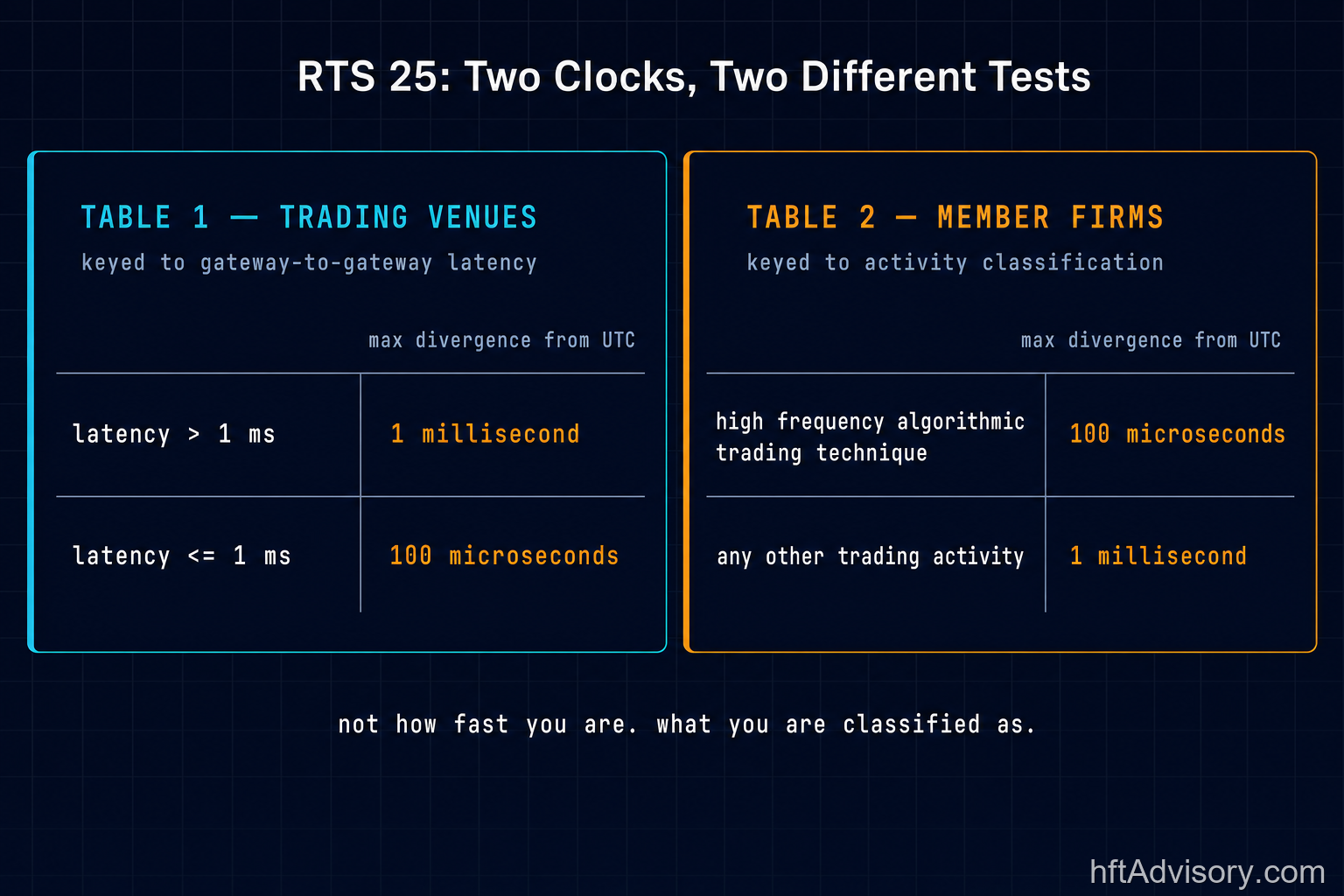
That is the Italian tax structure arriving from a different direction. Landing inside the high-frequency category tightens your clock requirement by an order of magnitude, and the coupling runs through the classification, not through what you call your desk. Retention runs five years, extendable to seven at a competent authority’s request, under MiFID II Directive 2014/65/EU Article 16(7), not RTS 24 itself, a distinction worth getting right.
The obligation almost nobody discusses sits in RTS 6, Articles 12 and 13. Article 12 requires kill functionality: the ability to “cancel immediately, as an emergency measure, any or all of its unexecuted orders submitted to any or all trading venues to which the investment firm is connected.” Article 13 requires self-surveillance: an “automated surveillance system which effectively monitors orders and transactions, generates alerts and reports” for signs of potential market manipulation. Together, weak cancel-stream reconstruction becomes an active compliance failure on its own, independent of whether the desk ever spoofs anything.
The Market Abuse Regulation names what these systems exist to catch. Article 12(1)(a) covers orders giving false or misleading signals about supply, demand or price; the Commission’s delegated regulation spells out the mechanics: submitting orders away from the touch to execute on the other side, after which “the orders with no intention to be executed shall be removed — usually known as layering and spoofing”; and entering large volumes of orders and cancellations “so as to create uncertainty for other participants… — usually known as ‘quote stuffing.'”
The Public Ledger, and What It Actually Counts
Three ledgers so far are private. The venue bills you privately. The tax authority assesses you privately. The regulator builds its case privately, and makes it public only at settlement. A fourth is different. It goes public monthly, on a schedule that started three days before this article published.
The amended Rule 605 had an effective date of June 14, 2024. Its compliance date, after one extension documented in Federal Register 2025-19316, moved from December 14, 2025 to August 1, 2026: “the Commission… is extending the compliance date for the amendments to the rules requiring the disclosure of order executions in national market system (‘NMS’) stocks from December 14, 2025, to August 1, 2026.” No further extension followed. That date arrived on schedule, unmodified, three days before this article publishes.
A FINRA Information Notice dated June 17, 2026 confirms what comes next: “the amendments to Rule 605 will become effective on August 1, 2026, and the first set of monthly reports (for August 2026) under the amended rule must be published before the end of September 2026.” The obligation is live now. The first visible artifact lands next month.
What the amended rule measures: realized spread at five time horizons, “50 milliseconds, 1 second, 15 seconds, 1 minute, and 5 minutes,” timestamped “in increments of a millisecond or finer.”
It also counts cancellations, and this is where the obvious assumption fails. Rule 605 is an execution-quality regime, so you would expect it to ignore orders that never executed. It does not. The rule requires reporting “the cumulative number of shares of covered orders cancelled prior to execution.”
That inclusion was deliberate, and it was argued. The Commission considered excluding quickly-cancelled orders from the covered-order definition, weighed it under the release’s “Reasonable Alternatives” heading, and declined, having observed that “limit orders that are canceled within a very short amount of time after submission are likely driven by trading strategies (for example, high frequency trading and ‘pinging’) that are not intended to provide liquidity…” It named the strategies, considered carving them out of the public statistics, and left them in.
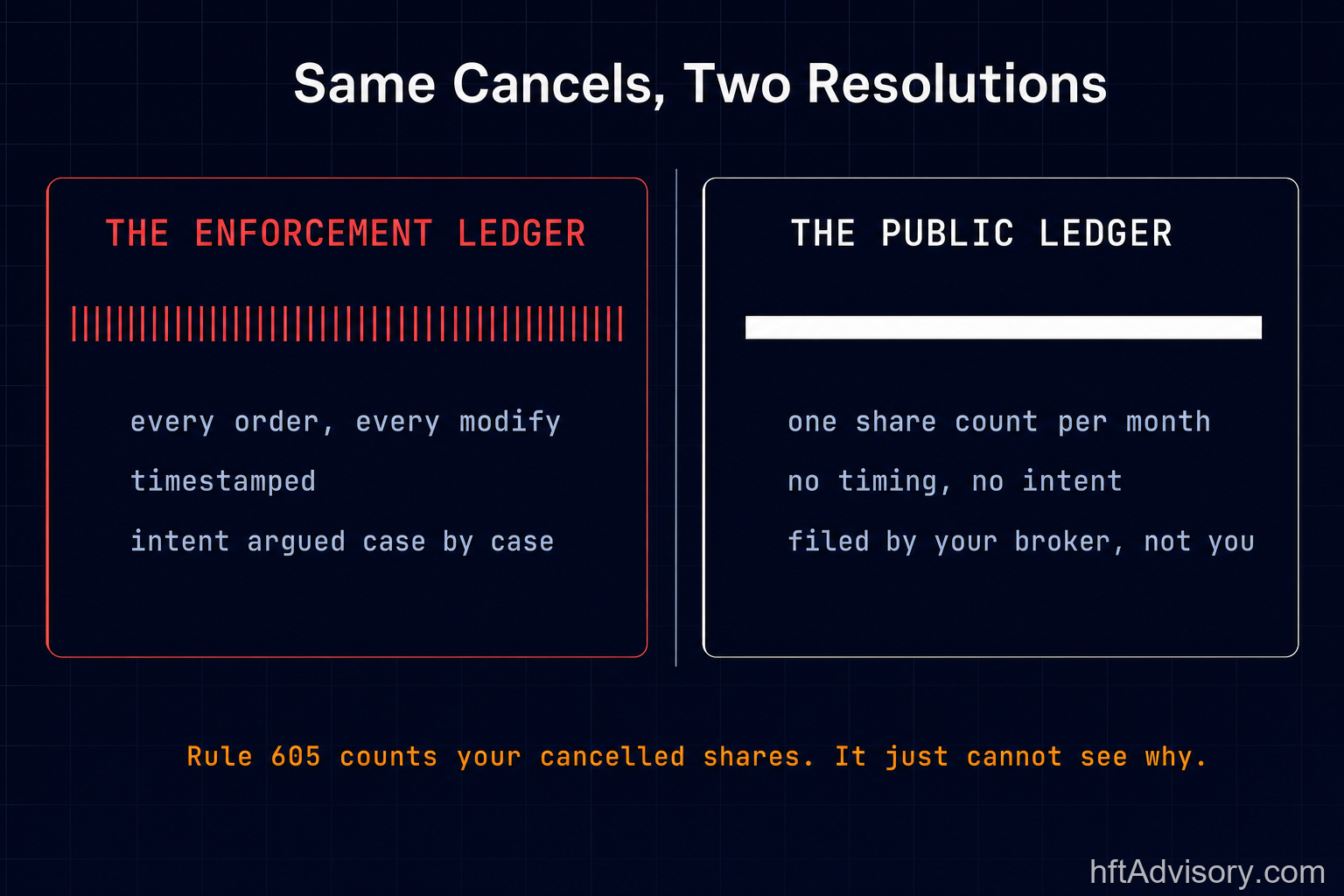
So the fourth ledger is not blind to your cancellations. It aggregates them, and the difference in resolution is the point. The enforcement ledger reads your cancel stream order by order, with a timestamp on every modification and intent argued over each one. The public ledger reads the same behaviour as a share count per security, per order type, per month, with the timing and the intent stripped out.
There is a second distinction that matters more for most readers of this piece, and the rule is explicit about it. The filing obligation falls on market centers and on broker-dealers meeting the 100,000-customer-account threshold, not on the desks whose orders they carry. If you run a quant fund or a proprietary desk, you are almost certainly not a Rule 605 filer. Your cancellation behaviour still reaches the public record, but it reaches it inside your executing broker’s monthly statistics, pooled with everyone else’s flow. You will not be asked to sign that report and you do not control what it says. Knowing which of your brokers has just started publishing it, and what your flow contributes to their numbers, is a different exercise from the other three ledgers, and nobody is going to invoice you for getting it wrong.
The Honest Complications
Eurex already conceded the point this section exists to make. Its December 2025 change gives passive, liquidity-providing cancellation a smaller volume factor than aggressive, liquidity-taking cancellation on the same instrument types. A venue that bills order-to-trade ratios for a living looked at its own cancellation-heavy flow and decided not all of it deserves the same price. The best answer to “high cancellation is usually legitimate market making” is a venue’s own fee schedule quietly admitting the distinction is real and worth pricing differently, not a rhetorical claim.
Start with the scale fact. Khomyn and Putniņš, in “Algos gone wild: What drives the extreme order cancellation rates in modern markets?” (Journal of Banking and Finance, Volume 129, 2021, Article 106170), found 97% of orders in US stock markets are cancelled before they trade, “straining market infrastructure and raising concerns about predatory or manipulative trading.” The same paper immediately qualifies its own headline number: “high OTTRs occur legitimately in stocks with high volatility, fragmented trading, small tick sizes, and low volume,” usually “within levels consistent with market making,” only “occasionally” spiking toward something that resembles spoofing.
The line is hard to draw from message patterns alone. M.E. Verhulst and J.M.E. Pennings, in “Spoofing in US futures markets: an interdisciplinary approach” (Capital Markets Law Journal, Volume 20, Issue 3, September 2025), put it directly: “under the present anti-spoofing statute of the Dodd-Frank Act, legitimate trading may constitute spoofing, making it difficult to distinguish legitimate from illegitimate trading,” since “HFT market makers can be seen as spoofers as they place several orders at multiple exchanges and cancel all of these orders as soon as the first order is executed.” The same paper documents two compliance officers at one bank looking at an identical pattern and reaching opposite conclusions. One called it “pretty obvious” and problematic. The other: “[W]hat is being seen may look like potential layering or spoofing, but based on the fact [that] we are talking [about] 1 lots, we believe he is just adjusting his exposure to the marketplace.” Same data. Same desk. Opposite read.
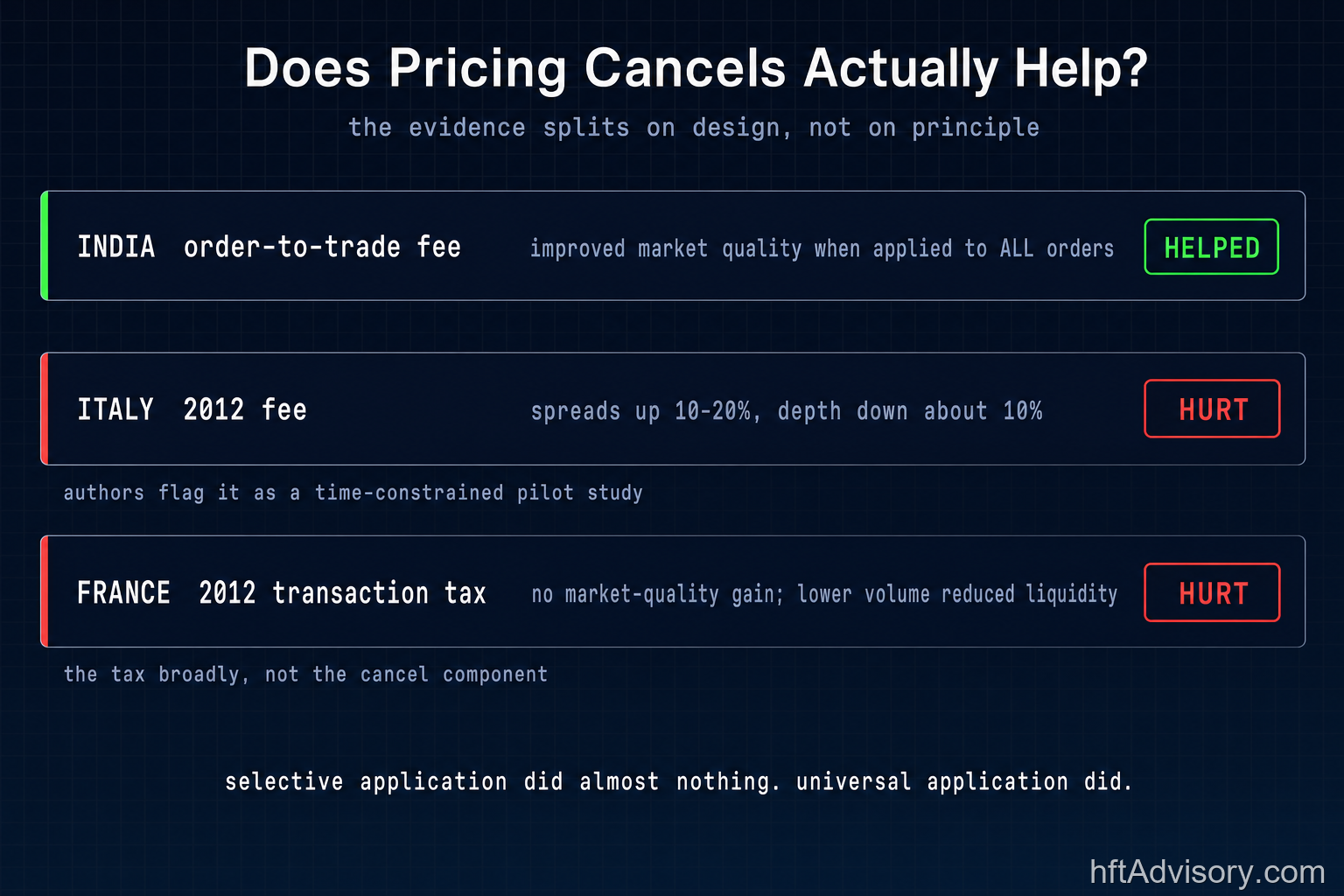
Even the fee evidence, the cleanest empirical case for cancel pricing, resolves on design rather than principle. Aggarwal, Panchapagesan and Thomas, in “When is the order-to-trade ratio fee effective?” (Journal of Financial Markets, Volume 62, 2023), found an Indian order-to-trade fee improved market quality only “when it was imposed on all orders,” with “little effect when it was imposed selectively on some orders,” the gain coming from “a reduction in adverse selection costs following lower OTR.” Friederich and Payne, writing for the UK Government’s Foresight project in 2012 on Italy’s April 2012 order-to-trade fee, found spreads rose “of the order 10 to 20%” and depth fell “by around 10%,” flagged by its own authors as “a pilot study… under strict time constraints.” Colliard and Hoffmann, in ECB Working Paper No. 2030 (February 2017) on France’s 2012 transaction tax, found “no support for the idea that an FTT improves market quality by affecting the composition of trading volume,” attributing the decline to lower volume broadly rather than to the cancellation mechanism.
Even the surveillance infrastructure sits under live review. On April 16, 2026, SEC Chairman Paul Atkins announced relief that “reduced the CAT’s projected annual operating costs by over $100 million and permanently eliminated the reporting of personal identifiable information to the CAT,” alongside a concept release seeking comment on “foundational and existential aspects of the CAT.” The system supplying evidence for the third ledger is itself being reconsidered.
What Transfers to Crypto Venues
Everything above is NYSE, Cboe, Euronext, LSE, Eurex, CME futures and two European tax codes. A desk trading crypto sits outside most of it, so rather than wave at a structural analogy, here is precisely which parts reach you and through what mechanism.
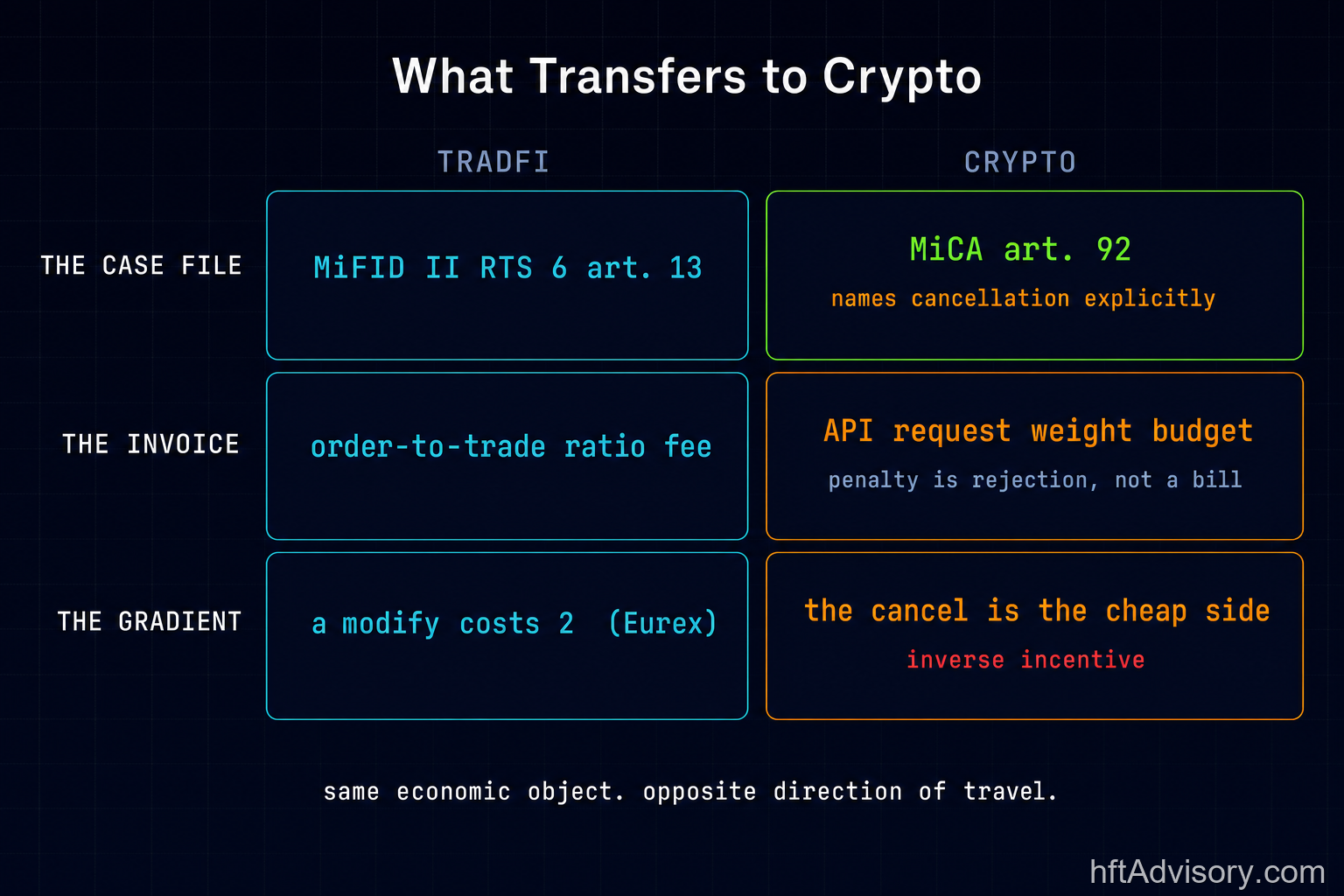
The case file transfers by name. MiCA, Regulation (EU) 2023/1114, has applied since 30 December 2024. Its Article 91 defines market manipulation in language that will look familiar from MAR, covering anyone “placing an order to trade or engaging in any other behaviour which… gives, or is likely to give, false or misleading signals as to the supply of, demand for, or price of, a crypto-asset.” Article 92 is the one to read twice. It requires any person “professionally arranging or executing transactions in crypto-assets” to maintain “effective arrangements, systems and procedures to prevent and detect market abuse,” and to report without delay “any reasonable suspicion regarding an order or transaction, including any cancellation or modification thereof.” That is the RTS 6 self-surveillance obligation arriving in crypto with cancellation and modification written into the operative text. Apply the same perimeter question here that the rest of this article applies elsewhere: Article 92 binds persons “professionally arranging or executing transactions,” which is an intermediary category, and whether your own entity sits inside it is a question for counsel rather than one I can answer from the regulation. Ask it before you either build to this or dismiss it.
The invoice transfers, but as a throttle rather than a bill, and the gradient runs the other way. Nobody is sending you an order-to-trade ratio invoice for spot crypto. Your messages are metered anyway. Binance’s own spot API specification prices a new order at request weight 1 and a cancel at request weight 1, so on that meter a cancel costs exactly what placing cost. But the new order also consumes an unfilled order count budget that the cancel does not, and cancelling can be batched. Net of both meters, the cancel is the cheap side and the placement is the metered one, which is the inverse of the incentive Eurex and NYSE create. Same economic object, message capacity priced as a scarce resource, opposite direction of travel. Worth knowing which way your venues lean before you port a TradFi intuition onto them, and worth remembering that the penalty here is rejection rather than an invoice, so you meet the limit during the volatility event instead of at the end of the month.
Where I stopped: I am not extending this to on-chain order books. Whether a cancel there is a metered state change or a free off-chain instruction depends on the venue’s architecture, and I have not verified it venue by venue. If your flow runs through one, that is the question worth asking before you assume either answer.
Practical Framework: The Four-Ledger Diagnostic
Five questions for an architecture review, built around the four ledgers above.
1. Compute your own order-to-trade ratio per venue, per day, before the invoice arrives. Confirm your model matches the venue’s own definition. On Eurex products, does your calculation count a modify as two events, delete plus add, the way Eurex’s own OTRvol formula does? That gap is the difference between forecasting your bill and discovering it.
2. Confirm you can reconstruct any single order’s full lifecycle, every modify and cancel included, at a timestamp accuracy that matches your RTS 25 activity classification rather than your assumptions about it. If nobody can say without checking whether your desk falls inside the high-frequency category, and therefore whether your clocks owe 100 microseconds or a millisecond, that uncertainty is itself the finding.
3. Know which venues price cancels, and at what threshold. Five structurally different mechanisms sit inside this article alone. Assuming NYSE’s math applies on Eurex, or that Euronext’s daily cap covers its per-trade allowance too, means treating one venue’s number as if it generalizes.
4. If you trade Italian or French instruments, establish scope before you build anything. Ask tax counsel whether either statute reaches your entity and your activity: France’s business-operated-in-France test, its market-making exemption, and its treatment of smart order routers; Italy’s exemption and exclusion lists at Articles 15 and 16 of the implementing decree. Only if the answer is yes does the second question matter, which is whether anything in your stack computes the statutory ratios themselves, Italy’s 60% same-day threshold measured under half a second and France’s two-thirds daily threshold, rather than assuming desk-level monitoring built for venue fees happens to satisfy a tax statute.
5. If you run a MiFID investment firm, or a crypto-asset service provider inside MiCA’s perimeter, run automated surveillance over your own order flow, not just your fills. Check that scope question first, because it is the gate on the most expensive item in this list: a US-domiciled fund trading through a prime broker is not carrying RTS 6 Article 13 itself. Where it does apply, it applies regardless of whether you have ever come near spoofing. The Sarao case is the standing reminder of what gets charged when nobody else does: not a P&L number, a count of order events and a ratio.
Questions one and two are cheap, and I would start there. Both are reads against data you already hold, both take about a week, and both return a yes or a no.
The rest are not cheap, and pretending otherwise would be dishonest. Durable lifecycle reconstruction means a capture path, a retention tier, clock discipline you can evidence rather than assert, and a query layer that can rebuild one order’s history months later. On most desks the order-update stream is consumed to maintain state and then dropped, so this is a project measured in engineering quarters. The case for scoping it is not that it is easy. It is that the two cheap questions tell you how exposed you are on the expensive ones.
Conclusion
Where I have not closed the loop: RTS 6 requires firms to build automated surveillance that draws a clean line between legitimate market making and manipulative layering, from order and message patterns alone. Verhulst and Pennings’ two compliance officers, looking at identical data, could not agree on which side of that line one trader sat. Eurex’s own December 2025 repricing suggests venues believe the line is drawable at the aggregate level, aggressive volume against passive, even where two experienced humans reviewing one individual pattern could not agree on it. I do not know how an automated self-surveillance system is supposed to succeed at a task two compliance officers split on, working with more context than an algorithm gets.
What I do know is that the four ledgers here do not wait for that question to resolve. The venue bills the ratio whether or not the flow was legitimate. The statute taxes it on a mechanical, half-second threshold. The enforcement record treats a single cancelled order, with the wrong intent, as a complete case. And the ledger that went public this month counts your cancelled shares in aggregate, inside a report your broker signs rather than you. One tape, four readings, and the hardest question of all, telling legitimate cancellation-heavy trading apart from the manipulative kind, is the one none of the four actually answers for you.
An architecture review that includes this question, whether your desk’s cancel stream would hold up if all four ledgers looked at it at once, is the kind of engagement I run. It starts with a Strategy Discovery Call at hftAdvisory.com.
This piece is the second reading of the tape. The first, on what the cancel stream costs your signal quality rather than your compliance posture, is The Cancel-Stream Gap: Why Your Signal Stack Is Building on 35% of the Order Book, published April 30, 2026.
Never Miss an Update
Get notified when we publish new analysis on HFT, market microstructure, and electronic trading infrastructure. No spam.
Subscribe by EmailAriel Silahian is a senior technology executive in institutional electronic trading, with 30+ years across the buy and sell side (New York, Miami, London, Hong Kong). He is the author of "C++ High Performance for Financial Systems" (Packt) and the creator of VisualHFT, the open-source microstructure analytics stack. He writes on exchange architecture, market microstructure, and execution quality, and advises a select number of trading firms on infrastructure decisions that move P&L. Book a strategy call at hftAdvisory.com