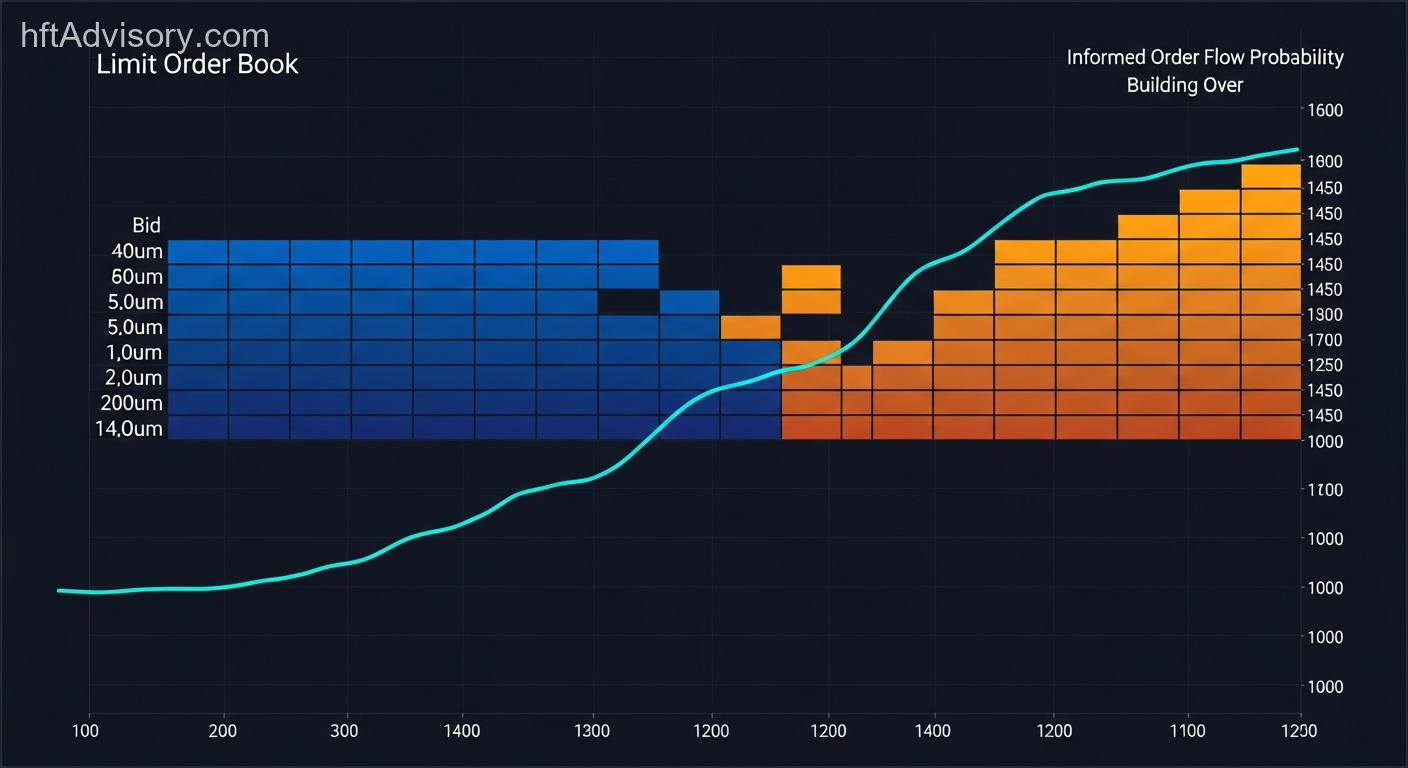
$600K in OMS infrastructure. On a $50M AUM crypto fund, a team-deployed custom system recovered that investment in under two weeks.
That is not a sales pitch. It is the arithmetic from a specific engagement I ran with a fund manually trading across 10 or more exchanges simultaneously. I will show you exactly how the math works and, more importantly, what was actually broken.
Table of Contents
- What Execution Drift Actually Is (And Why “Slippage” Is the Wrong Word)
- The Real Slippage Math: What 17-54 bps Costs at Scale
- Why Crypto’s Fragmented Structure Makes This Worse Than Equities
- The Exchange API Risk Nobody Models
- Build vs. Buy: The Vendor Landscape
- The Execution Stack Audit Checklist
What Execution Drift Actually Is (And Why “Slippage” Is the Wrong Word)
The industry uses “slippage” as a catch-all. That conflation is part of the problem.
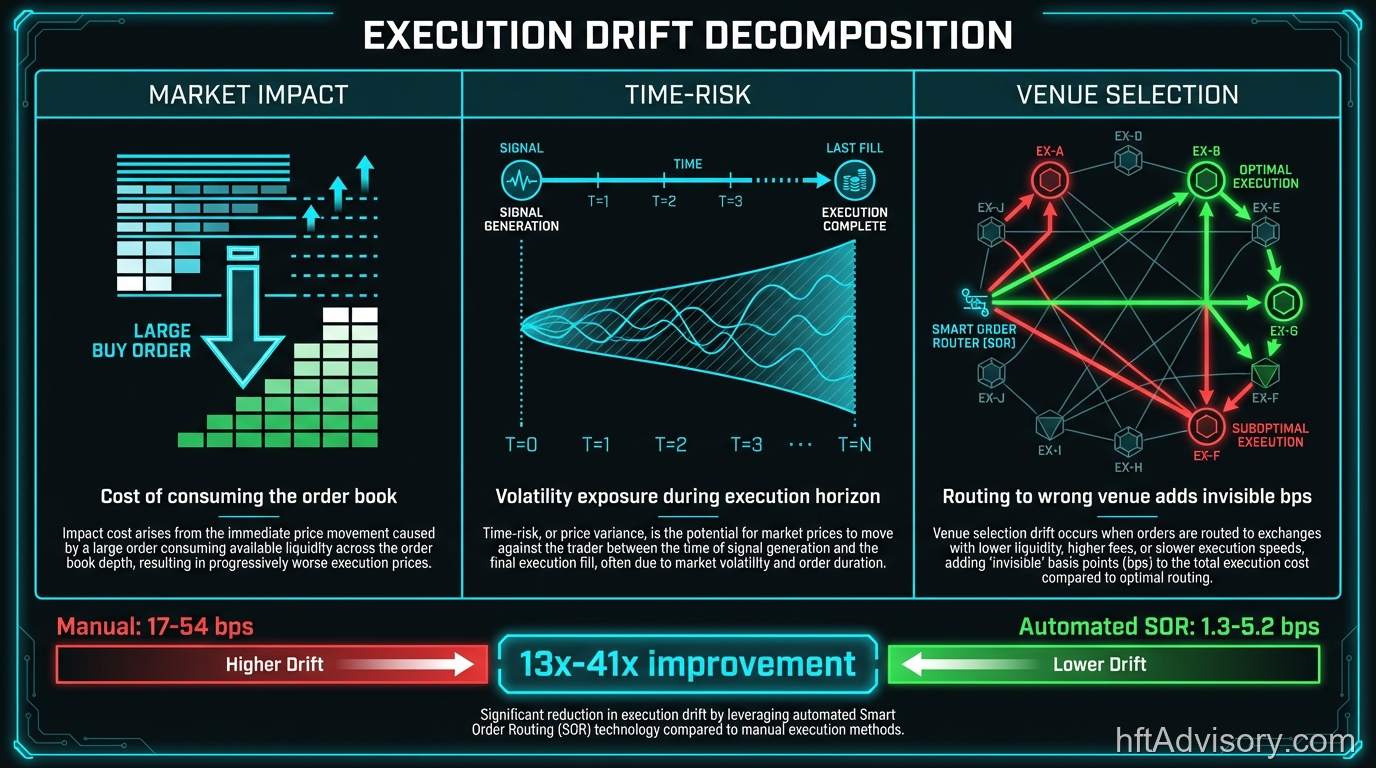
Slippage implies a single point of failure: the difference between where you expected to fill and where you did. Execution drift is a different diagnostic frame. It decomposes into three separable cost sources, each with distinct causes and distinct remediation paths:
Market impact is the cost of consuming the order book. A large order moves the market against you as it executes. This is the component most funds measure, and it is often the smallest of the three for funds under $500M AUM trading crypto spot.
Time-risk is the cost of volatility exposure during the execution horizon. From the moment a signal fires to the moment the last fill lands, you are exposed to price movement. The wider that window, the more you pay. Manual execution across 10 exchanges blows this window open.
Venue selection inefficiency is the cost most funds ignore entirely. Routing an order to a venue with insufficient liquidity, higher effective spread, or suboptimal fee structure adds basis points to every trade, invisibly and systematically, without triggering any alert.
The Quantitative Brokers framework describes this three-component decomposition precisely. The reason it matters for crypto specifically is that venue selection inefficiency is not a minor line item here the way it might be in US equities. Crypto has no consolidated tape. Bid-ask spreads are wider than equivalent FX pairs because of fragmented venues. DEX pool fees range from 1 to 100 bps depending on the pair. Routing decisions that are good enough in a centralized, consolidated market become systematically expensive in this structure.
When I say execution drift, I mean all three costs combined… not the single-point slippage number your current reporting probably shows you.
The Real Slippage Math: What 17-54 bps Costs at Scale
A Talos study covering BTC/ETH basis trades, calibrated on 50,000 or more parent orders across 50 or more venues between June 2024 and July 2025, produced a data point that should be on the desk of every crypto CTO: manual multi-exchange execution averaged 17 to 54 bps in slippage. Automated smart order routing brought that to 1.3 to 5.2 bps.
That is a 13x to 41x improvement in execution quality on the specific strategy class studied.
To translate that into dollar terms at realistic AUM levels:
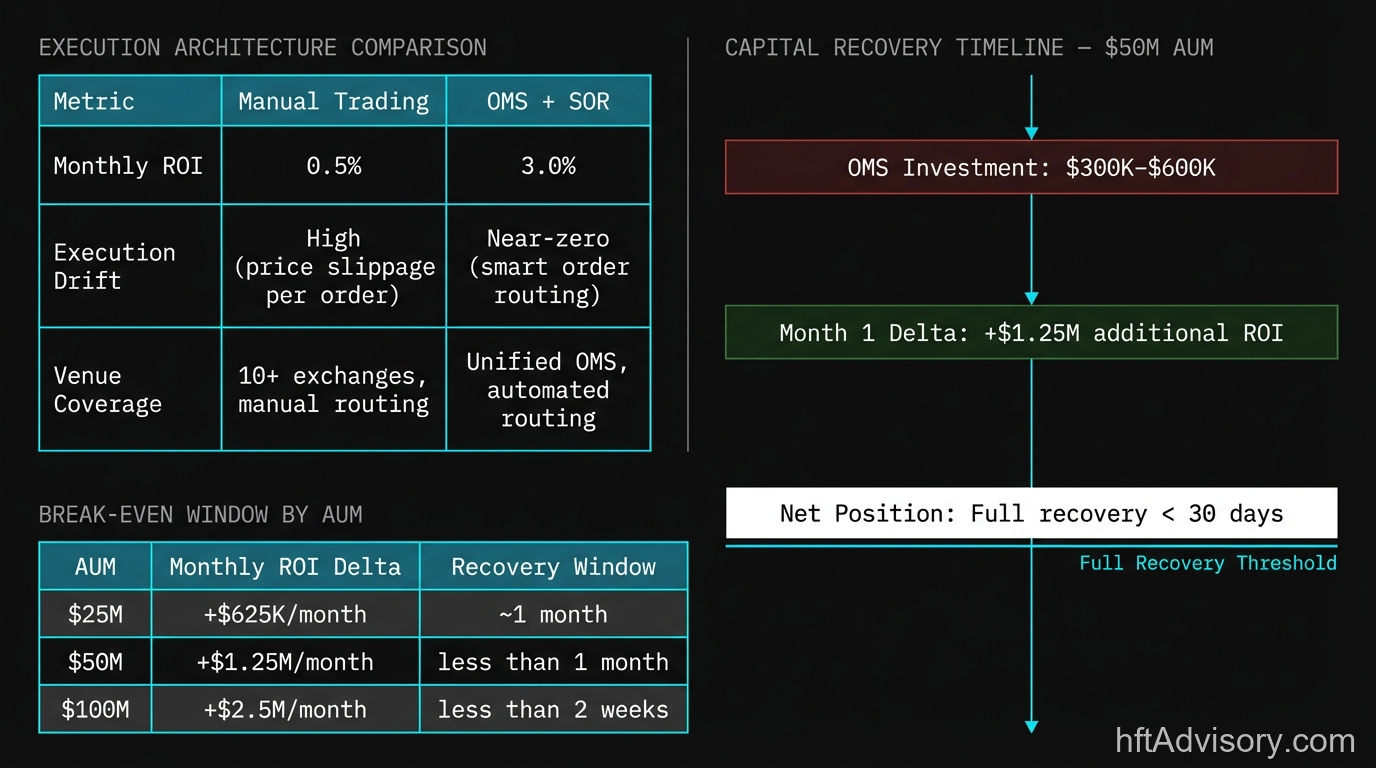
| AUM | 0.5% monthly ROI (manual) | 3.0% monthly ROI (automated) | Monthly delta | Annual delta |
|---|---|---|---|---|
| $50M | $250,000 | $1,500,000 | $1,250,000 | $15,000,000 |
| $100M | $500,000 | $3,000,000 | $2,500,000 | $30,000,000 |
| $250M | $1,250,000 | $7,500,000 | $6,250,000 | $75,000,000 |
These ROI figures come from a specific engagement I ran… not industry benchmarks. Actual results at larger AUM will vary by strategy concentration and market conditions. Before the infrastructure change: the fund was executing entirely by hand, routing exchange by exchange, watching prices slip between signal and fill. Monthly ROI in that period averaged approximately 0.5%. After the team deployed a custom OMS with smart order routing and integrated risk management: approximately 3% monthly. Same AUM. Same market conditions. Different execution architecture.
The OMS cost $300K to $600K for a custom build across 10 exchanges (mid-range of institutional trading system costs). At $50M AUM, with a $1.25M per month delta between manual and automated execution, the payback period is under two weeks.
The arithmetic does not require heroic assumptions. It requires fixing the execution stack.
Why Crypto’s Fragmented Structure Makes This Worse Than Equities
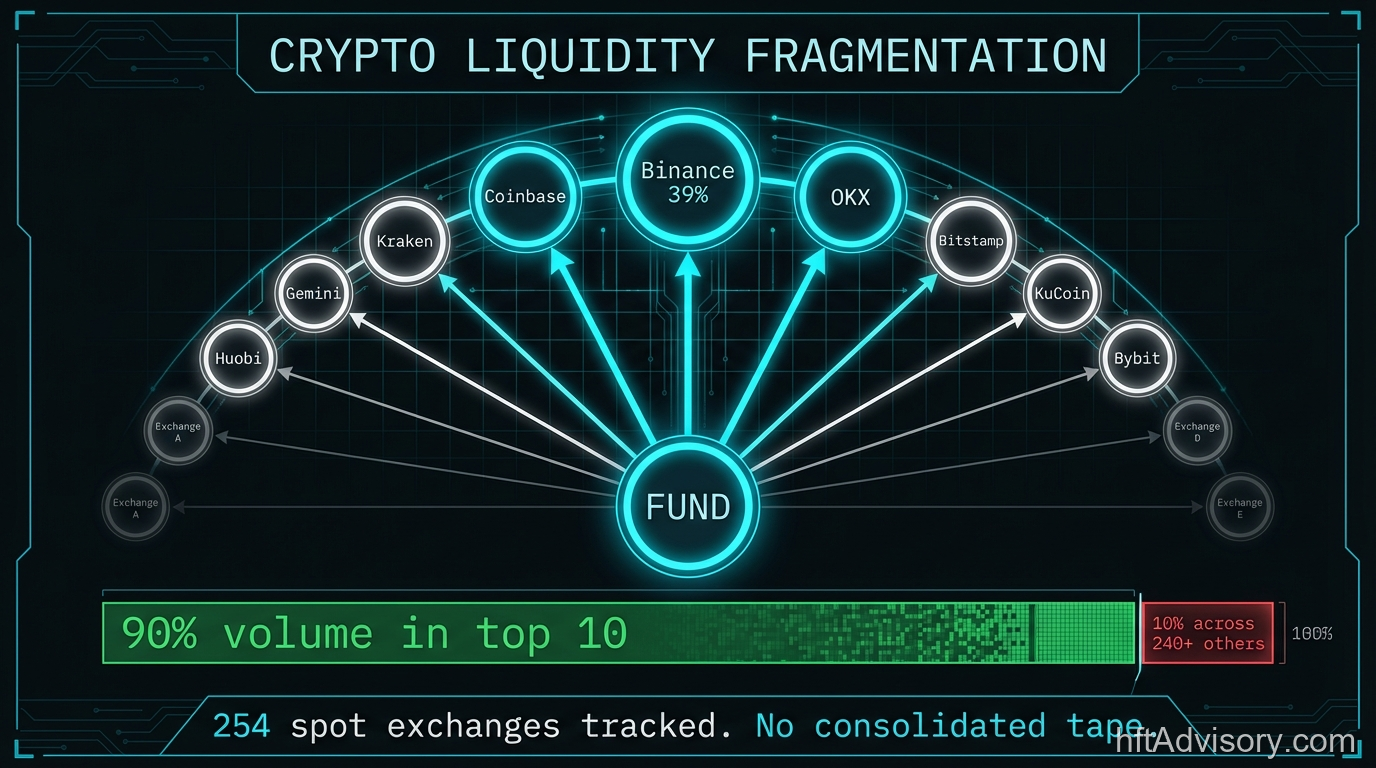
Of the roughly 250 spot exchanges tracked globally, the top 10 to 15 handle approximately 90% of volume. Binance alone accounts for 39.2% at $7.3T. The top 10 collectively process $18.7T (CoinLedger data).
That concentration looks reassuring until you examine the other side: the fund still needs to route across multiple venues to access sufficient liquidity for institutional-scale execution. You cannot run a multi-strategy crypto book entirely on one exchange. Cross-venue arbitrage requires simultaneous presence. And the moment you are routing across venues, you are absorbing venue selection costs at every order.
Intraday volume patterns compound this. Talos research identifies repeatable structure in execution drift: the percentage of daily volume nearly doubles during US market open windows. Automated systems that understand and exploit this structure fill at materially better prices than systems that do not.
On the arbitrage side: documented opportunity windows in crypto range from 200 to 800 milliseconds. Exchange processing at institutional venues runs 5 to 10 milliseconds. From a practitioner standpoint, human manual execution on multi-exchange arb falls in the range of 5 to 30 seconds from signal recognition to full fill. Against a 200 to 800 millisecond window, that is not suboptimal. The opportunity does not exist.
There is no version of manual multi-exchange execution that captures crypto arbitrage at institutional frequencies. The architecture is the strategy.
The Exchange API Risk Nobody Models
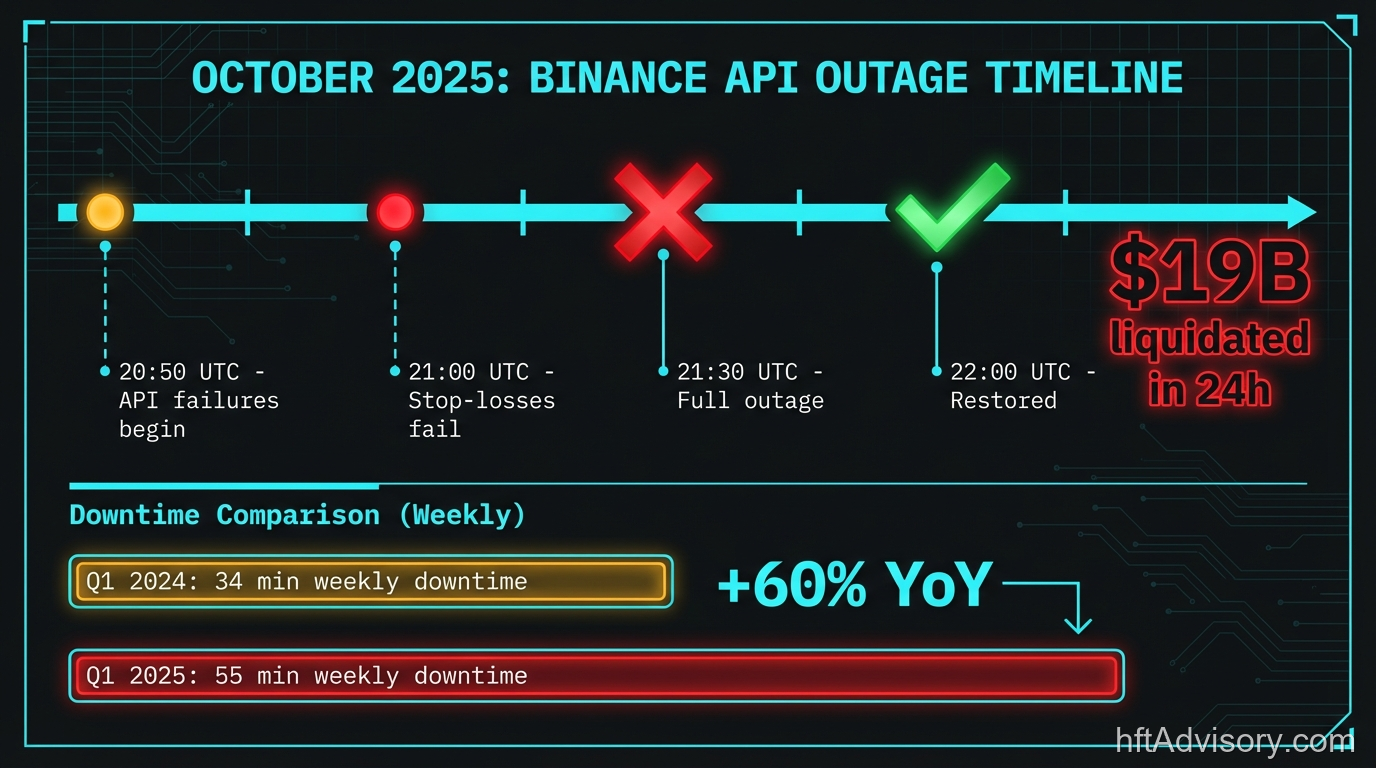
In October 2025, Binance experienced an API outage from 20:50 to 22:00 UTC. Stop-loss orders failed. $19 billion was liquidated in under 24 hours.
The fund that went into that event with no connectivity failover did not have an execution problem. It had an architecture problem that became visible during an execution event.
Industry-wide API uptime has degraded materially. Q1 2024 weekly downtime averaged 34 minutes. Q1 2025 averaged 55 minutes… a 60% increase year-over-year. The trajectory is moving in the wrong direction as institutional volumes increase and API infrastructure struggles to scale.
Most OMS evaluations focus on execution quality under normal conditions. Nobody stress-tests the failover path. The questions that should be on the audit list:
- What happens to live positions when the primary venue API goes dark?
- Is there automatic rerouting to secondary venues, or does execution halt?
- Are stop-losses exchange-side or system-side? If exchange-side, what is the behavior during an API outage?
- What is the position state if a cancel acknowledgment never arrives?
A crypto OMS that does not include connectivity failover architecture is not a complete system. It is an execution layer with a missing risk layer. The October 2025 event was not a black swan. API downtime at 55 minutes per week is a base-rate planning assumption.
Build vs. Buy: The Vendor Landscape
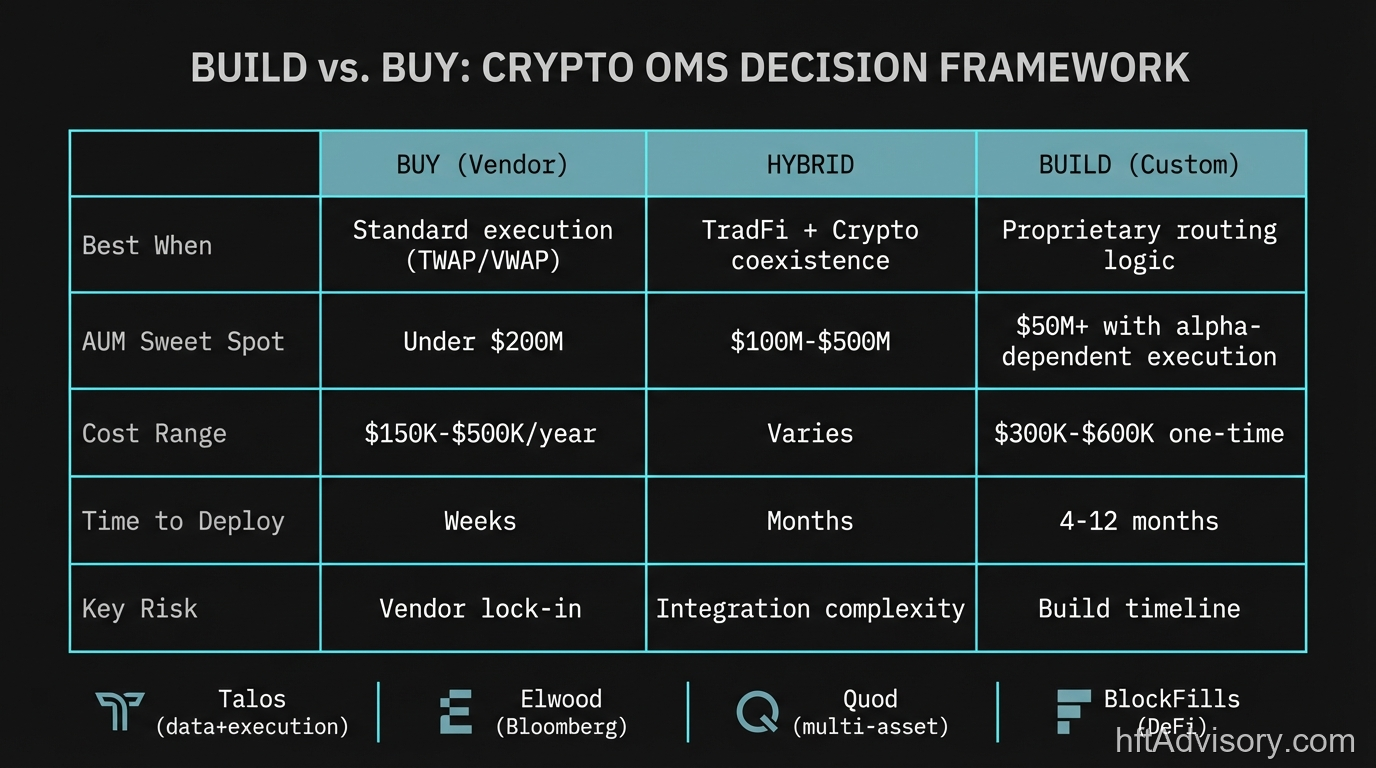
The institutional crypto OMS market has matured significantly since 2022. The relevant options in 2025 to 2026:
Talos (acquired Coin Metrics, July 2025, $100M-plus deal) is the most complete institutional platform… multi-asset, multi-venue, with a TMI (Transaction Market Impact) model calibrated on 50,000-plus parent orders. Strong for funds that need a turnkey solution with execution analytics built in.
Elwood brings Bloomberg integration, which matters for funds operating in a hybrid TradFi/crypto structure with existing Bloomberg terminal workflows.
Quod Financial is modular and multi-asset… the better fit for funds that need crypto execution to coexist with FX or equities infrastructure without a rip-and-replace.
BlockFills covers DeFi gateway connectivity for funds with on-chain execution requirements alongside CEX.
Custom build ($300K to $600K mid-range): The right choice when the fund’s execution logic is sufficiently proprietary that vendor platforms cannot accommodate it without material compromise. Custom builds also eliminate per-trade licensing costs that can compound significantly at scale.
The decision framework I apply:
- If the execution strategy is standard (TWAP, VWAP, arrival price benchmarks across CEX venues) and the fund is under $200M AUM: buy a vendor platform. The economics favor it.
- If the execution strategy is proprietary, multi-venue with specific routing logic, or includes DeFi alongside CEX: the vendor platforms will constrain you. Build.
- If API uptime and failover guarantees are contractual requirements: read the SLA carefully before signing. Most vendor platforms do not offer execution-layer SLAs.
The $600K custom build in the engagement I referenced was justified by two factors: proprietary routing logic that no vendor platform supported, and an exchange concentration across 10 specific venues that required custom integration work regardless of which path was chosen.
The Execution Stack Audit Checklist
This is the framework I use when a fund brings me in to assess their execution infrastructure. It is structured as a diagnostic… not a vendor evaluation. The goal is to identify drift before quantifying it.
Tier 1: Measure Arrival Price Slippage
The arrival price is the mid-price at signal time. Slippage is the distance between that reference price and your average fill. If your reporting system does not capture this per-order for every venue, you are not measuring execution quality… you are measuring P&L, which aggregates too many factors to isolate the execution component.
Minimum data requirements:
– Signal timestamp (microsecond-level)
– Order submission timestamp
– Fill timestamps per partial fill
– Venue-level fill price and quantity
– Arrival mid-price at signal time per venue
Without this data, the audit cannot proceed. If a fund cannot produce this data, that is itself a finding.
Tier 2: Benchmark Against TWAP and VWAP
Arrival price slippage tells you where you fell short of ideal. TWAP and VWAP benchmarks tell you whether smart order routing is adding value versus naive time-distributed or volume-distributed execution. A fund paying for smart order routing that consistently underperforms a naive TWAP benchmark is paying for a label, not a capability.
For crypto specifically, VWAP is the more informative benchmark given the intraday volume concentration patterns. If your fills consistently land outside the daily VWAP band, the routing logic is not exploiting known liquidity structure.
Tier 3: Venue Selection Distribution
Pull the last 90 days of fills and map them by venue. For each venue, calculate:
– Effective spread at time of fill vs. quoted spread
– Fill rate (orders placed vs. orders filled) by venue
– Average time-to-fill by venue
– Partial fill percentage by venue
A healthy multi-venue execution footprint should reflect liquidity-weighted routing. If one venue is receiving disproportionate flow relative to its liquidity contribution, the routing logic has a bias… either from fee optimization that ignores spread cost, or from latency-driven venue preference that does not account for fill quality.
Tier 4: API Connectivity Audit
Map every exchange API dependency. For each:
– What is the fallback if the primary connection fails?
– Are open position queries possible via an alternate endpoint?
– Are cancel requests idempotent (safe to retry on timeout)?
– What is the position reconciliation procedure if fills arrive out of order?
This is the tier most funds skip entirely until a Binance-style outage forces the question.
Tier 5: Latency Profile vs. Opportunity Window
If the fund has any strategies that depend on cross-venue price dislocations, map the end-to-end execution latency for a round-trip order (signal to fill acknowledgment) and compare it to the documented opportunity window range (200 to 800ms for crypto spot arbitrage). If your round-trip latency exceeds the lower bound of that range, the strategy is structurally unprofitable regardless of signal quality.
The Standard… and the Gap
The standard for institutional crypto execution in 2026 is 1.3 to 5.2 bps on execution costs for BTC/ETH basis strategies, automated smart order routing across primary venues, and sub-100ms order submission from signal to wire. Connectivity failover is table stakes.
If your current architecture cannot tell you your arrival price slippage on the last 90 days of trades… the gap between where you are executing and where you should be executing is not a risk estimate. It is an unquantified liability sitting inside every trade you place.
The Discovery Assessment framework I use to size that gap for new engagements is available at hftadvisory.com. The first conversation is diagnostic, not commercial.
Ariel Silahian has over 20 years of experience building and advising on institutional HFT and electronic trading infrastructure. He is the creator of VisualHFT, an open-source real-time market microstructure analytics platform.
This article was originally shared as a LinkedIn post. View the original post
Never Miss an Update
Get notified when we publish new analysis on HFT, market microstructure, and electronic trading infrastructure. No spam.
Subscribe by EmailHFT Systems Architect & Consultant | 20+ years architecting high-frequency trading systems. Author of "Trading Systems Performance Unleashed" (Packt, 2024). Creator of VisualHFT.
I help financial institutions architect high-frequency trading systems that are fast, stable, and profitable.
I have operated on both the Buy Side and Sell Side, spanning traditional asset classes and the fragmented, 24/7 world of Digital Assets.
I lead technical teams to optimize low-latency infrastructure and execution quality. I understand the friction between quantitative research and software engineering, and I know how to resolve it.
Core Competencies:
▬ Strategic Architecture: Aligning trading platforms with P&L objectives.
▬ Microstructure Analytics: Founder of VisualHFT; expert in L1/L2/LOB data visualization.
▬ System Governance: Establishing "Zero-Failover" protocols and compliant frameworks for regulated environments.
I am the author of the industry reference "C++ High Performance for Financial Systems".
Today, I advise leadership teams on how to turn their trading technology into a competitive advantage.
Key Expertise:
▬ Electronic Trading Architecture (Equities, FX, Derivatives, Crypto)
▬ Low Latency Strategy & C++ Optimization | .NET & C# ultra low latency environments.
▬ Execution Quality & Microstructure Analytics
If my profile fits what your team is working on, you can connect through the proper channel.