Table of Contents
- The 40-Seat Floor: Full Cost Breakdown
- What Compute-First Actually Looks Like: Virtu, HRT, and Jane Street
- The Market Structure That Made Human-Speed Trading Obsolete
- What the Critics Get Wrong
- A Framework for the 40-Seat vs. 8-Seat Decision
- Is Your Floor Sized for 2025? A Diagnostic Checklist
Goldman Sachs ran 600 equity traders in 2000. By 2017, that number was 2. Two hundred computer engineers had replaced them. Marty Chavez made that number public at a Harvard IACS symposium — not as a warning, not as a boast, but as a statement of structural reality.
That compression did not stop in 2017. It is still happening. Most trading floors being designed and built today are sized for a market structure that ended years ago.
I have spent more than 20 years building and advising on production HFT infrastructure — systems that operate at the microsecond level, execution stacks that touch 16+ active national exchanges simultaneously, risk architectures that have to clear in nanoseconds. What I see when I look at floor buildout proposals is a persistent mismatch between what the market actually demands and what institutions are budgeting to build.
This article is for the CTO or Head of Trading who is sitting with a floor buildout proposal on their desk right now. The argument I am going to make is specific: the math behind a 40-seat floor no longer closes. The same capital, reallocated to an 8-seat compute-first stack, generates structurally better economics — not marginally better, but by $10M to $20M per year in recoverable operational spend, before you model any alpha impact.
I am going to show you the full cost breakdown, show you the public benchmarks from firms that have already made this transition, address the market structure reality that drives the conclusion, dismantle the most common objections, and give you a decision framework you can bring to your next budget meeting.
The 40-Seat Floor: Full Cost Breakdown
Let’s start with the terminal cost.
Bloomberg Terminal at a single-seat rate runs $31,980 per seat per year as of January 2025. Enterprise and multi-seat contracts reduce that to approximately $28,320 per seat. For a 40-seat floor, that range is $1.13M to $1.28M annually — and that is before a single trade, before a single hire, before infrastructure. That is the information cost alone.
Now the personnel cost.
A fully loaded senior trader or quant at an institutional desk runs $350,000 to $625,000 in year one in base compensation and bonus. Fully loaded means what it actually costs to employ someone: FICA, healthcare, recruiting fees, onboarding, technology overhead per seat, real estate overhead per occupied position. When you run those numbers across 40 seats — even with a blended rate that assumes not every seat is a $625K quant — you land at:
- Base personnel cost: $14M–$25M per year
- Fully loaded with overhead: $16M–$28M per year
Now colocation density, which is where the infrastructure reality bites.
CBRE’s 2024 data puts primary market colocation at $163 to $184 per kilowatt per month. Their H2 2025 update projects that to $195.94/kW/month — a 6.5% year-over-year increase that reflects persistent power capacity constraints in primary US colocation markets. A trading floor does not just need office space. It needs power-dense rack space for execution infrastructure, market data feeds, and real-time risk systems. That cost is rising, not falling.
Add a floor build, and the total operating cost for a 40-seat institutional trading floor lands at:
$18M to $30M per year. Before alpha generation starts.
That is the number you are committing to when you approve a 40-seat floor. Not the build cost — the annual operating run rate.
What Compute-First Actually Looks Like: Virtu, HRT, and Jane Street
The counter-model is not theoretical. It is documented in three publicly available datasets.
Virtu Financial operates with 969 employees and generated $2.877B in total revenue in 2024. That is approximately $2.97M in revenue per employee. Trading income was up 40% year-over-year. Headcount decreased 0.62% while total revenue increased 25.4%. Virtu is not an HFT firm that happens to be lean — it is an HFT firm that has operationalized the ratio between compute capacity and human headcount as a core business model.
Jane Street produced roughly $6.4M in revenue per employee in 2024. In Q2 2025, they recorded $10.1B in net trading — a single-quarter record. Jane Street’s model is not a hedge fund model or a prop desk model. It is a systematic trading model running at scale, where the human capital is concentrated in engineers and researchers rather than traders watching screens.
Hudson River Trading trained foundation AI models on 20+ years of market data — a dataset exceeding 100TB. Their July 2024 Google Cloud partnership was significant enough operationally that HRT’s GPU purchasing was cited as bottlenecking H100 deliveries on the US East Coast. Their 2025 net trading revenue reached approximately $12.3B. HRT does not run a traditional trading floor. They run a compute infrastructure with a research function attached to it.
These are not outliers. They are the revealed benchmark.
What does the same $18M–$30M annual operating budget buy if you restructure toward 8 seats and 10x the compute?
The 8-seat compute-first model (modeled cost estimate):
- 8 senior quants and engineers at $400,000–$700,000 average fully loaded: $3.2M–$5.6M per year
- Compute and colocation infrastructure: $2M–$4M per year
- Total: $5.2M–$9.6M per year
The delta against the 40-seat floor — $10M to $20M per year — is what funds your entire colocation build, execution infrastructure, FPGA budget, and smart order routing layer. Not as an incremental spend. As a structural reallocation.
Goldman’s own documented ratio from the same period: 4 traders replaced by 1 engineer in currency trading, per Marty Chavez’s 2017 public statements. That ratio is not Goldman-specific. It reflects what the underlying economics of modern execution actually look like.

The Market Structure That Made Human-Speed Trading Obsolete
The case for compute-first is not primarily philosophical. It is structural.
Between January 2024 and January 2025, off-exchange trading — broadly defined as registered ATSs, dark pools, and principal dealer bilateral trades — went from 44.1% of consolidated US equity volume to crossing 50% for the first time in November 2024, reaching a record 51.8% in January 2025. That is a majority of US equity volume moving through venues and mechanisms that do not operate on a traditional exchange price-time priority model.
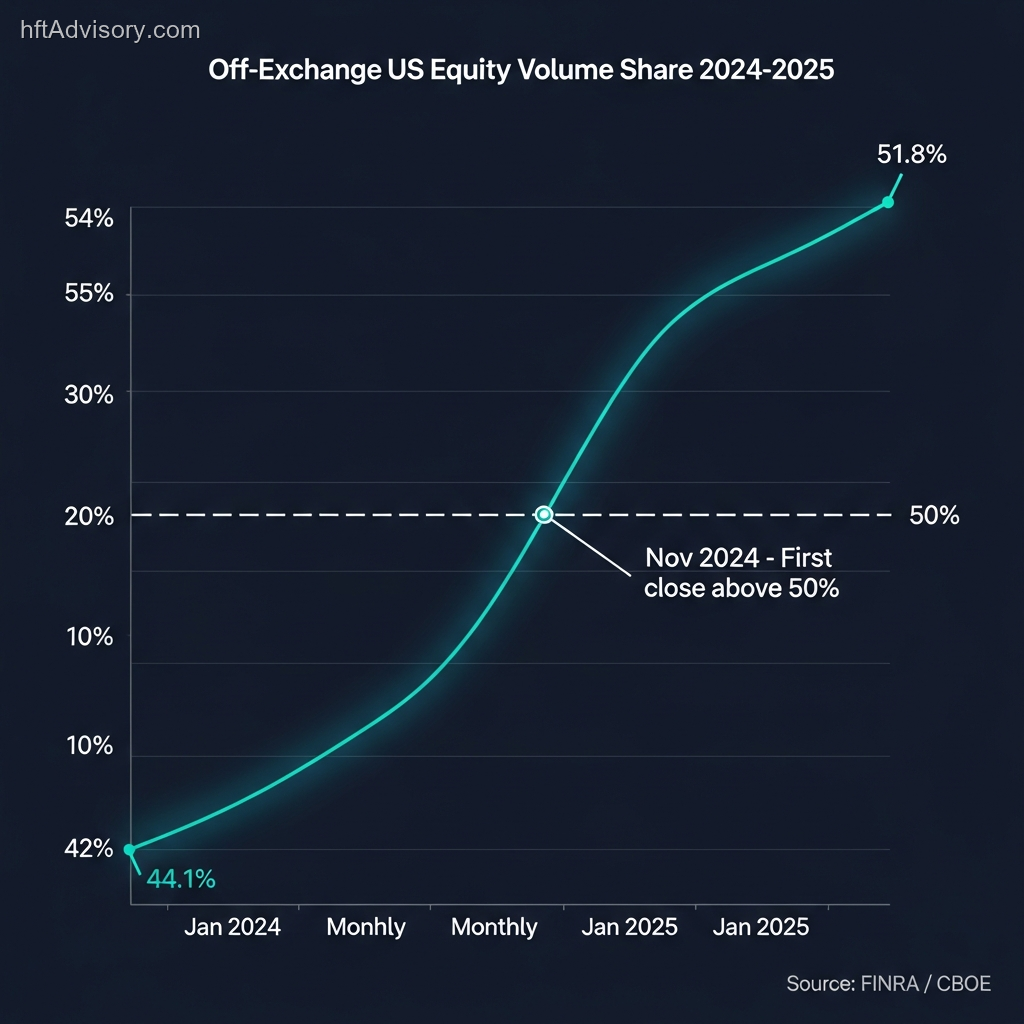
There are 16 or more active national equity exchanges in the US, plus 30 to 40 dark pools and ATSs operating simultaneously. A single institutional execution stack has to manage order routing, venue selection, and real-time risk monitoring across all of them in parallel. The speed at which venue conditions change — liquidity conditions, adverse selection risk, spread compression, short-term alpha decay — operates at a latency level where human reaction is not a factor. It is not that humans are slow relative to machines in some abstract sense. It is that the market structure has physically moved beyond the latency range where human judgment can intervene in execution decisions.
JPMorgan estimates put algorithmic flow at 60 to 75% of US equity volume. Some methodologies citing broader definitions reach 78%. However you define the scope, the majority of price formation in US equity markets is occurring through automated systems operating faster than human neurological response time.
FPGA-based execution achieves an average trade execution latency of 480 nanoseconds per IEEE 2024 benchmark data. AMD’s FinTech FPGA accelerator delivers a 7x latency reduction over the prior generation. CPU-based execution runs in milliseconds — three orders of magnitude slower. The gap between human-paced execution and FPGA-paced execution is not something you close with better training or more experienced traders. It is a physical constraint.
The SEC’s Reg NMS tick-size reforms, effective November 2025, and the ongoing Rule 611 Order Protection Rule review initiated in December 2025 are further signals that market structure continues to evolve in ways that reward execution sophistication over execution headcount.
What the Critics Get Wrong
The Flash Crash argument surfaces every time this conversation happens. The argument runs as follows: algorithmic systems contributed to the May 2010 Flash Crash; therefore, concentrating more capital in algorithmic infrastructure increases systemic risk; therefore, human oversight and a larger trading floor provide a risk management function that compute-first models eliminate.
This argument misreads the lesson. The academic post-mortem on the Flash Crash identifies algorithmic uniformity and the absence of circuit breakers as the root causes — not automation itself, but automation without adequate kill switches, without real-time risk monitors, without circuit breakers at the venue and firm level. The conclusion that follows is not “build more human capacity.” The conclusion is “build better infrastructure.”
The same analysis applies to regime-change failures observed during COVID volatility in March 2020. Models trained on historical correlation structures broke down when correlations shifted across the board within days. The lesson is not that human traders should make more execution decisions. The lesson is that algorithmic systems require robust regime-detection components, stress testing against fat-tail scenarios, and circuit-breaker logic that engages when model confidence falls below defined thresholds. Those are engineering problems, not headcount problems.
Morgan Stanley’s recent trajectory makes this explicit. After cutting fixed-income headcount approximately 25% following an electronic trading revamp, they rolled out OpenAI tools to their investment banking and trading division in October 2024. In early 2026, Morgan Stanley announced 2,500 job cuts following record 2025 revenue — explicitly paired with AI and automation. Revenue up, headcount down, and the stated driver is infrastructure investment, not workforce reduction for its own sake.
The critics who argue for human floors are not wrong that risks exist in algorithmic systems. They are wrong about the remedy. The remedy for algorithmic risk is better algorithmic infrastructure — not more seats.
A Framework for the 40-Seat vs. 8-Seat Decision
This is the decision framework I use when advising firms on floor sizing. It forces the specific questions that a floor buildout budget should answer before capital is committed.
Question 1: What percentage of your target strategy set requires sub-millisecond execution? If the answer is greater than 20%, you have a latency problem that headcount cannot solve. Any strategy operating in that window lives in FPGA territory, not in human reaction time territory. Budget accordingly.
Question 2: What is your cost per unit of alpha generated? Take your fully loaded annual operating cost and divide by the alpha you actually generate or expect to generate. Model the same calculation for a compute-first stack. If the cost per unit of alpha is not materially better under a compute-first architecture, you are paying for organizational familiarity, not performance.
Question 3: How many simultaneous venues does your execution infrastructure need to manage? With 16+ active national exchanges and 30–40 dark pools and ATSs operating concurrently, plus off-exchange bilateral flow now exceeding 50% of consolidated volume, your routing logic is the execution bottleneck — not your headcount.
Question 4: What is your infrastructure’s regime-detection capability? You need circuit breakers, kill switches, and real-time P&L monitors that operate at execution speed. These are infrastructure components, and they belong in the engineering budget, not the headcount budget.
Question 5: What does your floor need to do that compute cannot? Client relationship management, regulatory engagement, discretionary macro overlays on longer time horizons — these are legitimately human functions. If your headcount budget is concentrated there, it is defensible. If it is concentrated in execution functions that operate below human reaction latency, you are paying for a capability that cannot be utilized at the speed the market operates.
The decision rule: For every seat you are adding to a floor, ask whether that seat is funding a human function or an execution function. Human functions are defensible at institutional scale. Execution functions running below 1 millisecond are not.
Is Your Floor Sized for 2025? A Diagnostic Checklist
Execution Speed
- Does your primary execution infrastructure operate below 1 millisecond for latency-sensitive strategies?
- Do you have FPGA capacity in your colocation stack, or are you dependent on software-only execution?
- Have you benchmarked your execution latency against the current FPGA standard (480ns average, IEEE 2024)?
Cost Structure
- What is your fully loaded annual operating cost per occupied seat?
- What percentage of that cost is attributed to execution functions that operate below human reaction time?
- Have you modeled the delta between your current cost structure and a compute-first allocation of the same capital?
Venue Coverage
- Does your smart order routing logic cover 16+ active national exchanges simultaneously?
- Are you routing to off-exchange venues as a systematic function or on an ad-hoc basis?
- Do you have real-time adverse selection monitoring across all active venues?
Risk Infrastructure
- Do you have kill-switch logic that engages at execution speed?
- Are your circuit breakers calibrated to regime-change scenarios, not just normal volatility bounds?
- What is the latency of your real-time P&L monitor relative to your execution latency?
Regulatory Readiness
- Has your architecture been reviewed against Reg NMS tick-size reforms effective November 2025?
- Is your order routing logic updated for the Rule 611 Order Protection Rule review currently underway?
If you have more than three items in this checklist that your current architecture cannot answer with a confirmed yes, your floor is not sized for the market that exists.
Conclusion
The standard for institutional execution infrastructure in 2025 is compute-first, venue-comprehensive, and sub-millisecond where it needs to be. A floor sized for human-speed execution in a market where 60–75%+ of equity flow is algorithmic, where off-exchange volume has crossed the majority threshold, and where FPGA execution operates three orders of magnitude faster than CPU execution is not a conservative choice. It is a miscalibrated one.
The math on a 40-seat floor is straightforward: $18M to $30M per year in operating cost, before alpha generation starts. The math on an 8-seat compute-first stack — modeled on the actual headcount and infrastructure economics of Virtu, Jane Street, and HRT — is $5.2M to $9.6M per year. The delta funds the infrastructure that actually matters.
If your architecture cannot guarantee execution at the speed the current market structure operates, it may be time to audit whether your floor is sized for the right problem.
A structured Discovery Assessment can establish your current infrastructure baseline, identify the specific gaps between your execution architecture and the compute-first standard, and produce a prioritized capital reallocation roadmap.
Originally shared as a LinkedIn post by Ariel Silahian on March 10, 2026. View the original post
Never Miss an Update
Get notified when we publish new analysis on HFT, market microstructure, and electronic trading infrastructure. No spam.
Subscribe by EmailHFT Systems Architect & Consultant | 20+ years architecting high-frequency trading systems. Author of "Trading Systems Performance Unleashed" (Packt, 2024). Creator of VisualHFT.
I help financial institutions architect high-frequency trading systems that are fast, stable, and profitable.
I have operated on both the Buy Side and Sell Side, spanning traditional asset classes and the fragmented, 24/7 world of Digital Assets.
I lead technical teams to optimize low-latency infrastructure and execution quality. I understand the friction between quantitative research and software engineering, and I know how to resolve it.
Core Competencies:
▬ Strategic Architecture: Aligning trading platforms with P&L objectives.
▬ Microstructure Analytics: Founder of VisualHFT; expert in L1/L2/LOB data visualization.
▬ System Governance: Establishing "Zero-Failover" protocols and compliant frameworks for regulated environments.
I am the author of the industry reference "C++ High Performance for Financial Systems".
Today, I advise leadership teams on how to turn their trading technology into a competitive advantage.
Key Expertise:
▬ Electronic Trading Architecture (Equities, FX, Derivatives, Crypto)
▬ Low Latency Strategy & C++ Optimization | .NET & C# ultra low latency environments.
▬ Execution Quality & Microstructure Analytics
If my profile fits what your team is working on, you can connect through the proper channel.