Table of Contents
- When 47 Seconds Costs $2.3 Million
- The Speed Problem: Markets Move in Microseconds, Minds Think in Seconds
- Three Architecture Failures That Bled Real Capital
- What Regulators Already Require — And What Most Desks Still Do Not Have
- The Three-Level Automated Risk Architecture
- The Counterargument: Is Over-Automation Its Own Risk?
- The 500ms Self-Audit
When 47 Seconds Costs $2.3 Million
“My senior trader froze for 47 seconds — that cost us $2.3M.”
A Head of Desk told me that after a flash crash. I have heard variations of the same story more times than I can count over two decades in this industry. The details change. The dollar amount changes. The trader’s tenure changes. The outcome — paralysis, capital loss, a post-mortem that should have been architecture — stays the same.
That trader had the skills. Fifteen years of experience. He knew the protocols by name. When the market collapsed, he had three legitimate responses available: close positions, resize exposure, activate kill-switches. He knew all three. The problem was that all three demanded execution within the same compressed window of time, and no human decision tree processes a three-way branch under acute stress in a market moving against him at speed.
The absence of trained response under extreme stress paralyzed a 15-year veteran in 47 seconds flat. That is the architecture failure — not the human failure.
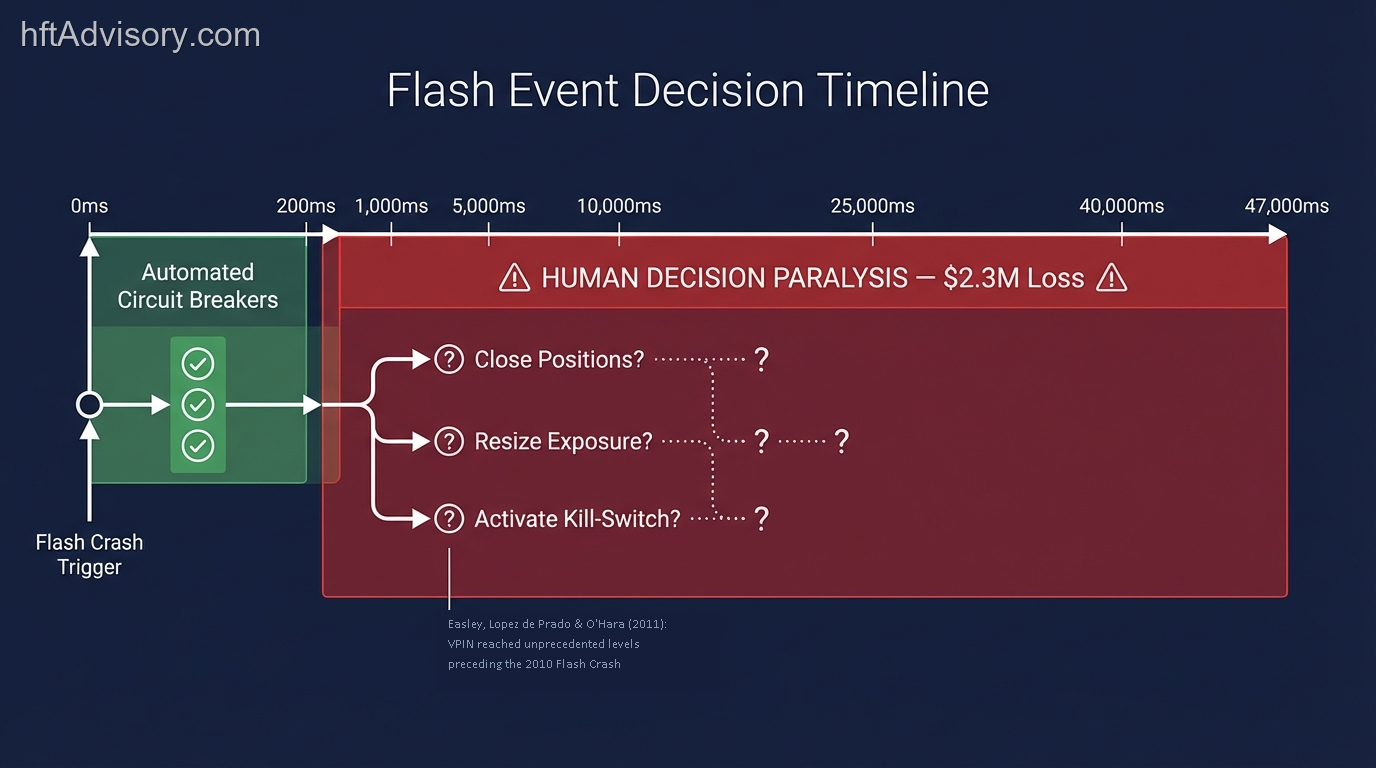
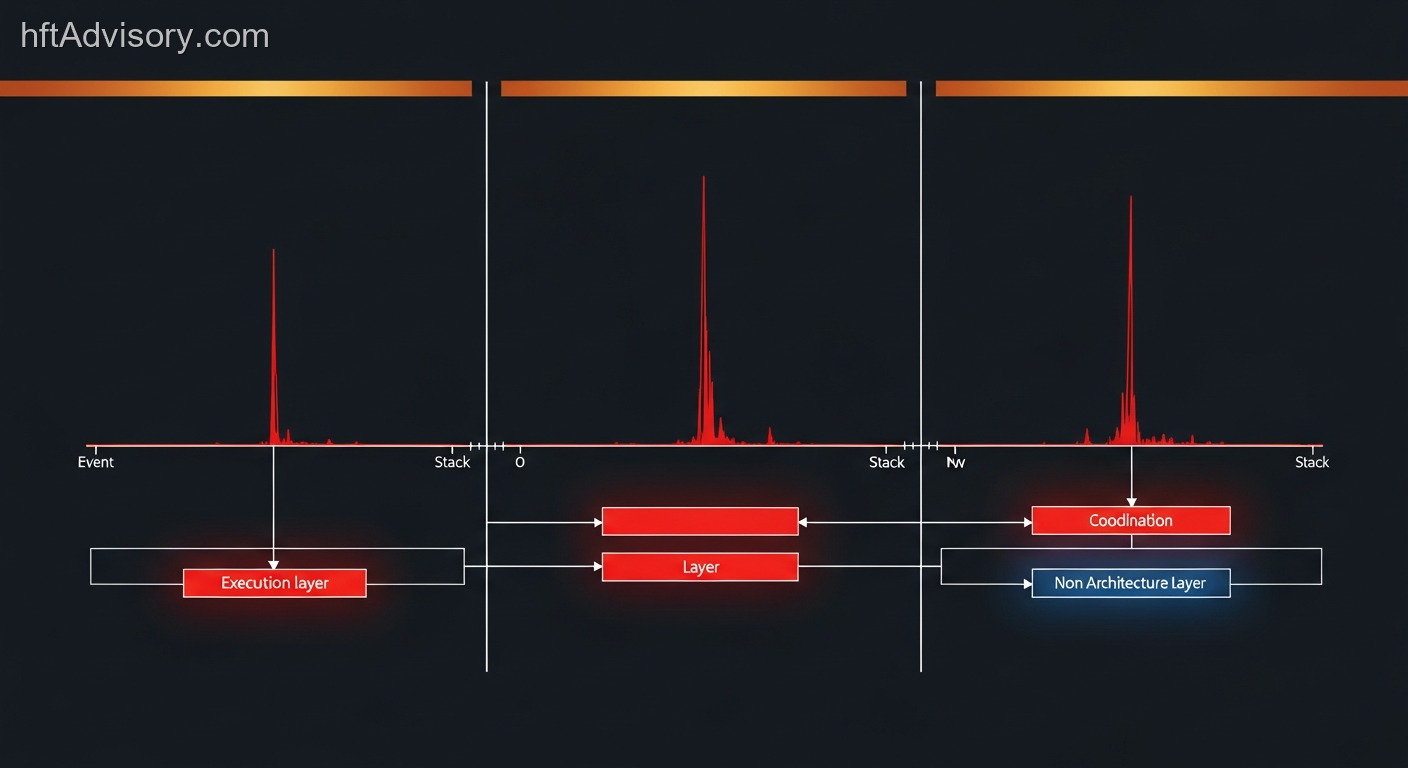
The diagram above is not theoretical. It represents the actual decision window available during a flash event. The human cognitive bottleneck is visible in every timeline. The question is whether your architecture is designed around that constraint — or whether it expects humans to work faster than biology allows.
I have worked in environments where decisions become irreversible in milliseconds. After that conversation with the Head of Desk, we redesigned their risk architecture around automated circuit breakers and tiered escalation paths. The next time the market fractured, their systems handled the first 200 milliseconds autonomously, within their specific implementation parameters. Zero human hesitation in that window. Zero decision paralysis.
The rest of this article is the framework behind that rebuild.
The Speed Problem: Markets Move in Microseconds, Minds Think in Seconds
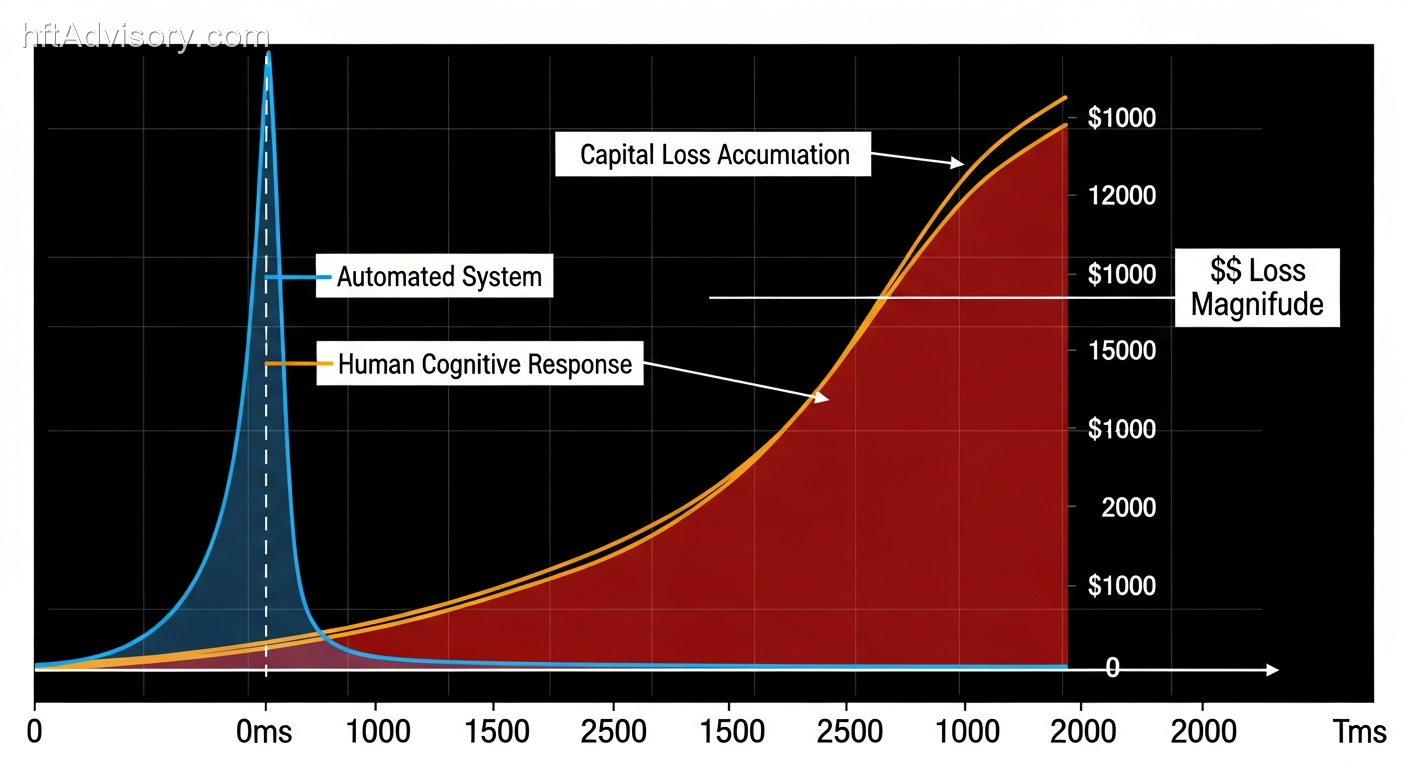
The 2010 Flash Crash is the canonical case study, and the academic literature on it is precise. Kirilenko, Kyle, Samadi, and Tuzun (2017) in “The Flash Crash: High-Frequency Trading in an Electronic Market” — published in the Journal of Finance, Vol. 72, No. 3 — documented that high-frequency traders collectively demanded immediacy ahead of slower participants during the crash, amplifying price dislocations that no human trader could detect or respond to in real time. Separately, Easley, Lopez de Prado, and O’Hara (2011) in “The Microstructure of the Flash Crash: Flow Toxicity, Liquidity Crashes and the Probability of Informed Trading” showed that order flow toxicity — measured by VPIN — reached unprecedented levels in the volume intervals preceding the May 6 collapse, faster than market makers could adjust quotes or humans could issue orders.
The combined picture: toxicity built up faster than quote adjustment, and once the cascade began, HFT demand for immediacy amplified dislocations at a speed that human reaction time physically cannot match.
The neuroscience reinforces this. 2024 research published in PMC demonstrates that acute stress promotes intuitive responses while directly impairing prefrontal cortex function — the DL-PFC region responsible for working memory and deliberate decision-making. Under stress, working memory compresses to 4–7 items. When cognitive complexity increases by one standard deviation, information processing speed drops 18% and mispricing duration extends by 23%. A trader facing a cascade event is not performing at baseline. His cognitive bandwidth is running at a fraction of the capacity his years of experience built on.
The standard assumption — that experience produces composure — is inaccurate under the conditions that matter most. Experience produces faster pattern recognition. It does not override the neurological stress response that degrades working memory and extends decision latency to seconds when the market is moving against you in milliseconds.
HFT firms now account for 70–80% of total U.S. equity trading volume. When a flash event begins, the counterparties on the other side of your positions are operating on sub-millisecond automated logic. The asymmetry between their response time and your trader’s response time is not a training problem. The architecture is the problem.
Three Architecture Failures That Bled Real Capital
Knight Capital Group — August 1, 2012
Knight Capital’s failure is the most documented case of automated risk architecture running without adequate controls. A faulty code deployment activated legacy trading logic that sent 4 million erroneous orders across 154 stocks in 45 minutes. The firm lost $460 million. Knight was subsequently acquired. The SEC charged Knight with Market Access Rule violations.
The failure was not the code. Faulty deployments happen. The failure was the absence of a kill-switch capable of detecting and terminating anomalous order flow autonomously within the first 60 seconds. Forty-five minutes of hemorrhage is what happens when your architecture assumes a human will notice, diagnose, and intervene in time.
March 2020 — The COVID VIX Spike
The VIX peaked at 82.69 in March 2020, the second-highest reading ever recorded, surpassing the 2008 financial crisis. Average U.S. Treasury hedge funds lost 7% and reduced exposure by 20% in a single month. Volatility-targeting funds — representing approximately $300 billion AUM — were forced into rapid, mechanistic deleveraging that amplified the move.
The desks that suffered the worst capital destruction in March 2020 were those relying on discretionary risk management during a volatility regime that rendered discretionary management structurally impossible. When VIX moves from 30 to 82 in days, the decision tree available to a human risk manager does not have a “this scenario” branch. Pre-programmed escalation paths are the only reliable mechanism when the volatility surface moves faster than manual response protocols can track.
August 5, 2024 — The Nikkei Flash Crash
The Nikkei 225 plunged more than 12% in a single session on August 5, 2024 — the steepest single-day decline since 1987 — erasing approximately $790 billion in market value. The proximate trigger was the Bank of Japan’s rate hike combined with the unwinding of an estimated $250 billion in yen carry trades. Automated deleveraging cascades amplified the initial move into a structural collapse.
What made this event architecturally significant is the speed of the carry trade unwind. Positions that had been built over months were closed in hours through automated mechanisms. Any desk with manual risk management protocols that day was responding to a market that had already moved past the point where their response was relevant. The cascade did not wait.
Three events. Three different asset classes. Three different triggering mechanisms. One common thread: architectures that expected human reflex to compensate for system-level gaps lost capital at scale.
What Regulators Already Require — And What Most Desks Still Do Not Have
The regulatory framework around automated risk controls is not new. It is already in force.
MiFID II Article 17 mandates kill-switch mechanisms, real-time monitoring of all algorithmic order flow, and automated controls including price collars and maximum order value and volume limits. This is the European baseline. SEC Rule 15c3-5 — the Market Access Rule — requires broker-dealers to implement pre-trade risk controls. CFTC Regulation AT extends analogous kill-switch requirements to futures commission merchants operating in U.S. derivatives markets.
The requirement for automated controls is settled. The gap is not regulatory awareness. The gap is implementation depth.
A kill-switch that a human must manually activate is not a kill-switch — it is a protocol with a human bottleneck. The regulatory intent is autonomous response. The implementation gap at most desks is between “we have a kill-switch” and “our kill-switch activates within 500ms of a circuit breaker trigger without a single manual keystroke.”
NYSE circuit breakers operate at three levels: a 15-minute halt triggered by a 7% S&P decline (Level 1), a second 15-minute halt at 13% (Level 2), and market closure for the day at 20% (Level 3). CME coordinates with the same 7/13/20% thresholds. Your internal circuit breakers should trigger well before the exchange-level halts — because by the time a Level 1 NYSE halt is triggered, you have already survived through a 7% adverse move. The architecture question is how much of that 7% move your systems contained autonomously before it hit 7%.
The Three-Level Automated Risk Architecture
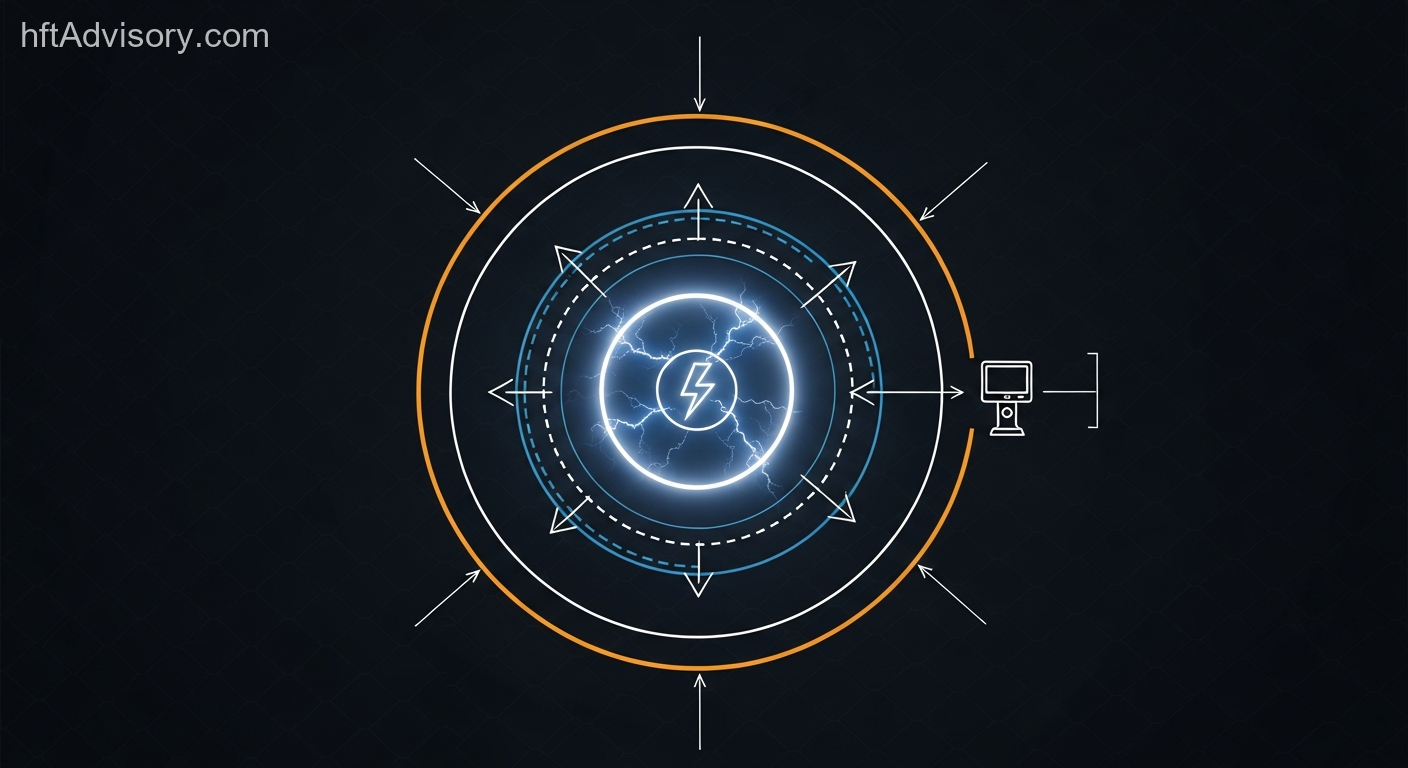
After the desk I described in the introduction was restructured, the architecture we implemented operated across three distinct tiers. This is the framework — not the implementation blueprint, which depends on the specific stack, asset class, and regulatory jurisdiction.
Tier 1 — Autonomous Termination (Sub-Millisecond)
The first tier operates without human involvement by design. Kill-switch logic runs at the kernel or FPGA level, monitoring order flow toxicity signals, position delta thresholds, and P&L velocity. When pre-defined thresholds breach, the system flattens or halts exposure autonomously. No human keystroke. No human approval loop. The decision is made in the architecture before the event, not during it.
Platforms like Eventus Validus benchmark real-time monitoring at 150,000 message bursts per second. Tier 1 controls need to operate within that message density without introducing latency into the execution path.
Tier 2 — Automated Escalation (1–200ms)
The second tier triggers conditional logic that does not fully halt trading but reshapes the risk profile automatically: resizing position limits, widening spread thresholds, or shifting to passive-only order flow. This tier handles the scenarios where full termination is premature but discretionary management would be too slow. It operates on pre-programmed decision trees that were built and validated before the flash event, not during it.
Tier 3 — Human Oversight (200ms+)
The third tier is where human judgment enters — after the autonomous layers have contained the immediate cascade. At this stage, the trader’s cognitive load is not “which of three urgent actions do I take simultaneously.” The autonomous layers have already executed the time-critical responses. Human judgment is now applied to the strategic question: do we resume trading in this regime, and on what terms?
This is the architecture that converts a 47-second paralysis into a 200-millisecond autonomous response followed by a deliberate human decision. The trader’s experience becomes an asset again — because the architecture has removed the task that biology cannot execute under stress.
The Counterargument: Is Over-Automation Its Own Risk?
The objection I hear most often from experienced heads of desk is this: “Fully automated kill-switches can fire at the wrong time and create losses through false positives.”
The objection is valid. Knight Capital’s failure was itself an automation failure. Poorly calibrated autonomous logic can execute on bad signals. An overly sensitive kill-switch in a normally volatile market can trigger unnecessary flattening that generates real slippage.
The counterargument is not that automation is riskless. It is that the risk of a miscalibrated automated system is bounded and auditable, while the risk of human paralysis during a genuine cascade is unbounded. Knight lost $460 million in 45 minutes because there was no autonomous termination. A well-calibrated kill-switch firing 30 seconds prematurely costs slippage — recoverable. A human freeze during a genuine cascade costs capital at the rate the market is moving — often not recoverable.
The engineering problem is calibration, not automation itself. Threshold parameters for Tier 1 triggers should be validated against historical flash event data, stress-tested against the worst observed volatility regimes (March 2020, August 2024), and reviewed on a cadence that reflects the evolution of the desk’s strategy and position size. The kill-switch is not set-and-forget infrastructure. It is architecture that requires the same maintenance discipline as the execution stack.
The desks that have solved this are not fully automated and not fully discretionary. They have defined, in advance, which scenarios belong to Tier 1, which belong to Tier 2, and which belong to Tier 3 human judgment. That taxonomy is the hard work. The technology to execute it is available.
The 500ms Self-Audit
The diagnostic question I ask every desk running more than $500M in daily flow is the same one the Head of Desk asked himself after the 47-second event:
Can your systems independently flatten exposure within 500ms of a circuit breaker trigger, without a single manual keystroke?
This is a practitioner benchmark derived from the operational requirements of real flash events, not a regulatory standard. It is a starting point for the audit. The questions below will tell you where your architecture stands.
1. Kill-Switch Autonomy Does your kill-switch require any human action — login, confirmation, approval — to activate? If yes, you have a protocol with a bottleneck, not an autonomous kill-switch.
2. Trigger Calibration Are your internal circuit breaker thresholds defined against your specific book’s volatility profile, or are they generic parameters inherited from a vendor configuration? Generic thresholds calibrated for average conditions will misfire in tail-risk regimes.
3. Latency of Autonomous Response Have you measured, in production conditions with full order book load, how long it takes from threshold breach to position halt? Not in a test environment. In production, during a market stress simulation.
4. Escalation Path Clarity When Tier 1 fires, what happens next? Does Tier 2 logic engage automatically, or does a human need to assess whether to engage it? If the answer is a human assessment, you have a Tier 1 system feeding into a Tier 3 response gap.
5. Post-Event Audit Trail After the last significant volatility spike your desk experienced, could you reconstruct the full decision timeline: what the system did, when, triggered by what threshold, and what the P&L impact of each automated action was? If that audit trail does not exist, the architecture is not auditable — which means it is not improvable.
6. Human Override Protocol Under what conditions is a human authorized to override the Tier 1 kill-switch? Is that protocol documented, trained, and tested? Override capability without a tested protocol is a vulnerability, not a feature.
The standard is: Tier 1 autonomous response within 200–500ms, Tier 2 conditional logic within the first two seconds, Tier 3 human deliberation with full situational awareness after the autonomous layers have contained the cascade.
If your architecture cannot guarantee that sequence, the 47-second paralysis is a foreseeable event, not a surprising one.
Conclusion
Two decades in this industry have shown me one pattern repeated across every major flash event I have witnessed, consulted on, or rebuilt from. The desks that lose the most capital in tail-risk events are not the ones with the worst traders. They are the ones with architectures that expected human reflex to compensate for system-level gaps — and discovered, in real time, that biology does not work that way.
The best trading desks engineer composure into their stack. The trader’s experience is most valuable when the architecture has already handled the first 200 milliseconds autonomously.
The standard is Tier 1 autonomous kill-switch response within 500ms of a circuit breaker trigger, without a single manual keystroke. If your architecture cannot guarantee that, it may be time to audit where the human bottlenecks are in your current risk stack — and whether the next flash event will find them first.
Originally shared as a LinkedIn post. View the original post
Never Miss an Update
Get notified when we publish new analysis on HFT, market microstructure, and electronic trading infrastructure. No spam.
Subscribe by EmailHFT Systems Architect & Consultant | 20+ years architecting high-frequency trading systems. Author of "Trading Systems Performance Unleashed" (Packt, 2024). Creator of VisualHFT.
I help financial institutions architect high-frequency trading systems that are fast, stable, and profitable.
I have operated on both the Buy Side and Sell Side, spanning traditional asset classes and the fragmented, 24/7 world of Digital Assets.
I lead technical teams to optimize low-latency infrastructure and execution quality. I understand the friction between quantitative research and software engineering, and I know how to resolve it.
Core Competencies:
▬ Strategic Architecture: Aligning trading platforms with P&L objectives.
▬ Microstructure Analytics: Founder of VisualHFT; expert in L1/L2/LOB data visualization.
▬ System Governance: Establishing "Zero-Failover" protocols and compliant frameworks for regulated environments.
I am the author of the industry reference "C++ High Performance for Financial Systems".
Today, I advise leadership teams on how to turn their trading technology into a competitive advantage.
Key Expertise:
▬ Electronic Trading Architecture (Equities, FX, Derivatives, Crypto)
▬ Low Latency Strategy & C++ Optimization | .NET & C# ultra low latency environments.
▬ Execution Quality & Microstructure Analytics
If my profile fits what your team is working on, you can connect through the proper channel.