Table of Contents
- The Timestamp Gap: What Fill Data Reveals That P&L Reports Do Not
- The Execution Tier Map: Where $500M Funds Sit vs. Where They Should Be
- Fragmentation Is a Feature — If You Can Exploit It
- The OMS Architecture: What Unified Position-Level Risk Requires
- Execution Quality Diagnostic Checklist
- Conclusion
Introduction
A pattern I have seen across crypto funds managing $500M or more in AUM: monthly ROI plateaus at 0.5% and stays there regardless of how talented the trading team is. The traders know it. The CTO knows it. The quants have run the analysis. Everyone has a theory. Nobody can explain exactly where the alpha is going — until you look at the timestamps.
The root cause is almost always the same: manual execution across a fragmented exchange stack.
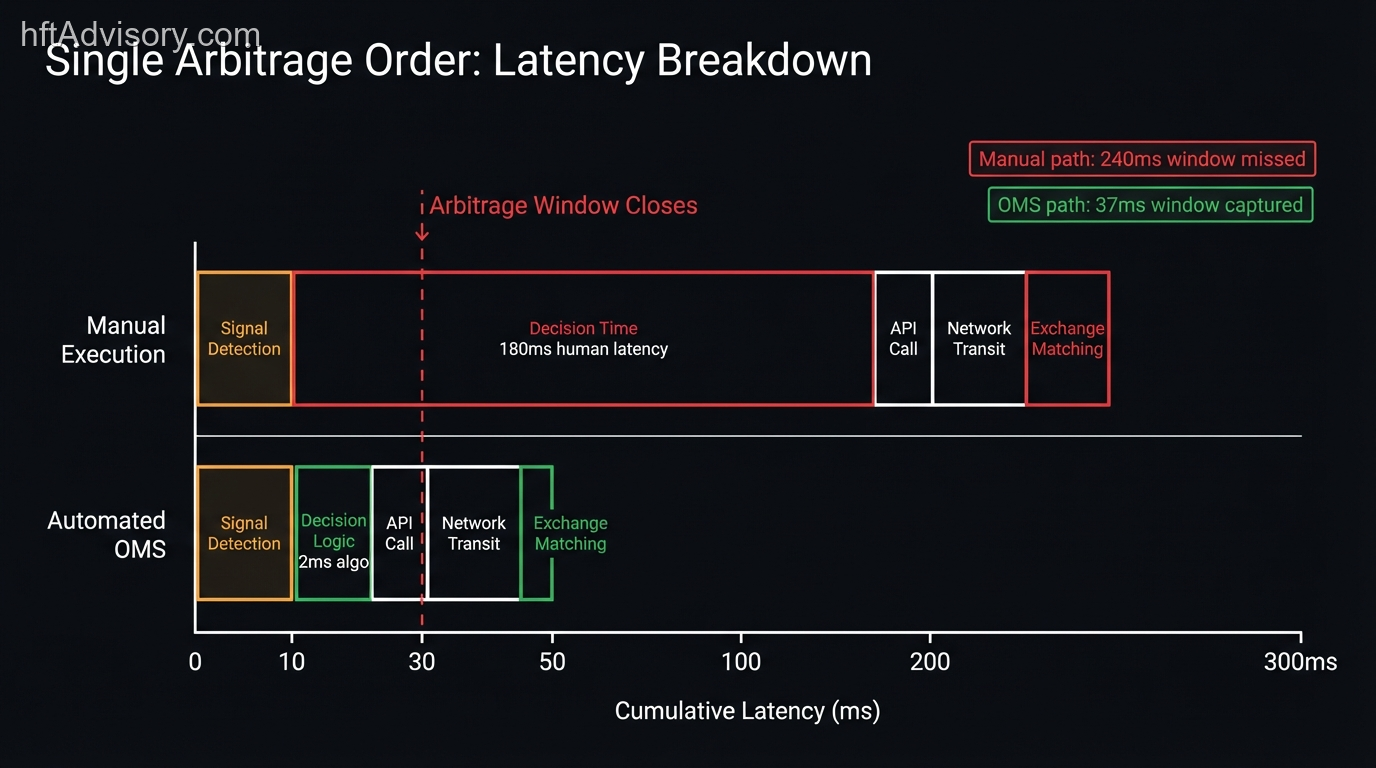
Binance, Coinbase, Kraken, OKX, Bybit — the full exchange stack — running through traders watching screens, copying orders, racing against arbitrage windows that physically cannot be captured by human hands. Human reaction time floors at 200-300ms for simple motor responses; for a complex trading decision involving price confirmation, size calculation, and risk check, that floor rises to 300-500ms or more. Cross-exchange arbitrage opportunities in crypto close in 30-50ms under practitioner observation. That timing gap is structural. It does not shrink with experience or with better traders. It is a physics problem, and physics does not negotiate.
This article dissects the execution architecture failure mode that creates the 0.5% ceiling, maps the execution tier hierarchy across the industry, and describes what a unified order management system with dynamic cross-venue routing and integrated position-level risk actually requires to collapse that gap. The goal is a diagnostic framework — a map, not a car. The implementation detail stays inside the engagement. The map, however, is worth sharing.
The Timestamp Gap: What Fill Data Reveals That P&L Reports Do Not {#the-timestamp-gap}
P&L reports are lagging indicators. By the time adverse selection shows up on the monthly statement, the damage has been accumulating for weeks in the fill data — specifically in the gap between order submission timestamps and fill confirmation timestamps measured against the venue order book state at the moment of submission.
Most crypto funds at the $500M AUM tier do not run transaction cost analysis at the venue-by-venue, order-by-order granularity required to see this. They look at realized P&L. They look at Sharpe. They look at drawdown. What they rarely look at is the distribution of time-in-flight for orders across each venue, segmented by market volatility regime.
When you build that distribution, a specific pattern emerges: orders submitted during high-volatility windows — which is precisely when cross-exchange price dislocations are largest and most tradeable — show dramatically worse fill quality than orders submitted during quiet periods. The intuition reverses what most teams expect. They assume more volatility means more opportunity. At the microstructure level, more volatility means faster adverse selection for any participant with latency above the arbitrage window.
Talos TCA data from June 2024 through July 2025 covering 50,000+ parent orders and 50 million child orders demonstrates this directly: price slippage is consistently higher on single-exchange execution compared to smart order routing across venues. The gap is not marginal. Smart order routing at the institutional level systematically captures better fills because it routes to the venue with the most favorable immediate liquidity, not the venue a trader happened to have a screen open on.
The execution data from Albers, Cucuringu, Howison, and Shestopaloff — published in Quantitative Finance (2025) and covering more than 3 million orders on Bybit and 40,000 market orders on Binance — found discrepancies between expected and actual order outcomes caused directly by latency-induced gaps. The mechanism is consistent: when latency exceeds the arbitrage window, the order arrives at a price that has already moved against the sender. The order book state at fill time differs from the order book state at decision time. That delta is the adverse selection tax your manual execution stack is paying on every significant trade.
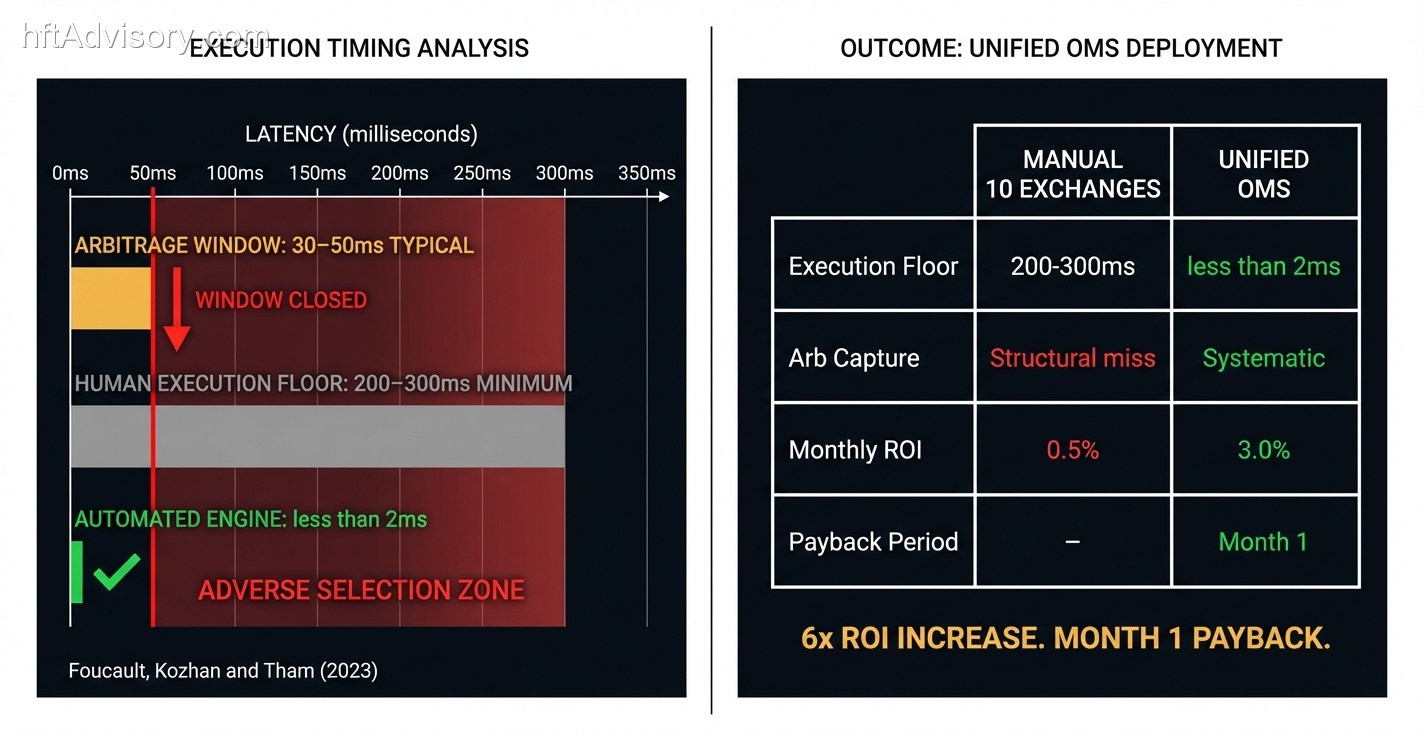
The diagram above shows the collision point. The arbitrage window closes at 30-50ms. Human execution lands at 200-300ms minimum. The automated execution engine at less than 2ms. The shaded adverse selection zone between the window close and the human execution floor is the region where every manually submitted order arrives into a market that has already repriced. That zone is not recoverable through better trade selection or smarter signals. It is recovered only by changing the execution tier.
The Execution Tier Map: Where $500M Funds Sit vs. Where They Should Be {#the-execution-tier-map}
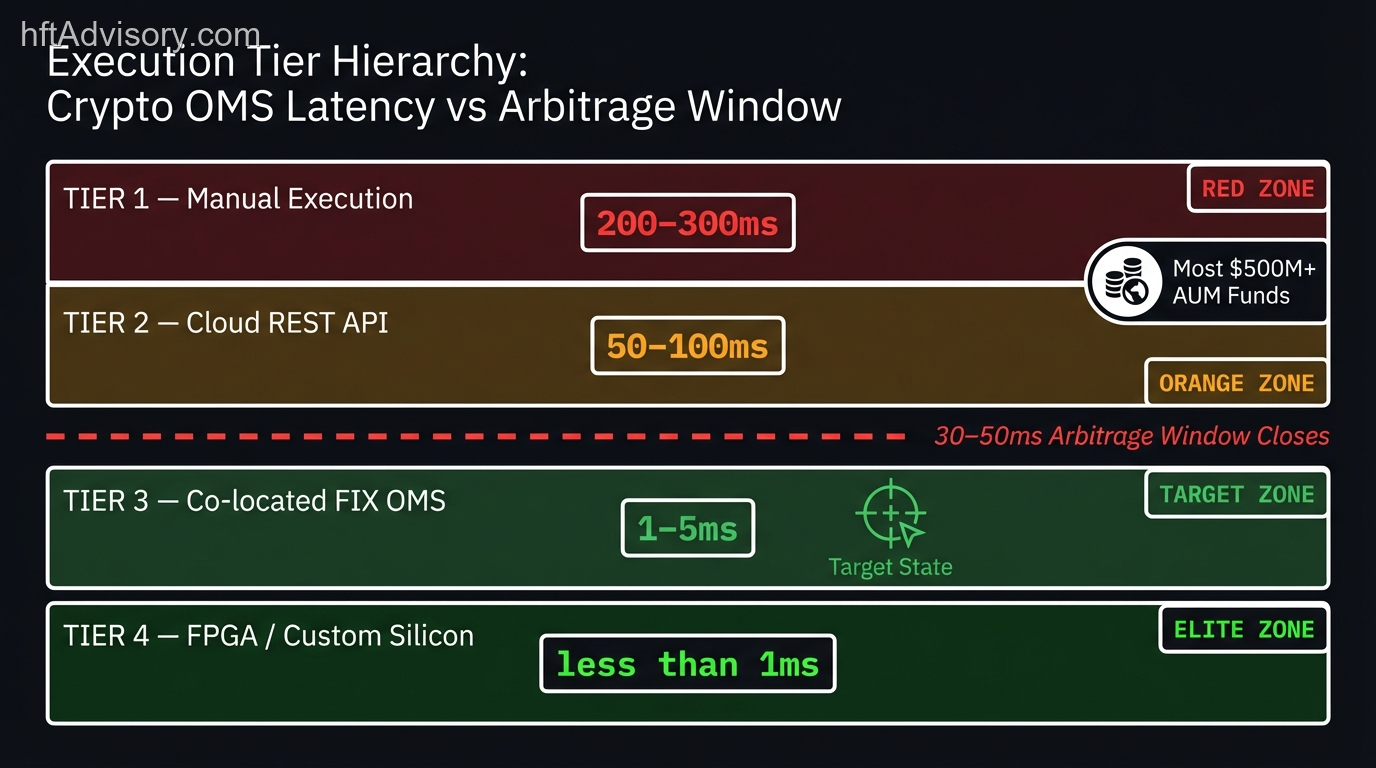
There are four distinct execution tiers in institutional crypto trading. Most $500M+ funds sit at Tier 1 or Tier 2 while their strategy parameters assume Tier 3 or Tier 4 performance. That mismatch between assumed execution speed and actual execution speed is where the 0.5% monthly ROI ceiling gets manufactured.
Tier 1 — Manual and Human-Mediated Execution
Latency: 200-300ms (simple responses), 300-500ms+ (complex trading decisions)
This is a trader watching screens, making decisions, and submitting orders via exchange web UI or basic API wrapper. The reaction-time floor is physiological. Regardless of how experienced the trader is, the human nervous system does not route orders in 30ms. The research is unambiguous here: Alexander’s 2025 paper “Latency Arbitrage in Cryptocurrency Markets” (SSRN 5143158) documents that retail-level latency of 100-500ms can only exploit price discrepancies lasting minutes, not the seconds-or-less windows that institutional cross-exchange arbitrage depends on. Funds running multi-exchange strategies with Tier 1 execution are structurally locked out of the fastest and most reliable alpha sources.
Tier 2 — Cloud-Automated REST API Execution
Latency: 50-100ms
Automated bots running on cloud infrastructure submitting orders via REST API. This eliminates the human reaction floor but introduces cloud networking latency, REST protocol overhead, and virtualization jitter. The “noisy neighbor” effect on shared cloud infrastructure creates latency spikes that are unpredictable in timing and magnitude. A strategy calibrated to 60ms average latency may see 150ms spikes in the exact volatility windows where it needs to be fastest. Kaiko data shows that price differences of 0.2%-1.5% regularly appear across major exchanges during volatility, lasting only seconds. A Tier 2 system operating at 50-100ms average with unpredictable spikes captures a fraction of those windows, and inconsistently.
Tier 3 — Co-Located or Direct-Connection FIX OMS
Latency: 1-5ms
Infrastructure co-located near exchange matching engines, running native FIX protocol or binary market access. This is where institutional execution quality begins. FIX protocol adoption has been accelerating in crypto through 2025 in response to institutional demand for protocol parity with traditional finance. At 1-5ms, a properly designed OMS captures the vast majority of arbitrage windows that remain open for 10ms or longer. The Skyriss execution quality data illustrates the magnitude of the improvement: execution hit rates above 50ms latency are 31%; below 50ms, 82%. That 2.6x degradation from a 100ms latency increase represents real fill quality, real adverse selection avoidance, and real P&L.
Tier 4 — FPGA and Kernel-Bypass Execution
Latency: sub-millisecond
Hardware-level execution bypassing the operating system network stack entirely. The exclusive domain of pure HFT shops competing on co-location and wire speed. For most $500M crypto funds running multi-exchange arbitrage strategies, this tier is not the target — Tier 3 is. The marginal gain from Tier 3 to Tier 4 does not justify the infrastructure cost unless the strategy is specifically designed around sub-millisecond windows.
The diagnostic question for any fund stuck at the 0.5% monthly ROI ceiling: at which tier is your execution infrastructure operating, and at which tier does your strategy require it to operate? When those two numbers do not match, the gap between them transfers to your counterparties.
Fragmentation Is a Feature — If You Can Exploit It {#fragmentation-is-a-feature}
The crypto market structure is fundamentally fragmented in a way that equity markets are not. There are 370+ exchanges globally (CoinAPI 2025) with no consolidated tape, no mandatory best-execution obligation, and significant persistent price dislocations across venues. For a manual execution desk, this fragmentation is purely a cost — more venues to monitor, more screens, more complexity, more coordination overhead, with no systematic mechanism to capture the price differences across them.
For an automated OMS with dynamic smart order routing, this same fragmentation is the primary alpha source.
Easley, O’Hara, Yang, and Zhang (2024) — “Microstructure and Market Dynamics in Crypto Markets” (SSRN 4814346) — confirmed that classical microstructure metrics including Roll spread, Kyle’s lambda, and VPIN retain predictive power in BTC/ETH markets. Informational frictions persist across venues. Price discovery is not synchronized. The implication for execution architecture: a system that can observe the order book state across multiple venues simultaneously, route dynamically to the venue with the most favorable immediate liquidity, and execute within the arbitrage window captures a real and measurable structural edge.
Kaiko’s monitoring of price differences across major exchanges shows 0.2%-1.5% dislocations appearing regularly during volatile periods — lasting only seconds before faster participants close them. The arbitrage is not theoretical. The question is whether the fund’s execution infrastructure arrives before or after the window closes.
Foucault, Kozhan, and Tham demonstrated in “Toxic Arbitrage” (Review of Financial Studies, 2017) — a study of foreign exchange fragmentation — that latency-advantaged participants in fragmented markets systematically extract alpha at the expense of slower counterparties. The market they studied was FX, not crypto, but the mechanism is identical: fragmentation creates price dislocations; speed determines who captures them and who gets selected against. The crypto market, with its extreme venue fragmentation and absence of consolidated infrastructure, applies this dynamic at full intensity.
The Polymarket case from 2025 illustrates the mechanism from the venue operator’s perspective. Polymarket introduced dynamic taker fees — up to 3.15% — specifically because latency arbitrage bots were exploiting gaps between its internal pricing and external spot feeds. When a venue feels compelled to price-protect itself against latency arbitrageurs, that is direct evidence the arbitrage opportunity is real and systematic, not theoretical.
What fragmentation requires to be a feature rather than a liability: unified view of order book state across all venues, simultaneous not sequential. A routing engine that evaluates venue liquidity in real time and routes to the best fill, not the most convenient open screen. Position-level risk that is consolidated across all venues in real time, not reconciled manually at end of day. And execution at Tier 3 or above so the routing decisions arrive before the window closes.
The OMS Architecture: What Unified Position-Level Risk Requires {#the-oms-architecture}
The order management system design that collapses the execution gap operates across three interconnected layers. Understanding the failure modes at each layer is more useful than a feature checklist.
Layer 1 — Market Data and Order Book Aggregation
The system must maintain a unified, real-time view of order book depth across all connected venues simultaneously. The failure mode at this layer is latency asymmetry: if the market data feed from Venue A arrives 40ms before Venue B, routing decisions will systematically favor Venue A regardless of actual best execution — because the system sees Venue A’s book state more accurately at decision time. Stale data from any single venue corrupts the routing logic for all venues. Normalized data pipelines, latency monitoring per-feed, and automatic feed-quality degradation flags are requirements, not optional instrumentation.
Layer 2 — Smart Order Routing and Dynamic Routing Logic
Routing decisions must execute within the arbitrage window, which means the routing logic must be deterministic and fast — not a sequential loop evaluating each venue in turn. At 1-5ms latency, there is no room for iterative decision trees. The routing engine evaluates all venues in parallel against the order parameters and routes simultaneously or in priority order with sub-millisecond decision time. The failure mode at this layer is routing rigidity: pre-configured routing rules that do not adapt to real-time venue liquidity conditions. A rule that routes BTC-USD orders to Binance as primary may be correct 80% of the time and systematically wrong during the 20% of volatile windows where Binance liquidity is thin and Kraken or Coinbase is offering depth. Static routing rules in a dynamic market destroy the edge that dynamic routing is designed to capture.
Layer 3 — Position-Level Risk Integration
This is the layer that most multi-exchange OMS implementations get wrong. Risk limits defined per-venue rather than per-position across the consolidated portfolio create a specific failure mode: a fund can be simultaneously long BTC on Binance at maximum position limit and short BTC on Coinbase at maximum position limit, with no system-level awareness of the net exposure. Manual reconciliation at end of day is not risk management — it is damage assessment. Position-level risk must be computed in real time against the consolidated view of all open positions and pending orders across all venues. Any new order submission must clear the consolidated risk check before routing, not the per-venue risk check in isolation.
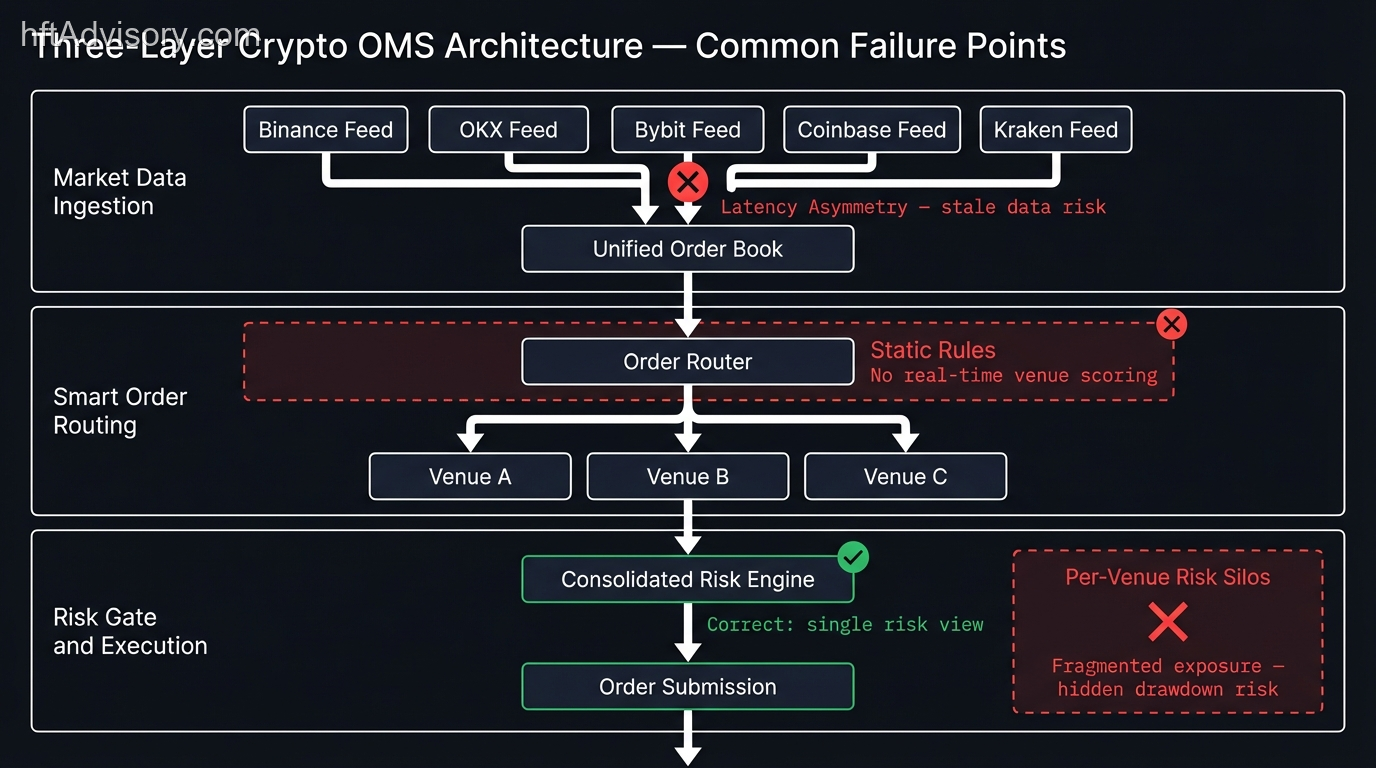
The three-layer architecture — real-time aggregated market data, parallel smart order routing, consolidated position-level risk — is the minimum viable structure for a multi-exchange OMS that can systematically capture cross-venue opportunities. In one engagement, architecting this unified structure connecting 10+ exchanges moved monthly ROI from 0.5% to 3.0%. The infrastructure paid for itself within the first month of operation. That result was specific to that engagement’s strategy and venue mix; the directional dynamic — that closing the execution tier gap produces measurable, compounding ROI recovery — holds across the pattern.
Execution Quality Diagnostic Checklist {#execution-quality-diagnostic-checklist}
The following diagnostic questions are structured for a CTO or Head of Trading conducting an internal execution quality audit. They are organized by the three architecture layers described above. None of these require external tools to answer — they require pulling data you should already have and asking questions your infrastructure should be able to answer.
Layer 1 — Market Data Quality
- Can you report the average latency for each venue’s market data feed independently, segmented by time of day and volatility regime? If not, your data pipeline has no quality instrumentation.
- During the last three high-volatility events on any venue, what was the maximum latency spike observed on that venue’s data feed? Is that number available?
- Do your routing decisions use order book depth data or last-trade price data? Depth-based routing requires order book feed quality; last-trade routing is a proxy that degrades in thin markets.
Layer 2 — Routing Logic
- Is your current smart order routing logic static (pre-configured venue priority) or dynamic (real-time liquidity evaluation)? If static, when was it last calibrated against actual fill data?
- What is your execution hit rate at the current latency tier, segmented by order size? Below 50ms: target 80%+ hit rate. Above 150ms: expect 30% or lower. Where does your data put you?
- What is the delta between your theoretical arbitrage capture (signals generated) and actual arbitrage fill rate (signals filled within the window)? If that number is not tracked, the routing logic cannot be optimized.
Layer 3 — Position Risk
- Is your position limit calculation per-venue or consolidated across all venues in real time? If per-venue, your consolidated net exposure is not risk-managed — it is manually checked.
- How long after a fill on one venue does that position update appear in your risk system for routing decisions on other venues? Seconds is not fast enough during volatile conditions. Milliseconds is the target.
- In the last 90 days, how many times did your end-of-day position reconciliation across all venues produce a result different from what your intraday risk system reported? Each discrepancy is a period where your risk controls were operating on stale data.
The pattern in these questions is deliberate. Each one targets a known failure mode in multi-exchange execution infrastructure. If more than two of these questions produce answers of “we do not track that,” the execution architecture has instrumentation gaps that are almost certainly also execution gaps.
Conclusion {#conclusion}
The 0.5% monthly ROI ceiling is not a strategy problem. The signals exist. The research is clear that cross-venue price dislocations in crypto markets are persistent and measurable. The ceiling is an infrastructure problem: execution tier mismatch between the strategy’s required latency and the system’s actual delivery latency, compounded by absence of unified position-level risk across venues.
The timestamps tell the story that the P&L report delays by weeks. Look at the gap between order submission and fill confirmation against the order book state at the moment of submission, across every venue, segmented by volatility regime. That analysis will show you exactly where the alpha is going.
The diagnostic question worth sitting with: what is the measured delta between your theoretical arbitrage capture rate across venues and your actual fill rate within the window? If you have that number, you know where you stand. If you do not have that number, you do not know what you are leaving on the table.
If that gap looks familiar and your current execution monitoring does not surface it at order-timing granularity, a Discovery Assessment maps where the leak is and what closing it requires.
This article was originally shared as a LinkedIn post on February 21, 2026.
I help financial institutions architect high-frequency trading systems that are fast, stable, and profitable.
I have operated on both the Buy Side and Sell Side, spanning traditional asset classes and the fragmented, 24/7 world of Digital Assets.
I lead technical teams to optimize low-latency infrastructure and execution quality. I understand the friction between quantitative research and software engineering, and I know how to resolve it.
Core Competencies:
▬ Strategic Architecture: Aligning trading platforms with P&L objectives.
▬ Microstructure Analytics: Founder of VisualHFT; expert in L1/L2/LOB data visualization.
▬ System Governance: Establishing "Zero-Failover" protocols and compliant frameworks for regulated environments.
I am the author of the industry reference "C++ High Performance for Financial Systems".
Today, I advise leadership teams on how to turn their trading technology into a competitive advantage.
Key Expertise:
▬ Electronic Trading Architecture (Equities, FX, Derivatives, Crypto)
▬ Low Latency Strategy & C++ Optimization | .NET & C# ultra low latency environments.
▬ Execution Quality & Microstructure Analytics
If my profile fits what your team is working on, you can connect through the proper channel.