Table of Contents
- Why FX Liquidity Works Nothing Like Equities
- What “Last Look” Actually Means for Your Execution Stack
- The Principal-vs-Agency Dynamic That Is Pricing Your Flow Against You
- The Five-Layer Diagnostic for FX Execution Stack Failures
- How to Read Your LP Panel Before the Losses Accumulate
- Practical Diagnostic Checklist
- Conclusion
Introduction
An equities shop I worked with expanded into FX. In their first month, they lost $800,000. Details have been anonymized to protect client confidentiality.
The fills were not catastrophically bad. That was the problem. They looked acceptable if you did not know what you were looking at. The P&L bleed only showed up in aggregate, and only when you cross-referenced fill quality across venue and counterparty — not just price. By price alone, every fill was defensible. In aggregate, the desk was bleeding steadily from the first trade.
This is the most dangerous kind of execution failure: the kind that does not trigger alerts. There was no system misbehavior. The algo was executing exactly as designed — for a market it was never built for.
For CTOs and Heads of Electronic Trading conducting or planning cross-asset expansion, this piece is a forensic account of what happened and why. I have spent more than 20 years building and auditing Tier 1 electronic trading infrastructure across equities, FX, and derivatives desks. FX operates on fundamentally different market microstructure rules than equities. The technology gap is rarely the problem. The knowledge gap — who is quoting you, why, and what they are doing with your order flow after the fill — is where the losses accumulate.
FX daily turnover reached $9.6 trillion as of April 2025, per the BIS 2025 Triennial Survey. FX spot alone accounts for $3 trillion per day — 31% of global FX turnover. The market is deep, liquid, and institutionally mature. What it is not is transparent, centralized, or structured the way exchange-based markets are. That distinction costs desks real money when they miss it.
Why FX Liquidity Works Nothing Like Equities
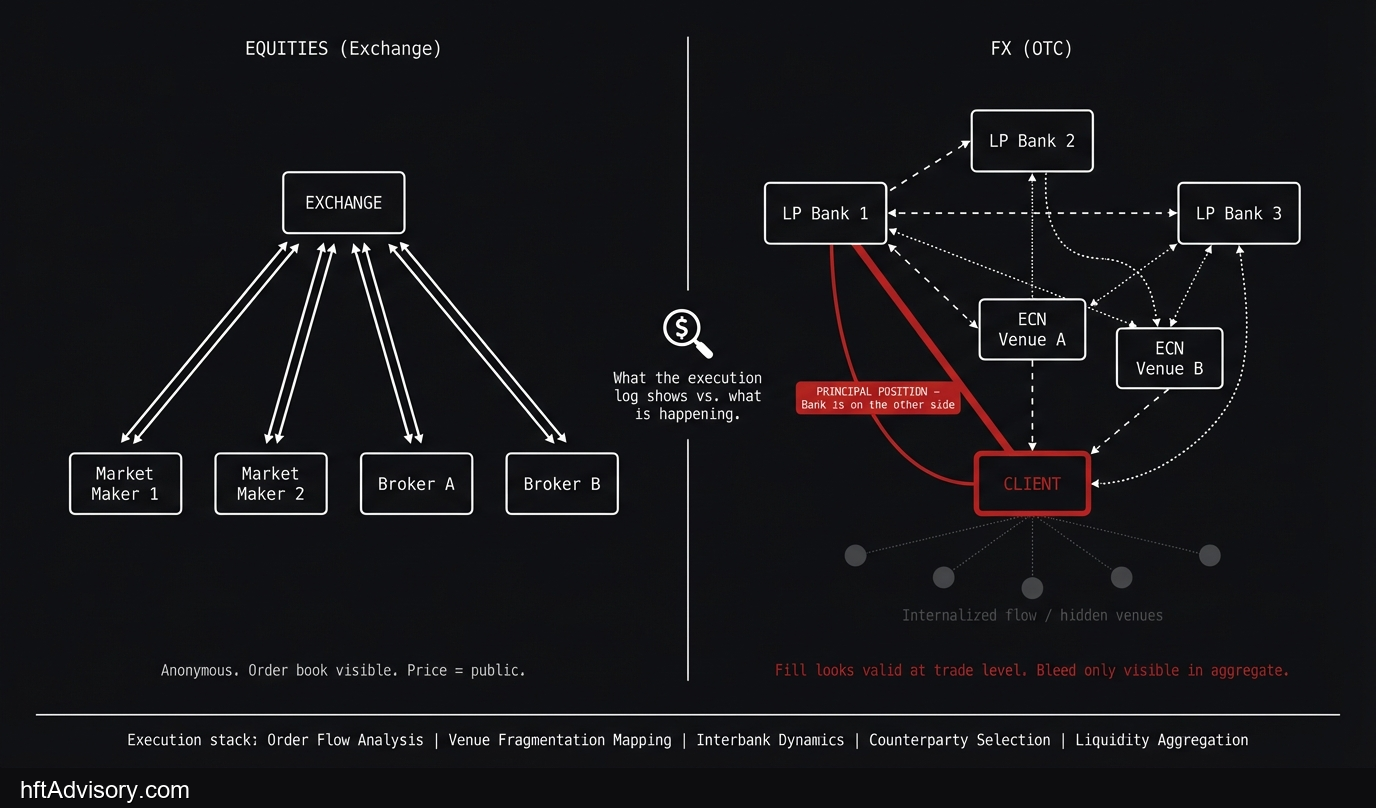
Every equities trader learns the same foundational market structure early on: there is a centralized exchange, a consolidated tape, a visible order book. Price discovery is public. When you submit an order, you are competing anonymously against other orders at a published price. The exchange is the counterparty of record. Your identity, your flow profile, your order frequency — none of that reaches the person on the other side in real time.
FX operates on none of those rules.
The market is entirely OTC. Liquidity is fragmented across more than 75 different FX venues — a figure the BIS documented in its December 2019 Quarterly Review. There is no consolidated tape. There is no central order book. What exists instead is a network of bilateral relationships: your firm streams requests to liquidity providers, and each LP prices you individually based on information that includes your historical flow behavior.
That last part is where equities intuitions break down.
In equities, exchange-based price discovery provides reference prices and anonymity that substantially reduce — though do not eliminate — the information asymmetry problem. In FX, there is no central reference price, no consolidated tape, and no anonymity mechanism built into the market structure. When you stream to a bank LP, they observe your order patterns in real time. They classify your flow — is it informed, directional, toxic to their inventory, or benign? They price you accordingly. This is standard LP risk management, disclosed in GFXC Principle 17, and it is perfectly legal. It is also the mechanism that turns a poorly configured execution stack into a slow, invisible capital drain.
The equities desk I worked with was routing to their LP panel as if the LPs were anonymous market makers on a centralized exchange. In equities, that routing logic works. In FX, it meant they were broadcasting their flow profile without any of the counterparty segmentation or venue fragmentation logic that would have protected them. The fill prices looked fine. The adverse selection costs were accumulating beneath the surface.
What “Last Look” Actually Means for Your Execution Stack
Last look is the mechanism that most clearly separates FX execution from equities execution. In equities, when your order matches a posted price on an exchange, the fill is binding. The counterparty cannot reject after seeing the match.
In FX, most liquidity providers retain the right to reject a fill during a brief hold period — typically 50 to 500 milliseconds — after the order is submitted. During that window, the LP can assess whether the fill would be profitable given the current market direction. If the price has moved against them, they can reject the order. From the trading desk’s side, this looks like a failed fill or a slight delay. What it actually represents is a structural option the LP holds over your order flow.
The LMAX TCA whitepaper studied 7.1 million orders and found that last-look liquidity costs between $2.25 and $48.86 more per million than firm liquidity. Some LPs maintain rejection rates of 80 to 90% while still showing top-of-book pricing — meaning the prices you see are real, but the fills are largely theoretical.
The Barclays NYDFS consent order from November 2015 gives the clearest public example of how last-look can be weaponized. NYDFS fined Barclays $150 million for operating its BARX last-look system in a way that auto-rejected orders when intra-hold-period price moves would have been unprofitable for the bank. Clients were told the rejections were “technical issues.” Flow classified internally as “toxic” was silently rejected. From the client’s perspective, the fills looked acceptable at the trade level. The bleed only showed up in aggregate — which is exactly the pattern I observed with the equities desk in this case study.
Barclays was fined because they obscured what they were doing. Most LPs are more transparent, and last-look itself is a disclosed feature of FX markets, addressed in the FX Global Code. The issue for equities desks expanding into FX is not that last-look is hidden — it is that their execution infrastructure was not instrumented to measure it. Fill rate by LP, intraday rejection patterns, slippage symmetry across hold periods: none of that was in their monitoring stack. A TCA tool calibrated for equities does not capture the FX-specific dimensions that reveal last-look exposure.
For reference: 86% of equity traders use TCA, according to industry surveys. Only 63% of FX traders do. The desks operating without FX-native TCA are making decisions about execution quality based on incomplete data.
The Principal-vs-Agency Dynamic That Is Pricing Your Flow Against You
In equities, principal trading exists. Market makers hold inventory. But the presence of exchange-based price discovery, a consolidated tape, and centralized clearing significantly limits the degree to which any single counterparty can build an information advantage over your flow and reprice you bilaterally without scrutiny.
FX is categorically different. The market operates bilaterally. Every quote you receive from a bank LP is a principal quote — the bank is on the other side of your trade, taking the risk onto their own balance sheet. They are not a neutral intermediary. They have a direct financial interest in the price at which your order fills, and they have real-time access to your flow behavior as a data input into their pricing engine.
The five largest banks dominate FX market-making. Internalization rates — the share of client orders matched internally against other client flow, never touching an external venue — are substantial. The BIS Quarterly Review (December 2016) estimated the aggregate internalization rate for FX spot at 63%. For major e-FX banks, the BIS noted rates “even above 90% in some major currency pairs.” In the 2025 BIS Triennial Survey cycle, intragroup spot trading grew 128% — a record pace that signals continued concentration of internalization capacity among the largest banks.
The practical consequence for a new entrant to FX: the LP you are treating as a neutral price provider is, in many cases, matching your order internally, observing your flow characteristics, and using that data to refine how they price you going forward. This is not manipulation. It is standard sell-side risk management, and the GFXC Principle 10 update in January 2025 strengthened transparency obligations on exactly this dynamic — requiring enhanced disclosure of principal execution practices and how client flow data is utilized.
The 2014–2015 global FX scandal — which resulted in $5.7 billion in penalties, FBI and DOJ guilty pleas, and FCA fines of £1.7 billion in November 2014 — involved five major banks (Citi, HSBC, JPMorgan, RBS, and UBS) using client order information to front-run benchmark fixings. That was manipulation at industrial scale. The routine flow profiling that happens within the current regulatory framework is legal and disclosed. But it operates on the same information asymmetry. Desks that do not understand principal dynamics are giving away flow intelligence without receiving any protection in return.
The equities desk I worked with had no model for any of this. Their counterparty selection logic treated every LP as interchangeable. In equities, that assumption is defensible because the exchange provides price neutrality. In FX, it meant their most directional orders were flowing to LPs who had the most to gain from observing and pricing against them.
The Five-Layer Diagnostic for FX Execution Stack Failures
After rebuilding the execution stack for the desk described above — working around an existing execution infrastructure, which kept the timeline to approximately six weeks — the execution cost reduction came in at 40% in this specific case. That outcome was case-specific: costs were elevated well above market benchmarks due to structural misalignment. Results vary by starting inefficiency level, currency pair mix, and trade size.
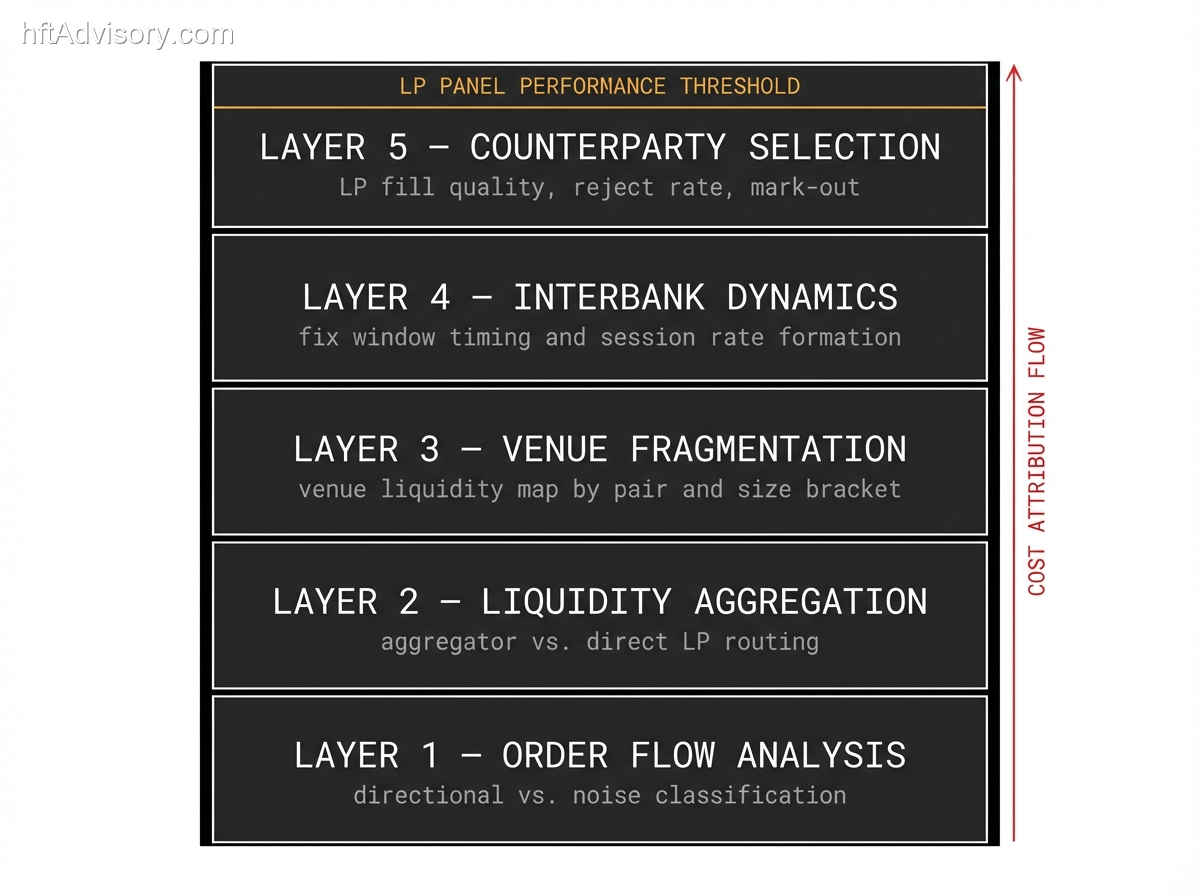
The rebuild was organized around five structural dimensions that institutional FX execution practitioners and the BIS identify as the core differentiators between a functional and a dysfunctional FX execution stack. These are not proprietary categories — they map directly to recognized industry frameworks. But for this desk, they had never been evaluated together as a coherent system.
Layer 1: Order Flow Analysis
What is the flow toxicity profile of the desk’s order flow, from the perspective of an LP? The LP is running mark-out analysis on every fill — comparing the price at fill to the price one minute, five minutes, and thirty minutes later. If the desk’s flow is directional and consistently moves against the LP post-fill, that flow will be classified as informed. The VPIN framework (Easley, Lopez de Prado, and O’Hara, 2012, “Flow Toxicity and Liquidity in a High-Frequency World”) provides the academic foundation for this measurement. The desk needs to run the same analysis on itself before the LP does.
Layer 2: Liquidity Aggregation Across Venues
With more than 75 FX venues globally (BIS Dec 2019), routing logic that treats all venues as equivalent is leaving execution quality on the table. Different venues carry different LP populations, different last-look terms, different price quality by currency pair. A functional aggregation layer optimizes routing based on real-time venue performance data — fill rate, price improvement frequency, and reject rate — not a static LP preference list.
Layer 3: Venue Fragmentation Mapping
The absence of a consolidated tape in FX means the desk must build its own real-time picture of where liquidity sits. Fragmentation mapping tracks which venues are showing actionable liquidity for a given currency pair and size bracket at any given time. Without it, the desk is routing based on yesterday’s liquidity picture.
Layer 4: Interbank Dynamics
The interbank market is where benchmark rates are set and where the largest flows price. Understanding the intraday timing of interbank rate formation — particularly around the WM/Reuters 4 PM London fix and regional session opens — shapes both when orders should be executed and when routing should avoid predictable pricing windows.
Layer 5: Principal-vs-Agency Structure and Counterparty Selection
This is the most underbuilt layer in most equities-to-FX migrations. Counterparty selection should be dynamic — rotating LP exposure based on measured fill quality, reject rate, and mark-out data. LPs who consistently reject during adverse price moves, or whose post-fill mark-out is consistently negative, should receive less order flow. The data to make those decisions is available. Most desks simply are not collecting it in a form that feeds back into routing logic.
How to Read Your LP Panel Before the Losses Accumulate
The most actionable thing a CTO can do before or immediately after entering FX is to instrument the execution stack for the right FX-specific signals. In equities, fill quality assessment is largely a price comparison exercise. In FX, fill quality assessment requires at minimum five data dimensions:
Fill ratio by LP and venue. Not overall fill rate — fill rate segmented by counterparty and venue, tracked over time. An LP showing a 30% fill rate while consistently posting top-of-book prices is a last-look intensive relationship that is costing you in ways that do not appear in price data alone.
Price variation and slippage symmetry. In a fair execution environment, slippage should be roughly symmetric — sometimes you get filled at a better price than quoted, sometimes worse. Consistently asymmetric slippage in one direction is an adverse selection signal. It means your flow is being priced against its direction before the fill executes.
Mark-out analysis. Compare your fill prices to mid-market prices at 30-second, 1-minute, and 5-minute intervals after the fill. Consistent negative mark-out means you are consistently buying at prices that fall after you buy and selling at prices that rise after you sell. That is the fingerprint of a flow profile that LPs have classified and are pricing accordingly.
Reject rate by intraday interval. If reject rates spike during periods of directional momentum, that is structural last-look exposure. The LP is filling you when the market is flat and rejecting you when your order would cost them money.
Counterparty-level cost attribution. TCA must be performed at the LP level, not just the aggregate level. Two LPs may show similar average fill prices but very different fill quality distributions. The one with higher variance and lower fill rate is extracting more from your flow.
Only 63% of FX market participants use TCA (industry surveys). The FX Global Code has 1,328 signatories as of the latest count, but buy-side adoption sits at only 51% versus 80% on the sell side. The buy-side information gap is systematic, not incidental.
Practical Diagnostic Checklist
A five-point diagnostic a CTO can apply immediately when evaluating FX execution quality or planning cross-asset expansion:
1. Flow toxicity self-assessment. Run mark-out analysis on your own order flow for the last 30 days. Calculate average price movement at 1-minute and 5-minute intervals post-fill, segmented by currency pair. Negative mark-out consistently above 0.5 bps signals that your flow profile is already classified by your LP panel.
2. LP fill-rate audit. Pull fill rates by LP, not in aggregate. Any LP showing a fill rate below 70% while consistently at top-of-book is a last-look intensive relationship. The LMAX TCA study quantified the cost range: $2.25 to $48.86 per million, depending on currency pair and order profile.
3. Slippage symmetry test. Compare your fill-vs-quoted-price distribution. If the distribution is skewed — more fills worse than quoted than better than quoted — you have adverse selection costs that are not visible at the individual trade level but accumulate significantly over a month of flow.
4. Counterparty segmentation review. Segment your LP panel into principal-dominant and agency-dominant relationships. Principal-dominant LPs require counterparty-specific TCA and dynamic routing logic. Routing all flow through the same static panel as you would on an exchange is the structural error most desks make.
5. Venue performance attribution. Run fill quality metrics — fill rate, price improvement rate, reject rate, intraday timing — by venue, not just by LP. With more than 75 venues globally, routing optimization at the venue level produces measurable cost improvements in execution quality that LP-level analysis alone will not surface.
Conclusion
The $800,000 was a market knowledge gap, not a technology failure. The algorithm executed exactly as designed. The execution stack was built for the market it was designed for — and FX was a different market entirely.
Most desks making this expansion underestimate how much edge lives in the plumbing: who is quoting you, why they are quoting you, and what they are doing with your flow after the fill. That intelligence gap closes when you treat FX execution quality as an instrumentation problem — not a technology procurement problem.
The question worth asking before expanding into FX: at the LP level, what is your fill rate on directional orders in the 30 seconds following a momentum signal? If that number is not in your monitoring stack, your current TCA is blind to the most expensive part of FX execution.
This article was originally shared as a LinkedIn post. View the original post
Never Miss an Update
Get notified when we publish new analysis on HFT, market microstructure, and electronic trading infrastructure. No spam.
Subscribe by EmailHFT Systems Architect & Consultant | 20+ years architecting high-frequency trading systems. Author of "Trading Systems Performance Unleashed" (Packt, 2024). Creator of VisualHFT.
I help financial institutions architect high-frequency trading systems that are fast, stable, and profitable.
I have operated on both the Buy Side and Sell Side, spanning traditional asset classes and the fragmented, 24/7 world of Digital Assets.
I lead technical teams to optimize low-latency infrastructure and execution quality. I understand the friction between quantitative research and software engineering, and I know how to resolve it.
Core Competencies:
▬ Strategic Architecture: Aligning trading platforms with P&L objectives.
▬ Microstructure Analytics: Founder of VisualHFT; expert in L1/L2/LOB data visualization.
▬ System Governance: Establishing "Zero-Failover" protocols and compliant frameworks for regulated environments.
I am the author of the industry reference "C++ High Performance for Financial Systems".
Today, I advise leadership teams on how to turn their trading technology into a competitive advantage.
Key Expertise:
▬ Electronic Trading Architecture (Equities, FX, Derivatives, Crypto)
▬ Low Latency Strategy & C++ Optimization | .NET & C# ultra low latency environments.
▬ Execution Quality & Microstructure Analytics
If my profile fits what your team is working on, you can connect through the proper channel.



Thanks this was a really great read. I am an equities guy so this post was very illuminating. I wanted to know why they couldn’t just submit passive limit orders to all LPs and cancel the non executed orders once they confirmed thier target fills. Presumably competition would push the best LP to win.
Great article on order toxicity and algo adjustment. The VPIN + TWAP pacing dynamic is exactly why a one-size-fits-all EA fails in live conditions. I’ve been testing Ratio X Toolbox for a few months – the bundle approach actually addresses this by rotating between different regimes (trend, range, breakout) so you’re not forcing the same execution logic when market microstructure shifts. Backtesting the Sharpe ratio across regime switches showed real edge vs. static parameters. Have you stress-tested your execution algos across sustained VPIN elevation scenarios, or just optimize on clean data?